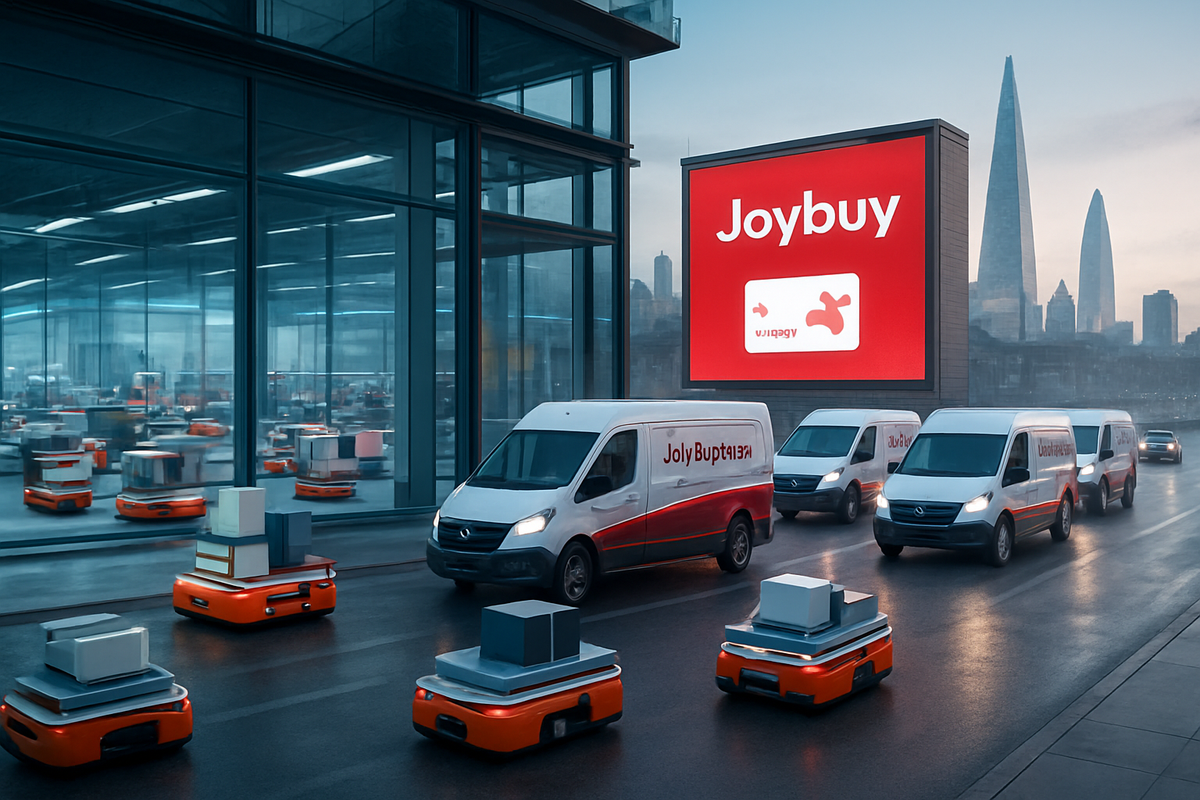
In a move that signals a seismic shift in the global e-commerce landscape, JD.com (Nasdaq: JD) has officially launched its Joybuy marketplace across the United Kingdom and Northern Europe. This aggressive expansion, centered on a massive $2.5 billion acquisition of the European electronics giant Ceconomy AG (ETR: CEC), represents the most significant challenge to Amazon’s dominance in the region to date. By integrating thousands of physical storefronts with a cutting-edge, automated logistics network, JD.com is attempting to replicate its Chinese success story on European soil, promising delivery speeds and service levels that local consumers have rarely seen.
The launch, which went live today, March 16, 2026, marks the culmination of a multi-year "bricks-and-clicks" strategy. With the rollout of its "JoyPlus" subscription service—priced aggressively to undercut established rivals—JD.com is not merely entering the market as a cross-border discounter. Instead, it is positioning itself as a premium, infrastructure-heavy alternative to the status quo. The immediate implications are clear: a price war is brewing in the subscription space, and the logistical bar for "last-mile" delivery has just been raised significantly across the continent.
The cornerstone of JD.com’s European entry is its mid-2025 acquisition of Ceconomy AG, the parent company of household names MediaMarkt and Saturn. This €2.2 billion ($2.52 billion) deal provided JD.com with an instantaneous footprint of over 1,000 brick-and-mortar locations and an established workforce of 50,000. Rather than treating these stores as traditional retail outlets, JD.com has spent the last nine months converting a significant portion of the Ceconomy estate into "dark stores" and high-tech showrooms. These locations now function as hyper-local fulfillment centers, allowing the company to bypass the traditional lag times associated with regional distribution hubs.
The timeline leading to today’s launch was meticulously managed. Following the Ceconomy takeover, JD.com deployed its proprietary "JoyExpress" logistics technology across 60 automated warehouses in Europe, including massive new hubs in Milton Keynes and Luton. These facilities utilize advanced Automated Ground Vehicles (AGVs) that JD.com claims can increase picking efficiency by up to 400% compared to manual operations. This logistical backbone supports the company’s "Double 11" delivery standard: a promise that orders placed by 11:00 AM will be delivered by 11:00 PM the same day. Initial market reactions from the beta phase in late 2025 were overwhelmingly positive, with the Joybuy platform earning high marks for its human-led customer service—a deliberate contrast to the increasingly automated support systems of its competitors.
As JD.com scales its operations, the competitive landscape is being forcefully redrawn. The most immediate "winner" in this scenario appears to be the consumer, who now benefits from a high-stakes competition between JD.com and Amazon (Nasdaq: AMZN). Amazon, which has long enjoyed a comfortable lead in the UK and Germany, now faces a rival with a similar "asset-heavy" philosophy but with the added advantage of a massive physical store network for returns, repairs, and instant pickups. For Ceconomy’s former shareholders and employees, the acquisition has breathed new life into a retail group that had previously struggled with the rapid shift to digital-first shopping.
Conversely, traditional European electronics retailers that lack JD.com’s technological scale may find themselves in a precarious position. Companies like Currys PLC (LSE: CURY) or local independent retailers are now squeezed between Amazon’s vast ecosystem and JD.com’s hyper-efficient logistics. Furthermore, other Chinese "value" players like Temu, owned by PDD Holdings (Nasdaq: PDD), or Alibaba’s (NYSE: BABA) AliExpress may lose ground among premium shoppers. While Temu dominates the low-cost, slow-shipping niche, JD.com’s focus on high-end brands like Apple, Samsung, and Dyson—coupled with same-day delivery—targets the more lucrative "price-sensitive but time-poor" demographic that has historically been Amazon Prime's core audience.
The launch of "JoyPlus" at a disruptive price point of £3.99 per month is perhaps the most aggressive component of JD.com’s strategy. By pricing its membership at less than half the cost of Amazon Prime, JD.com is making a direct play for subscription loyalty. This fits into a broader industry trend where "ecosystem lock-in" is the ultimate goal. However, unlike Amazon, which bundles video and music streaming into its fee, JoyPlus focuses strictly on retail utility: unlimited free delivery with no minimum spend, free professional installation for large appliances, and a robust rewards points system.
This move also carries significant regulatory and geopolitical weight. As a major Chinese firm deeply embedding itself into European physical infrastructure, JD.com will likely face intense scrutiny regarding data privacy and competition laws. However, by acquiring a storied European firm like Ceconomy rather than building from scratch, JD.com has effectively "Europeanized" its operations, utilizing local management and existing labor unions to mitigate potential backlash. This "localized expansion" model could serve as a blueprint for other global tech giants looking to navigate the increasingly complex trade relations between the East and the West.
In the short term, JD.com’s primary challenge will be maintaining its ambitious "Double 11" delivery speeds as order volumes scale beyond the initial launch surge. The company has already hinted at expanding its JoyExpress fleet with electric delivery vans and even drone delivery trials in less congested Northern European corridors. Strategically, the next logical step would be an expansion into the grocery sector, leveraging the refrigerated logistics capabilities it has perfected in the Chinese market. Should Joybuy successfully integrate fresh produce into its same-day delivery model, it could pose a systemic threat to traditional supermarket chains.
Long-term, the market will be watching to see if JD.com can sustain its low subscription pricing or if JoyPlus is merely a "loss-leader" designed to capture market share. The company’s ability to successfully integrate the physical MediaMarkt stores into a seamless digital experience will be the ultimate litmus test for its "O2O" (Online-to-Offline) strategy. If successful, we may see a wave of further consolidation in the European retail sector, as competitors scramble to acquire their own physical logistics assets to keep pace with the Joybuy machine.
The launch of Joybuy in the UK and Northern Europe represents more than just a new place to shop; it is a fundamental test of whether a logistics-first, asset-heavy e-commerce model can be successfully exported from China to the West. JD.com’s decision to commit $2.5 billion to the Ceconomy acquisition shows a level of "all-in" conviction that distinguishes it from the tentative entries of other international retailers. For the market, this marks the beginning of a high-intensity era of "last-mile" competition where speed and service reliability are the primary currencies.
Investors should closely monitor JD.com’s quarterly active user growth in Europe and, perhaps more importantly, Amazon’s response in terms of Prime pricing or delivery guarantees. The success of the JoyPlus subscription model will be a key indicator of JD.com’s long-term viability in the region. As we move through 2026, the "battle for the European doorstep" is no longer a lopsided affair, and the resulting innovation in logistics and pricing is likely to redefine the retail experience for years to come.
This content is intended for informational purposes only and is not financial advice