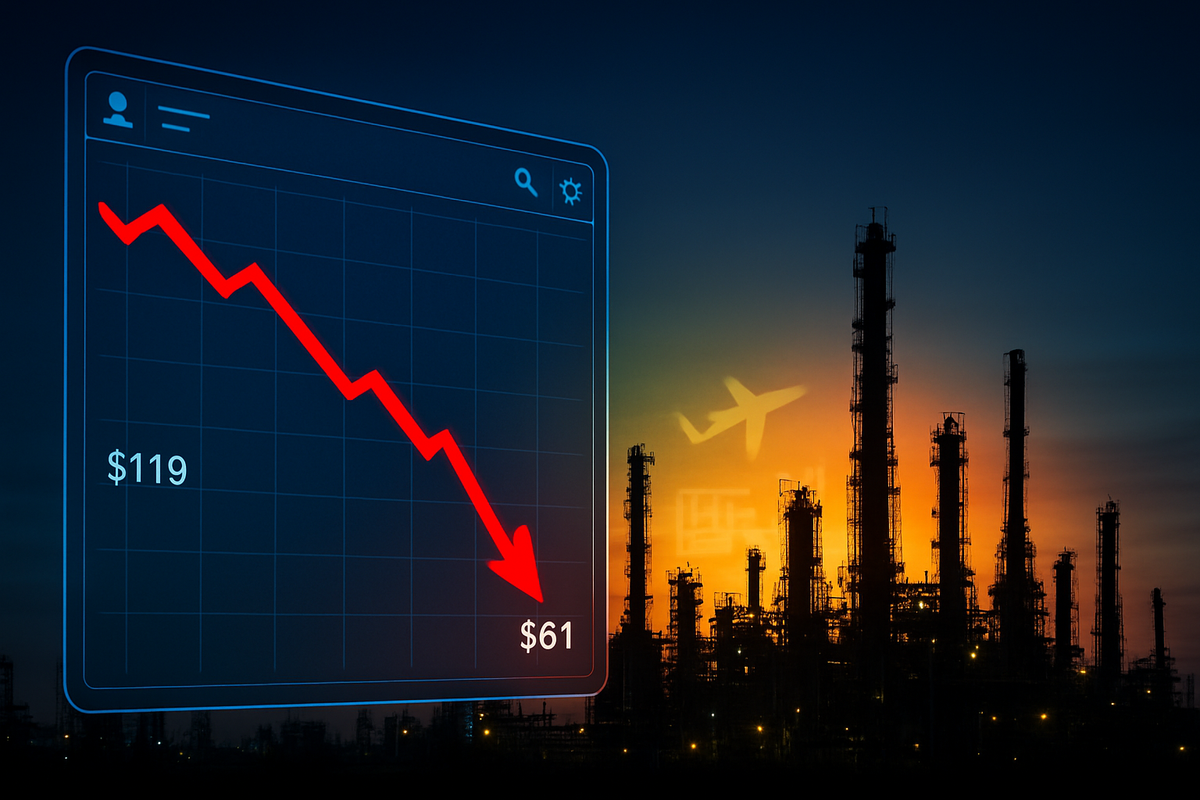
NEW YORK — In a dramatic reversal that has caught energy traders off guard, West Texas Intermediate (WTI) crude oil prices plummeted on Tuesday, March 10, 2026, falling into the $81 to $90 range after hitting a terrifying weekend high of nearly $119 per barrel. This sharp 25% retreat from the brink of a global energy crisis has sent a wave of relief through equity markets, effectively acting as a "safety net" for the S&P 500 and Dow Jones Industrial Average, which had been reeling from the prospect of triple-digit oil prices fueling a new wave of hyper-inflation.
The sudden cooling of the energy market on this Tuesday morning has significantly mitigated immediate fears of "stagflation"—a stagnant economy paired with high inflation—which many analysts feared would force the Federal Reserve into aggressive interest rate hikes later this spring. As gasoline and shipping costs projected for the second quarter began to adjust downward in real-time, the broader market responded with a vigorous rally, led by transport, retail, and manufacturing sectors that are most sensitive to fuel prices.
A Weekend of Peril: The Timeline of the $119 Spike
The volatility began in late February 2026, following a sharp escalation in the US-Israel-Iran conflict, which threatened to permanently shutter the Strait of Hormuz— a transit point for roughly 20% of the world’s daily oil supply. By Sunday evening, March 8, panic buying in the futures markets pushed WTI crude to a peak of $118.75, a level not seen in years. The "war premium" was fueled by rumors of a total blockade and reports of limited strategic reserves among European allies, leading to a frantic Monday session where energy stocks were the only green spot on a sea of red indices.
However, the tide turned late Monday night and into the morning of March 10. The catalyst for the crash was twofold: a series of diplomatic signals from the White House suggesting that the military phase of the regional conflict was "near completion," and a coordinated announcement from G7 nations regarding a massive, multi-national release of emergency petroleum reserves. By the time the New York floor opened today, the panic had evaporated, replaced by a selling frenzy that saw WTI break through support levels at $100, $95, and finally $90 in rapid succession.
The intraday low of $81.40 represented a staggering correction that erased nearly two weeks of geopolitical gains in a matter of hours. Market participants noted that a technical "fat finger" sell-off occurred briefly when a social media post from a high-ranking energy official was misinterpreted as a sign that the U.S. Navy had already secured all major shipping lanes. Although the post was corrected, the momentum of the sell-off stayed in place, fundamentally resetting the baseline for energy costs for the remainder of the month.
Market Winners and Losers: From Airlines to Big Oil
The primary beneficiaries of the March 10 price collapse were the "fuel-sensitive" giants. Delta Air Lines (NYSE: DAL), United Airlines Holdings (NASDAQ: UAL), and American Airlines Group (NASDAQ: AAL) all saw their stock prices surge by more than 7% in midday trading. For the airline industry, which had been bracing for a disastrous summer travel season under the weight of $120 oil, the retreat to the $80s represents a multibillion-dollar swing in projected operating costs. Similarly, logistics heavyweights like FedEx (NYSE: FDX) and United Parcel Service (NYSE: UPS) rallied as the specter of fuel surcharges began to fade.
In the retail sector, giants such as Walmart (NYSE: WMT) and Amazon.com (NASDAQ: AMZN) saw significant gains. These companies are not only impacted by the cost of shipping goods but also by the "disposable income effect." When gasoline prices at the pump drop, consumer spending on non-essential goods typically rises. Analysts at major brokerages immediately upgraded their Q2 consumer spending forecasts, citing the "energy dividend" now flowing back into the pockets of the American public.
On the flip side, the "Big Oil" momentum of the previous week came to a grinding halt. ExxonMobil (NYSE: XOM) and Chevron (NYSE: CVX) both traded lower, down 3.2% and 2.8% respectively, as investors rotated out of energy hedges and back into growth stocks. The oilfield services sector also took a hit, with SLB (NYSE: SLB) and Halliburton (NYSE: HAL) seeing declines as the incentive for rapid, high-cost emergency drilling programs slightly diminished with the lower price floor.
The Broader Significance: Inflation’s New 'Safety Net'
This event is more than just a fluctuation in a commodity price; it represents a critical pivot point for the 2026 global economy. Throughout 2025, oil had been in a structural bear market, averaging around $68 per barrel due to the rapid adoption of electric vehicles and a slowing industrial sector in China. The "War Spike" to $119 threatened to undo years of cooling inflation. By falling back to the $80-$90 range, oil has effectively provided a "safety net" that prevents the Consumer Price Index (CPI) from spiraling out of control.
Historically, this volatility mirrors the energy shocks of the early 1970s and 2022, but with a modern twist. The speed of the March 10 decline highlights how quickly algorithmic trading and 24-hour news cycles can deflate a bubble. Furthermore, the G7’s readiness to deploy reserves suggests a new era of proactive energy diplomacy, where "black gold" is no longer allowed to hold the global economy hostage for extended periods. This move signals to OPEC+ that the West is willing to use its strategic stockpiles aggressively to maintain market stability.
From a policy perspective, the drop gives the Federal Reserve much-needed "breathing room." With PCE inflation projected to hover around 2.7% for 2026, a sustained oil price above $110 would have made interest rate cuts an impossibility. Today's retreat keeps the "soft landing" narrative alive, allowing policymakers to focus on labor market stability rather than just firefighting energy-driven price hikes.
The Road Ahead: Volatility as the New Normal
In the short term, market participants should expect WTI to consolidate between $75 and $85 as the initial shock of the diplomatic resolution wears off. However, the long-term outlook remains clouded by the fragile state of the Middle East. Strategic pivots are already underway; many industrial firms that were caught off guard by the $119 spike are expected to increase their hedging activities, locking in fuel prices at these newly lowered levels to protect against future "black swan" events.
The coming months will likely see a push-pull dynamic between OPEC+ production cuts and the continued release of G7 reserves. If the conflict truly moves into a "peace-time" monitoring phase, the global "oil glut" of 2025 could return, potentially pushing prices back toward the $70 mark. Conversely, any breakdown in the current diplomatic framework could see a re-test of the $100 resistance level. Investors should watch for the next meeting of the International Energy Agency (IEA), which will likely set the tone for global inventory management through the end of the year.
Summary and Investor Takeaways
The events of March 10, 2026, serve as a potent reminder of the energy market's role as the heartbeat of the global economy. The retreat of WTI from $119 to the low $80s has effectively neutralized a major threat to the post-pandemic recovery and provided a "safety net" for a stock market that was on the verge of a correction. Key takeaways include the resilience of the transport and retail sectors when energy costs normalize and the waning influence of geopolitical "fear premiums" in an era of coordinated reserve releases.
Moving forward, the market appears more stable, but the "War Spike" has left deep scars on the psyche of institutional investors. For the next several months, the "energy-inflation-interest rate" triangle will remain the primary focus of Wall Street. Investors should keep a close eye on weekly inventory reports and any further diplomatic communiqués, as the transition from a war-time energy footing back to a supply-demand fundamental basis will likely be fraught with further, albeit smaller, bouts of volatility.
This content is intended for informational purposes only and is not financial advice.