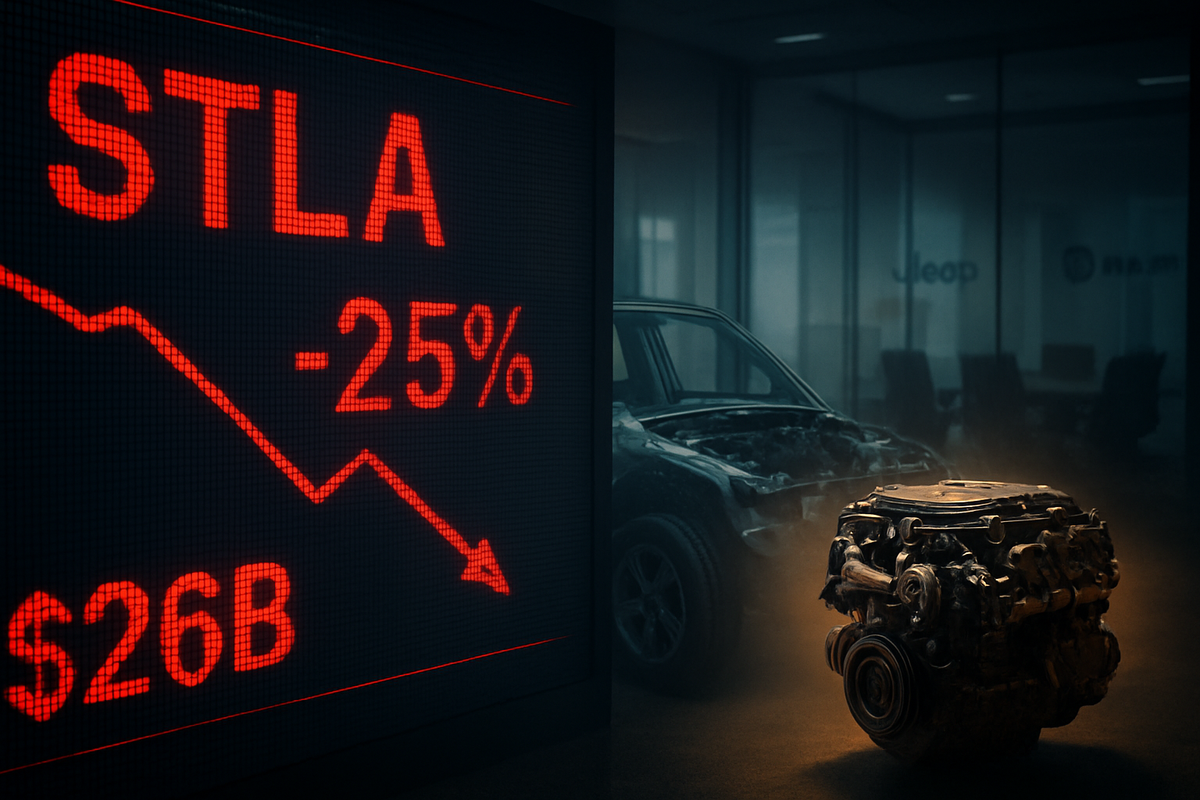
The global automotive landscape was jolted on February 6, 2026, as Stellantis N.V. (NYSE: STLA) saw its shares plummet by 25% following the announcement of a massive €22.2 billion ($26 billion) one-time charge. The staggering write-down is the cornerstone of a radical "business reset" orchestrated by new leadership to move the company away from its aggressive all-electric goals and toward a more flexible, hybrid-heavy manufacturing strategy.
For investors, the most immediate blow came with the board's decision to suspend the 2026 dividend payout. This move, intended to preserve a remaining liquidity cushion of €46 billion, marks a painful turning point for a company that just two years ago was a favorite among income-seeking value investors. The market’s reaction reflects a deep skepticism toward the cost of undoing years of "EV-or-bust" planning that analysts say left the company vulnerable to shifting consumer tastes and a glut of unsold inventory.
The Reckoning of the 'Great Reset'
The February 6 announcement is the culmination of a tumultuous eighteen-month period that saw the departure of former CEO Carlos Tavares in December 2024 and the subsequent rise of Antonio Filosa. Under Tavares, Stellantis had committed to the "Dare Forward 2030" plan, which aimed for 100% electric vehicle (EV) sales in Europe and 50% in the United States by the end of the decade. However, that plan collided with a harsh reality: cooling consumer demand for premium EVs and a massive inventory crisis in North America that saw Chrysler and Jeep lots overflowing with vehicles dealers could not sell.
The $26 billion charge disclosed today primarily covers the cancellation of several high-profile battery-electric programs, including the once-vaunted Ram 1500 REV BEV, and the costs associated with breaking long-term contracts with battery cell suppliers. The company’s preliminary full-year 2025 results now point to a net loss of roughly €21 billion, a historic low for the conglomerate formed by the merger of PSA Group and Fiat Chrysler Automobiles.
Key stakeholders, including the Stellantis National Dealer Council, had been sounding the alarm for over a year. In late 2024, dealers issued a public letter accusing the company of "pricing overreach" and "reckless short-termism." While Filosa spent much of 2025 aggressively cutting prices and clearing nearly 100,000 units of bloated inventory to stabilize the dealer network, the financial cost of those incentives—combined with the massive write-downs on EV R&D—has finally hit the balance sheet with full force.
Initial industry reaction has been one of shock at the scale of the charge, though many analysts had long warned that the "Tavares era" strategy was unsustainable. The decision to suspend the dividend is being viewed as a "scorched earth" tactic to ensure the company has the capital necessary to retool factories back for internal combustion engine (ICE) and hybrid production.
Winners and Losers in the Post-EV Pivot
The immediate losers are undoubtedly the shareholders of Stellantis (NYSE: STLA), who have seen billions in market capitalization evaporate in a single session. Suppliers deeply embedded in the Stellantis EV supply chain are also facing an existential crisis as the "Freedom of Choice" strategy significantly scales back battery orders. European battery manufacturers, who had banked on Stellantis's previous commitment to massive localized cell production, may now face a "lost decade" of demand.
Conversely, legacy competitors that pivoted earlier appear to be the primary beneficiaries. General Motors (NYSE: GM) has emerged as a sector leader, having taken a much smaller $7.6 billion charge in 2025 and successfully maintaining strong profits from its ICE truck and SUV lines. While Stellantis was crashing, GM shares remained stable, bolstered by a 20% dividend increase and a massive $6 billion share buyback program.
Toyota Motor Corporation (NYSE: TM) also stands as a significant winner. The Japanese automaker’s long-standing skepticism toward full-scale electrification in favor of hybrids has been vindicated by the market's shift. As Stellantis scrambles to return the HEMI V-8 to its Jeep and Ram lineups, Toyota’s established hybrid dominance gives it a multi-year lead in the very segment Stellantis is now trying to reclaim. Ford Motor Company (NYSE: F), while also undergoing its own $19.5 billion "re-jiggering" of EV plans, is viewed as being further along in its restructuring than Stellantis, though it too has had to scrap its special dividend to protect capital.
A Broader Shift in Global Automotive Policy
The Stellantis "reset" is more than just a corporate failure; it is a signal of a broader retreat across the global automotive industry. The "EV-or-bust" era, characterized by aggressive government mandates and massive R&D spending, is giving way to a more pragmatic "multi-energy" approach. This shift reflects a growing realization that charging infrastructure and consumer affordability have not kept pace with regulatory ambitions.
This event is likely to have significant ripple effects on policy. With one of the world's largest automakers admitting a $26 billion failure in its EV transition, European and American regulators are facing increased pressure to relax 2030 and 2035 emissions targets. The "Stellantis Crash" may serve as a historical precedent similar to the 2008 auto bailouts, demonstrating that forced technological transitions can threaten the very stability of the industrial giants they aim to modernize.
Furthermore, the pivot toward "Freedom of Choice" by Stellantis mirrors moves by other global players like Volkswagen and Mercedes-Benz, who have also signaled a slowdown in their EV timelines. The competitive threat from Chinese EV manufacturers remains a constant pressure, but the Stellantis reset suggests that Western automakers are prioritizing balance sheet health and existing customer loyalty over the race to beat China to full electrification.
The Road Ahead: A Multi-Year Recovery
In the short term, Stellantis must navigate a period of intense volatility. The company is expected to issue €5 billion in hybrid bonds to stabilize its balance sheet and reassure creditors. Strategically, the "Freedom of Choice" platform will require Antonio Filosa to oversee a massive re-engineering of the company's modular platforms to ensure they can cost-effectively produce ICE, hybrid, and electric versions of the same models on the same lines.
Long-term success will depend on whether Stellantis can win back the North American consumer. The return of high-margin internal combustion engines, such as the HEMI V-8, is a clear play for the brand's traditional base, but it remains to be seen if the company can regain the market share lost during the 2024-2025 inventory crisis. Potential divestitures are also on the table; rumors persist that niche brands like Maserati or DS could be sold or shuttered as the company focuses on its core profit centers: Jeep, Ram, and its European bread-and-butter brands like Peugeot and Fiat.
The market will be watching for the first signs of margin recovery in the second half of 2026. If the "Freedom of Choice" strategy can deliver the promised flexibility without the massive overhead of the previous era, Stellantis may eventually return to its status as a cash-flow powerhouse. However, that journey is likely to be measured in years, not quarters.
Summary and Final Outlook
The collapse of Stellantis stock on February 6, 2026, marks the end of an era for the automotive industry. The $26 billion "reset" is a stark admission that the path to electrification is far more treacherous and costly than many executives and regulators initially predicted. By suspending its dividend and taking a massive financial hit today, Stellantis is attempting to clear the deck for a more realistic, hybrid-focused future.
Moving forward, the market will transition from valuing automakers on their EV "promises" to valuing them on their ability to generate cash in a fragmented, multi-energy world. Investors should watch for the company's ability to stabilize its North American operations and the successful rollout of its new hybrid platforms. The "Great Reset" of 2026 will be remembered as the moment the auto industry finally chose pragmatism over dogma—though the cost of that choice has proved to be historic.
This content is intended for informational purposes only and is not financial advice.