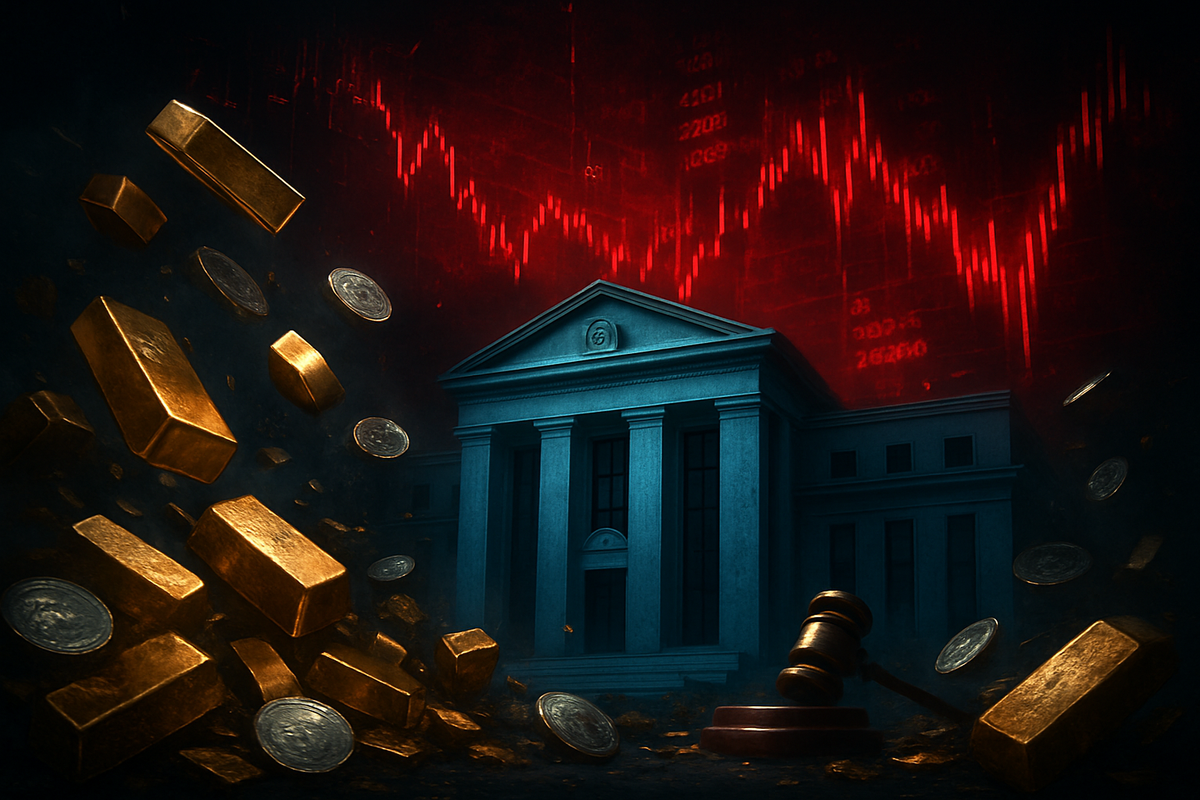
In a day that will be etched into the annals of financial history, January 30, 2026, witnessed a breathtaking collapse in the precious metals markets that has left investors reeling and analysts scrambling for historical comparisons. Gold prices, which had been buoyed by years of inflationary fears and geopolitical tension, plummeted an astonishing 9% in a single session, falling from $5,390 to $4,895 per ounce. Silver fared even worse, suffering a catastrophic 26% crash—dropping from $115 to $85—marking the largest one-day percentage decline on record for the "devil's metal."
The immediate implications of this "flash crash" were felt far beyond the trading floors of Chicago and London. In a frantic 48-hour window, an estimated $7 trillion in combined global market value was erased as the downturn triggered a systemic liquidity shock. This massive destruction of wealth has forced a rapid repricing of inflation-hedging assets and raised urgent questions about the stability of the global financial architecture in an era of high-leverage trading.
The "Warsh Shock" and the Nomination That Shook the World
The catalyst for this unprecedented volatility was not a geopolitical conflict or a sudden economic data release, but a single personnel announcement from the White House. On the morning of January 30, President Trump officially nominated Kevin Warsh as the next Chair of the Federal Reserve. Warsh, a former Fed Governor known for his hawkish stance on monetary policy and his vocal skepticism of the central bank’s bloated balance sheet, was immediately perceived by the markets as a "regime change" agent. His nomination signaled a definitive end to the dovish era of cheap money that had propelled gold and silver to their record highs throughout 2025.
The timeline of the crash was a textbook example of a "margin call death spiral." Following the 9:00 AM announcement, initial selling began as institutional funds moved to de-risk their portfolios in anticipation of a "Warsh Doctrine" characterized by aggressive interest rate hikes and rapid quantitative tightening. By midday, as prices broke through key technical support levels, the selling became reflexive. The CME Group’s automated systems began issuing massive margin calls to leveraged traders. Because many participants were unable to meet these collateral demands in such a rapidly falling market, exchanges were forced to liquidate positions at any price, creating a self-reinforcing vacuum of buyers.
Key stakeholders, from hedge fund titans to retail "silver squeeze" enthusiasts, found themselves caught in a liquidity trap. By the time the closing bell rang, the precious metals sector had undergone a decade’s worth of volatility in less than eight hours. While the move was violent, institutional giants like UBS and Deutsche Bank (NYSE: DB) were quick to weigh in, characterizing the carnage not as a structural collapse, but as a "healthy positioning reset." They argued that the market had become dangerously "over-extended" and that the Warsh nomination merely provided the necessary pin to pop a speculative bubble.
Mining Giants and the Architecture of the Crash
The equity markets felt the tremors of the commodity crash with equal intensity, particularly among the major mining firms that have enjoyed record profits over the last two years. Newmont Corporation (NYSE: NEM), the world's largest gold producer, saw its shares dive as the underlying value of its reserves was recalibrated in real-time. Similarly, Barrick Gold (NYSE: GOLD) experienced a double-digit percentage drop, as investors feared that the sudden price correction would eat into the massive operational leverage the company had used to fund recent expansions.
In the silver space, the impact was even more pronounced. Pan American Silver (NASDAQ: PAAS) faced a wave of selling that mirrored the 26% drop in the metal itself, highlighting the extreme sensitivity of silver miners to spot price fluctuations. Even companies with more conservative business models, such as the streaming and royalty giant Wheaton Precious Metals (NYSE: WPM), were not spared. WPM, which had hit an all-time high of $156 just days prior to the crash, saw its valuation contract sharply as the market reassessed the future cash flows of its diverse portfolio of mining streams.
However, the "losers" list extended beyond the miners. Financial institutions heavily involved in precious metals custody and the issuance of ETFs found themselves managing a logistical nightmare as investors rushed to the exits. Conversely, the "winners" of the day were the short-sellers and those positioned in the U.S. Dollar. The "Warsh Shock" caused the Greenback to surge, as the prospect of higher U.S. yields made the currency more attractive, further exacerbating the downward pressure on dollar-denominated assets like gold and silver.
A Systemic Shift in the Inflation Narrative
The significance of the January 30 crash goes far beyond the charts of gold and silver. It represents a fundamental shift in the broader industry trend regarding inflation and central bank independence. For years, the market had operated under the assumption that the Federal Reserve would always step in to support asset prices—the so-called "Fed Put." The nomination of Kevin Warsh, a man who has frequently criticized the Fed for blurring the lines between monetary policy and fiscal support, suggests that the "Fed Put" may be dead.
This event mirrors historical precedents such as the 1980 crash, when Fed Chair Paul Volcker broke the back of inflation through aggressive rate hikes, or the 2011 silver peak when margin requirement hikes by the CME ended a speculative frenzy. However, the $7 trillion in lost value makes this event far larger in scale. The ripple effects are already being seen in other "hard assets," including real estate and certain cryptocurrencies, as the market begins to factor in a world where the cost of capital is significantly higher and liquidity is no longer guaranteed.
From a regulatory standpoint, the crash is likely to spark a fresh round of inquiries into the role of high-frequency trading and automated margin liquidation. Critics argue that the "death spiral" seen on January 30 was exacerbated by algorithms that lack human judgment, turning a sharp correction into a systemic rout. Policy implications will likely include a push for higher capital requirements for commodity-linked derivatives, as regulators seek to prevent a repeat of a $7 trillion wealth evaporation.
The Road Ahead: Pivot or Perish?
In the short term, the precious metals market is entering a period of painful consolidation. The massive "positioning reset" mentioned by UBS and Deutsche Bank means that much of the speculative "hot money" has been flushed out of the system. This could lead to a period of lower volatility, but also lower prices, as the market waits to see if Kevin Warsh’s actual policies as Fed Chair match his hawkish rhetoric. Strategic pivots will be required for mining companies, who must now focus on cost-cutting and capital discipline rather than expansion at any price.
Long-term possibilities remain divided. Some analysts suggest that if Warsh successfully tames inflation and stabilizes the dollar, gold may return to its historical role as a slow-moving store of value rather than a high-octane speculative vehicle. Others believe the crash has created a generational buying opportunity. If the "Warsh Shock" leads to an over-tightening that triggers a global recession, the demand for gold as a safe haven could return with a vengeance, potentially leading to a recovery that is just as violent as the crash itself.
Investors should watch for the upcoming Senate confirmation hearings for Kevin Warsh, as any softening of his stance could provide the catalyst for a relief rally. Conversely, if he doubles down on his "hard money" views, the floor for gold and silver may still be several hundred dollars lower.
Final Assessment: The End of an Era
The January 30, 2026, gold and silver crash serves as a stark reminder that no asset class is immune to the gravity of central bank policy. The erasure of $7 trillion in market value is a sobering statistic that highlights the sheer scale of the leveraged bets that had been placed on the continuation of the "inflation trade." While the "Warsh Shock" was the immediate trigger, the underlying fragility of the market was the true culprit, as years of high prices had bred complacency and excessive risk-taking.
Moving forward, the market is likely to be characterized by a "wait and see" approach. The "positioning reset" has cleared the decks, but the scars of the 26% silver drop will take years to heal. For the public companies involved, the focus shifts from growth to survival and efficiency. For the public, the lesson is clear: in a market governed by the whims of central bankers, even the "safest" havens can turn into traps in the blink of an eye.
Investors should keep a close eye on U.S. Treasury yields and the Dollar Index (DXY) in the coming months. These will be the primary barometers for the "Warsh Doctrine" and will likely dictate whether gold and silver can find a bottom or if the $7 trillion meltdown was just the beginning of a larger structural shift in the global economy.
This content is intended for informational purposes only and is not financial advice.