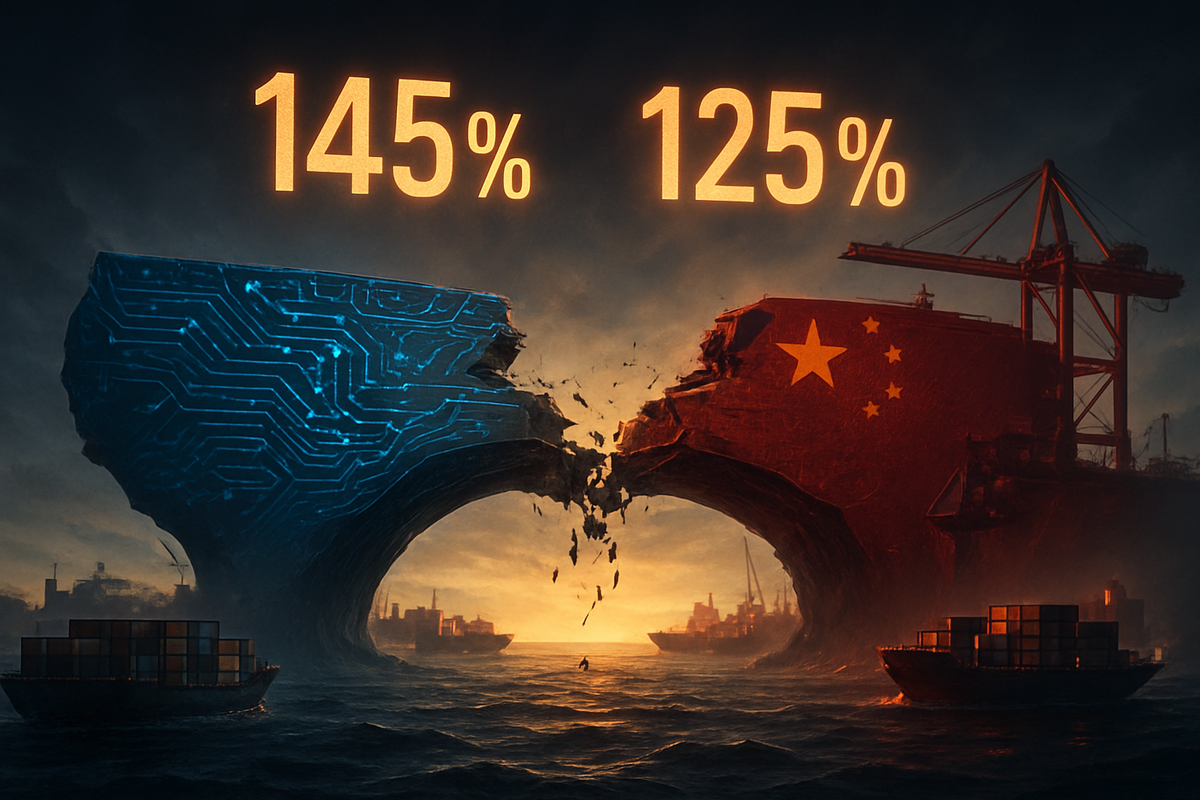
The global economic landscape stands at a precipice following a year of unprecedented trade hostilities between the world’s two largest economies. As of late February 2026, the era of "super-tariffs"—which saw reciprocal duties between the United States and China soar to 145% and 125% respectively—has reached a chaotic conclusion, leaving global supply chains in tatters and forcing a massive realignment of industrial strategy. While a recent landmark Supreme Court ruling has technically invalidated these specific extreme measures, the immediate pivot by the U.S. administration to a new 15% global tariff under the Trade Act of 1974 signals that the era of free trade has been replaced by a permanent state of economic warfare.
The immediate implications are stark: inflation in tech hardware has surged, manufacturing costs for heavy industry have hit decade-highs, and the "just-in-time" delivery model has been effectively abandoned by major multinationals. Investors are currently grappling with a market that remains hyper-sensitive to every policy shift, as the $770 billion "tech wipeout" seen late last year serves as a grim reminder of the volatility inherent in this new geopolitical reality. For the public, these trade barriers have translated into higher costs for everything from smartphones to electric vehicles, fundamentally altering consumer behavior and corporate investment patterns globally.
The Rise and Fall of the "Reciprocal Era"
The escalation toward the 145% tariff threshold began in earnest in April 2025, when the U.S. administration invoked the International Emergency Economic Powers Act (IEEPA) to implement what it termed "reciprocal tariffs." This move was designed to match and then exceed Chinese trade barriers, effectively attempting to decouple the two economies overnight. By April 9, 2025, combined duties on Chinese goods reached a staggering 145%, a figure that included specialized "fentanyl" tariffs and broad reciprocal rates. China’s response was swift and surgical; by April 12, it had raised duties on American imports to 125%, specifically targeting high-value manufacturing and the remaining bastions of U.S. agricultural exports.
This "Cold War" of commerce led to a period of extreme market fragility. A temporary truce was attempted in late 2025 via the Kuala Lumpur Joint Arrangement, which briefly saw U.S. reciprocal tariffs drop to 10% in exchange for Chinese concessions. However, the legal foundations of these moves were shaky. The tension culminated on February 20, 2026, when the U.S. Supreme Court ruled 6-3 in Learning Resources Inc. v. Trump that the executive branch had overstepped its authority under the IEEPA to unilaterally impose such tariffs. While the ruling initially sparked a massive relief rally, pushing the S&P 500 briefly over the 7,000 mark, the optimism was short-lived.
Within days of the court's decision, the U.S. administration pivoted to Section 122 of the Trade Act of 1974, announcing a 15% global tariff to address balance-of-payments concerns. This move, intended to bypass the Supreme Court's restrictions by focusing on broad national economic security, sent the Dow Jones Industrial Average tumbling by over 800 points on February 23, 2026. Key players, including U.S. Trade Representative officials and Chinese Commerce Ministry counterparts, remain in a state of high-stakes brinkmanship, with neither side willing to return to the pre-2025 status quo.
Corporate Winners and Losers in the Crossfire
The tech sector has borne the brunt of the "body blows" delivered by this conflict. NVIDIA (NASDAQ: NVDA) emerged as a primary victim of the escalation, facing severe export controls on its most advanced Blackwell and H20 AI chips. The company reportedly took an $8 billion financial hit in 2025 alone and was forced into a restrictive agreement to share 15% of its China-sourced revenue with the U.S. government just to maintain its export licenses. Similarly, Apple (NASDAQ: AAPL) has been forced into an expensive and rapid diversification strategy. To mitigate its massive exposure to Chinese assembly lines, Apple announced a $500 billion investment plan within the U.S., including new server facilities in Texas. While this secures their domestic footprint, the cost of shifting iPhone production to a mix of India, Vietnam, and the U.S. has significantly pressured their margins.
In the manufacturing space, Boeing (NYSE: BA) has seen its long-standing dominance in the Chinese market nearly evaporate. Following the 125% retaliatory tariffs, China effectively blocked the delivery of 737 MAX jets, redirecting orders toward European rival Airbus (OTC: EADSY) and domestic champion COMAC. Boeing’s China backlog has reportedly dwindled to just 3.7% of its total orders, a historic low that has forced the company to scramble for new markets in Southeast Asia and the Middle East. Tesla (NASDAQ: TSLA) has also faced extreme volatility due to its reliance on Giga Shanghai; the company spearheaded a $770 billion tech sector sell-off in late 2025 when tariff threats directly impacted its primary export hub.
Conversely, some niche players have found room to grow. U.S.-based robotics firms like Richtech Robotics (NASDAQ: RR) initially saw a competitive advantage as Chinese-made industrial robots were priced out of the American market by the 145% tariffs. However, even these "winners" are facing headwinds as the cost of specialized components—many of which are still sourced from China—continues to rise. Large-scale domestic manufacturers like Caterpillar (NYSE: CAT) are caught in a middle ground, benefiting from reduced Chinese competition in the U.S. but suffering from astronomical costs for the steel, aluminum, and rare earth materials required for their heavy machinery.
A Fundamental Shift in Global Trade Dynamics
The significance of the 145%/125% tariff era goes far beyond simple price increases; it represents a tectonic shift in global trade flows. We are witnessing the end of the "China-centric" supply chain that defined the last three decades. Trade diversion has seen countries like Vietnam, Mexico, and India surge as primary beneficiaries. Mexico, in particular, has solidified its position as the premier "near-shoring" hub for the U.S. market, while Vietnam's export volume has now reached parity with India's, despite having a much smaller economy. This fragmentation is creating a "multi-hub" global system where resilience is valued more than cost-efficiency.
This event also highlights a growing rift among Western allies. In early 2026, Canada signed a separate trade deal with China to ease tariffs on Chinese electric vehicles in exchange for increased agricultural access—a move that directly contradicts the U.S. policy of isolation. This suggests that the "unified front" against Chinese economic influence is fracturing, as different nations prioritize their own industrial needs over a collective geopolitical strategy. This echoes the protectionist trends of the 1930s, though updated for a digital and highly interconnected age where data and AI chips have replaced coal and steel as the primary weapons of economic statecraft.
Furthermore, the pivot to Section 122 tariffs marks a regulatory evolution. By moving away from specific "reciprocal" tariffs to "balance-of-payments" global tariffs, the U.S. is signaling that its trade policy is no longer just about China, but about a broader effort to re-industrialize the American economy at any cost. This has massive implications for regulatory bodies and international trade organizations like the WTO, which have found themselves largely sidelined and unable to mediate the disputes between the world's leading economic powers.
What Comes Next: Strategic Pivots and New Realities
In the short term, markets should expect continued volatility as companies adjust to the new 15% global tariff regime that replaced the invalidated 145% spikes. The primary challenge for firms in 2026 will be "re-shoring" versus "friend-shoring." We are likely to see more announcements similar to Apple’s $500 billion U.S. investment as companies seek to insulate themselves from future executive or judicial swings. Strategic pivots will require firms to build massive "buffer stocks" of critical components, essentially ending the era of lean manufacturing and potentially leading to a long-term inflationary floor for consumer electronics and automobiles.
Long-term, the possibility of a full decoupling remains on the table, though the Supreme Court’s intervention suggests that the path to that decoupling will be paved with legal battles. Investors should look for market opportunities in the "infrastructure of trade"—logistics firms, automated shipping hubs, and domestic raw material processors—that will thrive as the U.S. attempts to build a self-contained industrial ecosystem. However, the risk of a "balance-of-payments" crisis in emerging markets that rely on U.S.-China trade remains a significant "black swan" event that could trigger a broader global slowdown.
Summary and Market Outlook
The trade escalation of 2025-2026, peaking at reciprocal tariffs of 145% and 125%, will be remembered as the moment the old global trade order finally broke. The fallout has decimated the China-based backlogs of companies like Boeing, forced NVIDIA and Apple into costly domestic pivots, and shifted the center of gravity for manufacturing toward Mexico and Southeast Asia. While the Supreme Court has reined in the most extreme tariff measures, the subsequent 15% global tariff ensures that protectionism is the new baseline for the U.S. economy.
For investors, the coming months require a focus on "resilience premiums." Companies that have already diversified their supply chains and reduced their China exposure will likely outperform those still tethered to the old model. Watch closely for the 150-day review period of the new Section 122 tariffs; any extension or increase in these rates will be the next major catalyst for market movement. In this new era, the "geopolitical risk" line item on a balance sheet is no longer a footnote—it is the primary driver of corporate valuation and market stability moving forward.
This content is intended for informational purposes only and is not financial advice.