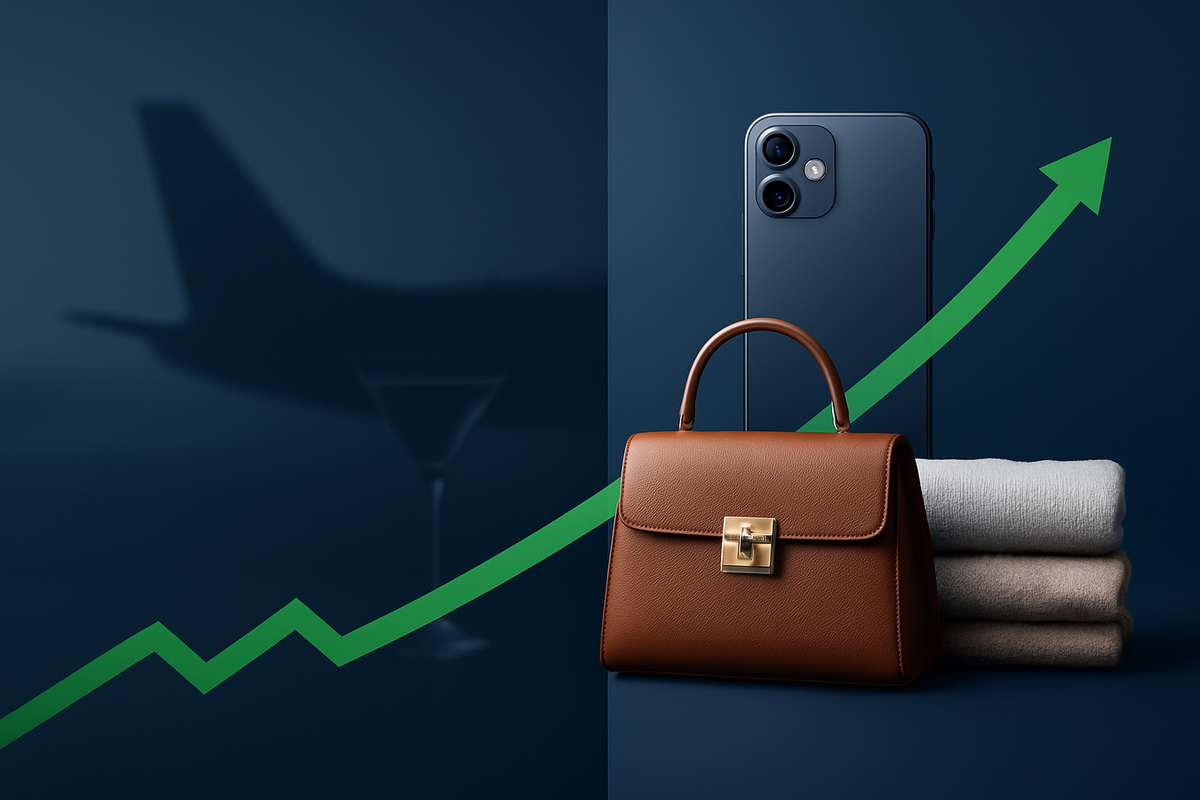
In a move that has sent ripples across Wall Street, Morgan Stanley (NYSE: MS) has officially upgraded the Consumer Discretionary Goods sector to Overweight, signaling a definitive preference for physical products over services for the first time since the global economic reopening in 2021. This strategic pivot, announced in full detail this February 2026, marks the end of the post-pandemic "Experience Economy" dominance and suggests a fundamental realignment in how American households are allocating their shrinking discretionary dollars.
The upgrade, led by Chief U.S. Equity Strategist Mike Wilson and retail analyst Alex Straton, argues that the "rolling recession" which plagued the manufacturing and retail sectors throughout 2024 and 2025 has finally concluded. As services inflation remains stubbornly high, physical goods have entered a period of relative value, triggering what Morgan Stanley calls a "mandatory replacement cycle" for items purchased during the 2020–2021 lockdown boom. The immediate implication for the market is a massive rotation of institutional capital out of overextended travel and hospitality stocks and into long-neglected retail and durable goods names.
The End of the Experience Era: A Timeline of the Shift
The transition away from services began to accelerate in late 2025, but the "Double-Upgrade" issued by Morgan Stanley this February has solidified the trend. For the past four years, the market was driven by "revenge travel" and live entertainment—a phenomenon that saw consumers prioritize trips and concerts over home upgrades and apparel. However, by the start of 2026, data revealed that the "Experience Economy" had finally hit a ceiling. Revenue Per Available Room (RevPAR) for major hotel chains began to plateau, and the stratospheric growth of short-term rentals showed signs of fatigue.
Key stakeholders, including Morgan Stanley’s top strategists, identified several catalysts that converged in early 2026 to force this shift. Foremost among them was the "One Big Beautiful Bill Act" (OBBBA), a fiscal package passed in late 2025 that injected nearly $100 billion into personal income through middle-class tax credits. Historically, such direct fiscal transfers have a higher "marginal propensity to consume" in the retail sector rather than in high-end services. Furthermore, the 4-to-5-year life cycle of pandemic-era electronics and appliances has reached its end, necessitating a "forced" wave of replacements that is driving consumers back into stores.
The market reaction has been swift. Since the upgrade, the Consumer Discretionary Select Sector SPDR Fund (NYSE: XLY) has seen a distinct divergence between its retail components and its service-oriented travel components. Institutional investors have begun shedding "late-cycle" services positions, fearing that the maturation of the travel frenzy will lead to multiple compression—a scenario where stock prices drop even if earnings remain stable, simply because the growth story has faded.
Picking the Winners: Retail’s "Rolling Recovery" vs. The Travel Trough
As the rotation takes hold, several public companies have emerged as primary beneficiaries of Morgan Stanley’s new thesis. In the apparel and specialty retail space—often referred to as "Softlines"—The Gap Inc. (NYSE: GPS) and Urban Outfitters (NASDAQ: URBN) have been highlighted as top picks. These companies have spent the last two years lean-sizing their inventories and are now perfectly positioned to capture the volume rebound expected from the OBBBA stimulus. Macy’s (NYSE: M) has also seen a resurgence, as department stores are increasingly viewed as the ultimate "value play" for consumers looking to refresh wardrobes that haven't been updated since 2021.
In the "Hardlines" and durable goods sector, Best Buy (NYSE: BBY) is the standout winner. As the primary hub for the aforementioned electronics replacement cycle, Best Buy is seeing a surge in demand for laptops and home theater systems purchased during the early 2020s. Additionally, as interest rates have begun a gradual descent from their peaks, financed goods are becoming more attractive once more. This has provided a tailwind for companies like AutoZone (NYSE: AZO) and Carvana (NYSE: CVNA), which benefit from improved credit conditions for consumers looking to upgrade their vehicles or maintain aging fleets.
Conversely, the "losers" in this pivot are the darlings of the 2022–2025 era. Airbnb (NASDAQ: ABNB) and Expedia Group (NASDAQ: EXPE) have faced significant selling pressure following Morgan Stanley’s move. Airbnb, in particular, was hit with an Underweight rating as analysts questioned its ability to maintain profit margins while battling new AI-native competitors. Hilton Worldwide (NYSE: HLT) also saw a cooling of investor interest, exacerbated by high-profile exits such as Bill Ackman’s Pershing Square, which reportedly offloaded its Hilton stake in early February 2026. Airlines like Delta Air Lines (NYSE: DAL) and United Airlines (NASDAQ: UAL) have similarly struggled, as "premium leisure" travel demand shows signs of softening in the face of a "rolling recession" in the services sector.
Broader Significance: Inflation Differentials and Historical Precedents
The shift to goods over services is not merely a tactical trading call; it is a reflection of a deeper structural change in the U.S. economy. Since 2023, services inflation has consistently outpaced goods inflation, creating a widening "value gap." By early 2026, many physical goods were experiencing flat or even negative year-over-year price growth due to supply chain efficiencies and lower freight costs. For the consumer, a new television or a designer coat now feels like a "bargain" compared to the skyrocketing costs of airfare, dining out, and hotel stays.
This event mirrors the 2021 period, but in reverse. In 2021, the world was starved for services and over-saturated with goods; in 2026, the reverse is true. This "Great Pivot" suggests that the U.S. economy is moving into a more balanced phase of growth. The ripple effects will likely extend beyond retail to include the logistics and freight sectors. If goods demand continues to outpace services, we could see a renewed boom in trucking and warehousing, potentially benefiting companies like United Parcel Service (NYSE: UPS) and FedEx (NYSE: FDX).
Furthermore, the OBBBA fiscal stimulus represents a pivot in policy. After years of the Federal Reserve fighting inflation with high interest rates, the fiscal side of the government is now stepping in to support consumption. This creates a complex dynamic where the Fed may be forced to keep rates "higher for longer" to combat services inflation, even as the retail sector booms due to fiscal tailwinds. This policy friction will likely be a major theme for the remainder of 2026.
Looking Ahead: Strategic Pivots and Market Risks
What comes next will depend largely on how quickly retailers can adapt to this sudden surge in demand. Short-term, the challenge for companies like Gap and Best Buy will be inventory management. After years of keeping stocks low to avoid the "inventory glut" of 2022, these companies must now scale up without overextending themselves. A strategic pivot toward "Just-In-Case" inventory models, as opposed to the "Just-In-Time" models of the past, may be necessary to navigate the volatility of the 2026 consumer.
Long-term, the market may see a period of "mean reversion" where the share of the consumer wallet spent on services settles back to pre-pandemic norms (roughly 65-67%). If Morgan Stanley’s "Rolling Recovery" thesis holds, we are currently in the early innings of a multi-year bull market for retail and durable goods. However, a potential scenario of "stagflation" remains the biggest threat; if the services sector recession deepens and spills over into employment, the retail recovery could be short-lived.
Investors should also watch for a potential wave of M&A activity. With retail valuations still relatively low compared to their 2021 peaks, cash-rich private equity firms and larger conglomerates may look to snap up "share gainers" in the apparel and home goods sectors before the recovery fully matures.
Final Assessment: A New Chapter for the Market
The Morgan Stanley upgrade represents a psychological turning point for investors. It acknowledges that the post-COVID "experience" boom was a temporary distortion rather than a permanent shift in human behavior. As we move through the first half of 2026, the key takeaway is clear: the physical world is back in fashion.
For the market to move higher from here, it will need to see these retail "winners" translate increased volume into bottom-line earnings. Investors should keep a close eye on Q1 2026 earnings reports from companies like Best Buy and Macy’s for confirmation that the "replacement cycle" is indeed underway. While the travel and hospitality sectors are far from dead, their days of easy outperformance are likely behind them. In the coming months, the successful investor will be the one who looks past the sunset of the "Experience Economy" and toward the sunrise of a revitalized American retail landscape.
This content is intended for informational purposes only and is not financial advice