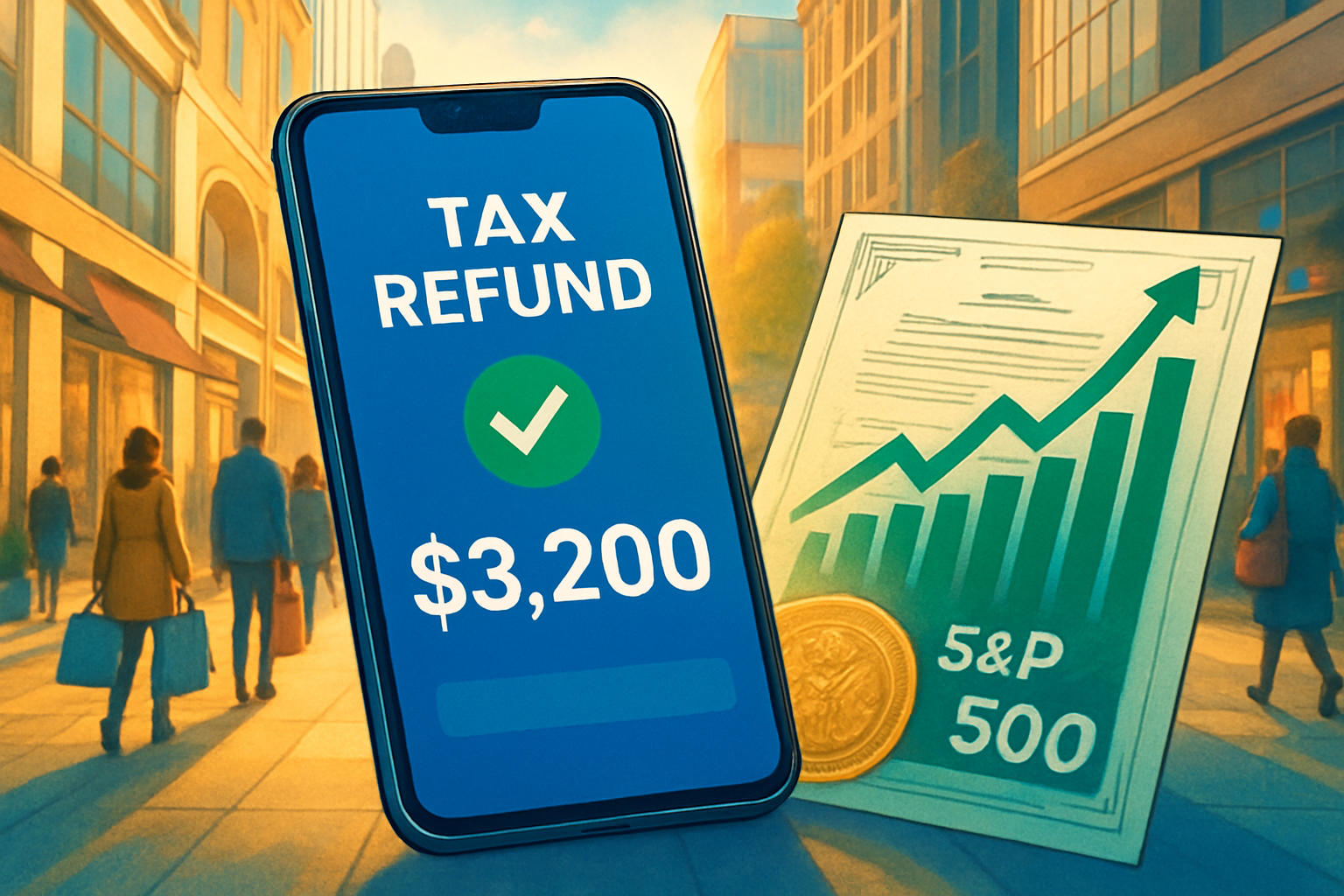
As of late February 2026, a massive wave of liquidity is washing over the American economy. Following the landmark passage of the One Big Beautiful Bill Act (OBBBA)—officially Public Law 119-21—in the summer of 2025, U.S. consumer bank accounts are now seeing the first major influx of expanded tax refunds. This "Spring of Stimulus" is not merely a seasonal uptick but a calculated fiscal injection designed to solidify the U.S. "rebound" narrative, propelling the S&P 500 Index (NYSEARCA:SPY) to record heights earlier this year and reshaping the macroeconomic landscape for the remainder of 2026.
Economists estimate that total tax refund volume for the current cycle will hit a staggering $517 billion, a nearly 44% increase over previous years. The average individual refund has climbed to approximately $2,476, driven by a unique legislative quirk: because the OBBBA’s tax cuts were passed mid-year in 2025 and withholding tables were not updated until the final months of the year, millions of taxpayers effectively overpaid their federal obligations for several months. Now, as those overpayments return to households, the U.S. consumer—long the engine of global growth—is prepared to spend with a level of confidence not seen in years.
The Mechanics of the OBBBA: From July 4th Signing to February Refunds
The One Big Beautiful Bill Act was signed into law by President Donald Trump on July 4, 2025, following a narrow but decisive victory in the Senate via the budget reconciliation process. The legislation was the cornerstone of the administration’s "American Economic Renaissance" platform. While its primary goal was the permanent extension of the 2017 individual and estate tax rates, it introduced several aggressive new measures: the removal of federal taxes on tipped income (up to $25,000) and overtime pay (up to $12,500), an increase in the State and Local Tax (SALT) deduction cap to $40,000, and an enhanced Child Tax Credit.
The timeline of the current spending surge began in earnest on February 1, 2026, when the Internal Revenue Service (IRS) began processing the first massive batch of returns. Early data from the Treasury Department indicates that the velocity of these refunds is significantly higher than in 2024 or 2025. This rapid disbursement has acted as an immediate "booster shot" for the economy. Initial market reactions were jubilant; the Dow Jones Industrial Average and the Nasdaq Composite (NASDAQ: IXIC) saw a "January Effect" on steroids, as investors anticipated the consumer spending spree that is now visibly materializing in retail and service sectors.
Retail and Service Giants Set to Reap the Rewards
The primary beneficiaries of this fiscal windfall are the heavyweights of the U.S. consumer discretionary and staples sectors. Retail giants like Walmart Inc. (NYSE: WMT) and Target Corp. (NYSE: TGT) are already reporting increased foot traffic and higher average basket sizes in their preliminary February reports. These companies, which cater to the middle-to-lower income demographics, are seeing the direct impact of the "No Tax on Tips" provision, which has effectively increased the take-home pay for millions of service workers. Similarly, the "catch-up" refunds for overtime workers are providing a significant lift to big-ticket retailers like Best Buy Co., Inc. (NYSE: BBY).
The service and dining industries are also experiencing a renaissance. Darden Restaurants, Inc. (NYSE: DRI) and Chipotle Mexican Grill, Inc. (NYSE: CMG) have noted a surge in weekend reservations and higher-margin menu item selections, a trend directly correlated with the refund timing. On the digital front, payment processors like Visa Inc. (NYSE: V), Mastercard Inc. (NYSE: MA), and Block, Inc. (NYSE: SQ) are tracking a record volume of transactions, benefiting from the sheer velocity of money as it moves from government coffers to consumer wallets and then immediately into the retail economy. Conversely, the "losers" in this environment may be found in sectors reliant on government transfers; the OBBBA included significant funding reductions for Medicaid and SNAP (Supplemental Nutrition Assistance Program), potentially pressuring regional healthcare providers and discount grocers that lean heavily on government-subsidized spending.
A Wider Significance: Fiscal Dominance and the Debt Debate
The OBBBA represents a pivot back toward aggressive fiscal expansionism, a move that fits into a broader global trend of governments using tax policy rather than just monetary policy to stimulate growth. By bypassing the traditional central bank "trickle-down" mechanics, the Act has created a direct-to-consumer stimulus that has forced the Federal Reserve to reconsider its 2026 trajectory. With the 10-year Treasury yield hovering around 4.1%, the bond market is signaling caution regarding the deficit. The Congressional Budget Office (CBO) has projected that the Act will add between $3.4 trillion and $4.1 trillion to the federal debt over the next decade.
This event also draws historical parallels to the post-World War II spending booms and the 1980s Reagan tax cuts, though with a modern twist. The inclusion of "Trump Accounts"—tax-deferred savings accounts for children set to launch in July 2026—suggests a long-term goal of fostering a "shareholder democracy." However, the immediate ripple effect is a widening gap between growth-oriented companies and those burdened by the rising cost of capital. Small-cap stocks, represented by the iShares Russell 2000 ETF (NYSEARCA:IWM), have seen a significant resurgence as the restoration of 100% bonus depreciation and immediate R&D expensing under the OBBBA allows smaller, capital-intensive firms to invest in domestic manufacturing with renewed vigor.
What Comes Next: Inflation Risks and the Fed Transition
In the short term, the market will likely continue to ride the "rebound" narrative as corporate earnings for the first quarter of 2026 are expected to reflect this spending surge. However, a potential strategic pivot may be required by the summer. If the influx of $517 billion in refunds leads to a re-acceleration of inflation, the Federal Reserve—which is expected to see a leadership transition in May 2026 with the potential appointment of Kevin Warsh—may be forced to keep interest rates higher for longer to counteract the fiscal stimulus.
Strategic adaptations are already underway in the corporate world. Many companies are shifting from "defense" to "offense," utilizing the OBBBA’s corporate tax benefits to fund mergers, acquisitions, and domestic expansion. Caterpillar Inc. (NYSE: CAT) and Deere & Company (NYSE: DE), for example, are seeing increased demand as the Act’s provisions incentivize businesses to upgrade their equipment and machinery immediately. The market opportunity lies in identifying which companies can most effectively translate these temporary tax windfalls into permanent market share gains before the potential inflationary headwinds arrive.
The Bottom Line for Investors
The 'One Big Beautiful Bill' Act has undoubtedly provided the "shot in the arm" that the U.S. economy needed to sustain its 2026 recovery. The massive refund cycle currently hitting bank accounts is more than just a seasonal quirk; it is a fundamental shift in fiscal policy that has prioritized consumer liquidity and corporate investment. While the "Spring of Stimulus" is driving consumer discretionary stocks to new heights and supporting the narrative of a robust U.S. economic rebound, the long-term sustainability of this growth remains tethered to the specter of inflation and the mounting national debt.
Moving forward, the market will be characterized by a high degree of sensitivity to CPI data and Fed rhetoric. Investors should watch for the official launch of the "Trump Accounts" in July and the subsequent adjustments to corporate guidance as the initial "refund high" begins to settle. The success of the OBBBA will ultimately be judged not just by the spending surge of February 2026, but by whether it can catalyze enough genuine revenue growth to outpace the fiscal costs it has incurred.
This content is intended for informational purposes only and is not financial advice.