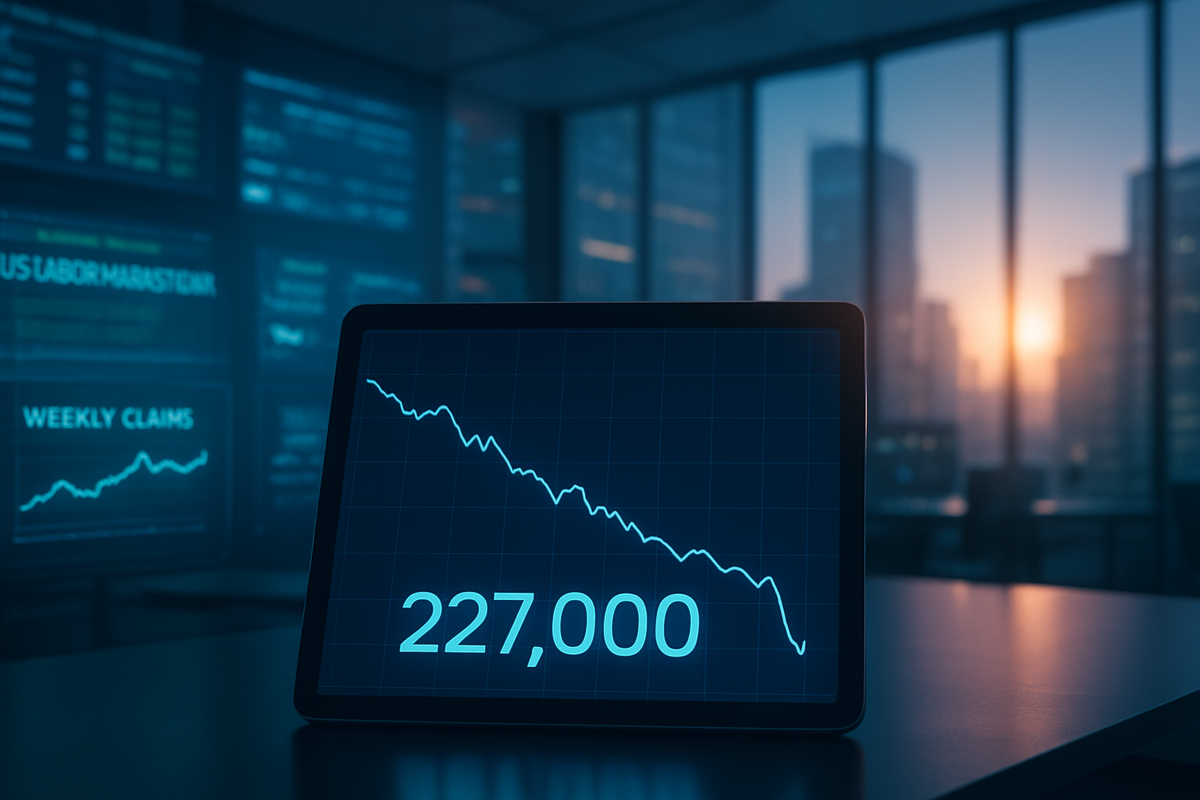
The U.S. labor market continues to display a startling durability that has left many economists recalibrating their recession models. According to data released by the Department of Labor on February 26, 2026, initial jobless claims for the week ending February 21 fell to 227,000, representing a decrease of 5,000 from the previous week’s revised level. This unexpected dip comes at a critical juncture for the American economy, which has been grappling with the corrosive effects of a partial government shutdown and a broader slowdown in manufacturing output.
The decline in claims suggests that despite the high-profile fiscal gridlock in Washington and a cooling global economy, American employers are still reluctant to let go of staff. While the "low-hire" environment remains a persistent theme of 2026, the "low-fire" side of the equation is providing a much-needed floor for consumer confidence. For investors, this data serves as a double-edged sword: it reaffirms the strength of the American consumer, but it also complicates the Federal Reserve’s path toward potential interest rate cuts later this spring.
The specific details of this morning’s report reveal a labor market that is bending but not breaking. While the headline number of 227,000 initial claims was a positive surprise—beating the consensus estimate of 235,000—the broader trend shows some underlying friction. The four-week moving average, which is often viewed as a more reliable gauge of labor market health because it strips out weekly volatility, rose slightly to 219,500. This suggests that while last week was exceptionally strong, the overall trajectory of unemployment filings has been on a very gradual upward slope since the beginning of the year.
The timeline leading up to this release has been defined by extreme uncertainty. Following the "One Big Beautiful Bill Act" (OBBBA) of late 2025, which aimed to stimulate growth through massive tax overhauls, the economy hit a localized speed bump in January 2026. A 20-day partial government shutdown over discretionary spending caps had led many analysts to fear a "federal spike" in jobless claims as contractors and non-essential personnel faced furloughs. However, the data suggests that private sector resilience has largely offset the temporary disruptions in the public sector.
Initial market reactions were swift but measured. The S&P 500 Index (NYSE: SPY) opened slightly higher as the news filtered through trading floors, while the 10-year Treasury yield ticked up to 4.35%, reflecting investor bets that a strong labor market will keep the Federal Reserve hawkish. Traders in the interest rate futures market are now pricing in only a 30% chance of a rate cut in May, down from 45% prior to the release. The "higher for longer" narrative, which many hoped would be retired in early 2026, appears to have gained a new lease on life.
In the wake of this data, several key public companies stand out as primary beneficiaries. Consumer retail giants like Walmart Inc. (NYSE: WMT) and Amazon.com, Inc. (NASDAQ: AMZN) are likely to see continued strength as the absence of mass layoffs supports steady household spending. With 227,000 claims indicating a stable workforce, these "essential" retailers can rely on a predictable flow of foot traffic and digital orders, even as the "affordability crisis" of 2025 lingers in the rearview mirror. Furthermore, credit card issuers like American Express Company (NYSE: AXP) and Visa Inc. (NYSE: V) may see reduced default risks as employment stability ensures that consumers can continue to service their debt loads.
Conversely, the technology sector remains in a precarious position. Companies that are highly sensitive to interest rates, such as Nvidia Corporation (NASDAQ: NVDA) and Apple Inc. (NASDAQ: AAPL), may face headwinds if the resilient labor data prevents the Federal Reserve from easing monetary policy. High borrowing costs continue to squeeze the valuations of growth stocks, and today's report does little to signal a reprieve. Additionally, staffing and recruitment firms like Robert Half Inc. (NYSE: RHI) may struggle; while layoffs are low, the "low-hire" trend means that new job placements are stagnating, limiting the growth potential for these professional services firms.
Industrial players such as Caterpillar Inc. (NYSE: CAT) and United Parcel Service, Inc. (NYSE: UPS) also face a mixed outlook. While a stable labor market is good for long-term demand, the lingering effects of the partial government shutdown on infrastructure projects and logistics contracts could dampen their short-term earnings. If the government gridlock continues to delay federal payments, even a strong private labor market may not be enough to shield these giants from the cooling effects of fiscal instability.
The broader significance of this report lies in its defiance of historical precedents. Typically, a prolonged government shutdown combined with an economic slowdown—as seen in the 2018-2019 and 2013 episodes—leads to a measurable surge in jobless claims within three to four weeks. The fact that claims fell to 227,000 suggests that the "labor hoarding" phenomenon that began in the post-pandemic era has become a permanent feature of the 2026 corporate landscape. Companies, haunted by the memory of the "Great Resignation," are choosing to absorb higher labor costs rather than risk being understaffed during a potential recovery.
Furthermore, this event highlights the emergence of a "K-shaped" labor resilience. While sectors like AI infrastructure and healthcare are booming, traditional consulting and administrative roles are seeing quiet displacement. This shift is creating a "jobless growth" environment where productivity increases through automation, keeping claims low even as new hiring slows to a crawl. The regulatory implications are significant; if the labor market remains this tight while inflation stays above the 2% target, the Federal Reserve may be forced to maintain its restrictive stance, potentially triggering a "delayed recession" in late 2026 or early 2027.
Comparing this to the 2025 shutdown, which lasted 43 days and dragged GDP down by 1.5 percentage points, the current situation appears much more manageable. The 2025 crisis saw federal jobless claims spike by over 600%, but the current 2026 "tail" of the shutdown seems to have been neutralized by the private sector's ability to pivot. This suggests that the U.S. economy has developed a more robust "immune system" against political volatility in Washington, though the long-term cost of this resilience—namely, sticky inflation—remains a concern.
Looking ahead, the next few months will be a proving ground for the "soft landing" thesis. The primary short-term focus will be on the March jobs report, which will offer a clearer picture of whether the 227,000 claims figure was a fluke or a sustainable trend. If claims continue to hover below the 230,000 mark, we may see a strategic pivot from the Federal Reserve, moving away from "inflation fighting" toward a "neutral" policy stance that acknowledges the fundamental shifts in the labor market.
Investors should prepare for a period of "volatility within stability." While the labor market looks solid, the implementation of the OBBBA tax cuts and the ongoing tariff negotiations will create winners and losers in the manufacturing and retail sectors. Companies will need to adapt their strategies to a world where labor is expensive and scarce, potentially leading to a new wave of capital investment in AI and robotics. The market opportunity here lies in firms that provide efficiency-boosting technology, as they will be the primary beneficiaries of a permanent "low-hire" environment.
The worst-case scenario remains a "stagflationary" trap where the labor market finally buckles under the weight of high interest rates just as inflation begins to re-accelerate due to trade tensions. However, the current data suggests a more optimistic outcome: an economy that is learning to function at a slower, more deliberate pace without falling into the abyss of a hard landing.
In summary, the February 26 jobless claims report is a testament to the unexpected strength of the American worker. By falling to 227,000, claims have provided a buffer against the political and economic headwinds that defined the start of 2026. While the four-week moving average’s slight rise to 219,500 serves as a reminder that the margin for error is narrowing, the overall picture is one of surprising stability.
Moving forward, the market will remain hyper-fixated on the Federal Reserve's reaction function. The "Goldilocks" scenario of steady employment and cooling inflation is still on the table, but it requires a delicate balancing act from policymakers and corporate leaders alike. Investors should maintain a diversified stance, favoring companies with strong cash flows and low debt sensitivity, as the era of "easy money" remains firmly in the past.
The key takeaway for the coming months is clear: do not bet against the resilience of the U.S. labor market, but do not ignore the rising costs of maintaining that resilience. As we move deeper into 2026, the ability of the private sector to decouple from Washington's dysfunction will be the defining story of the year.
This content is intended for informational purposes only and is not financial advice.