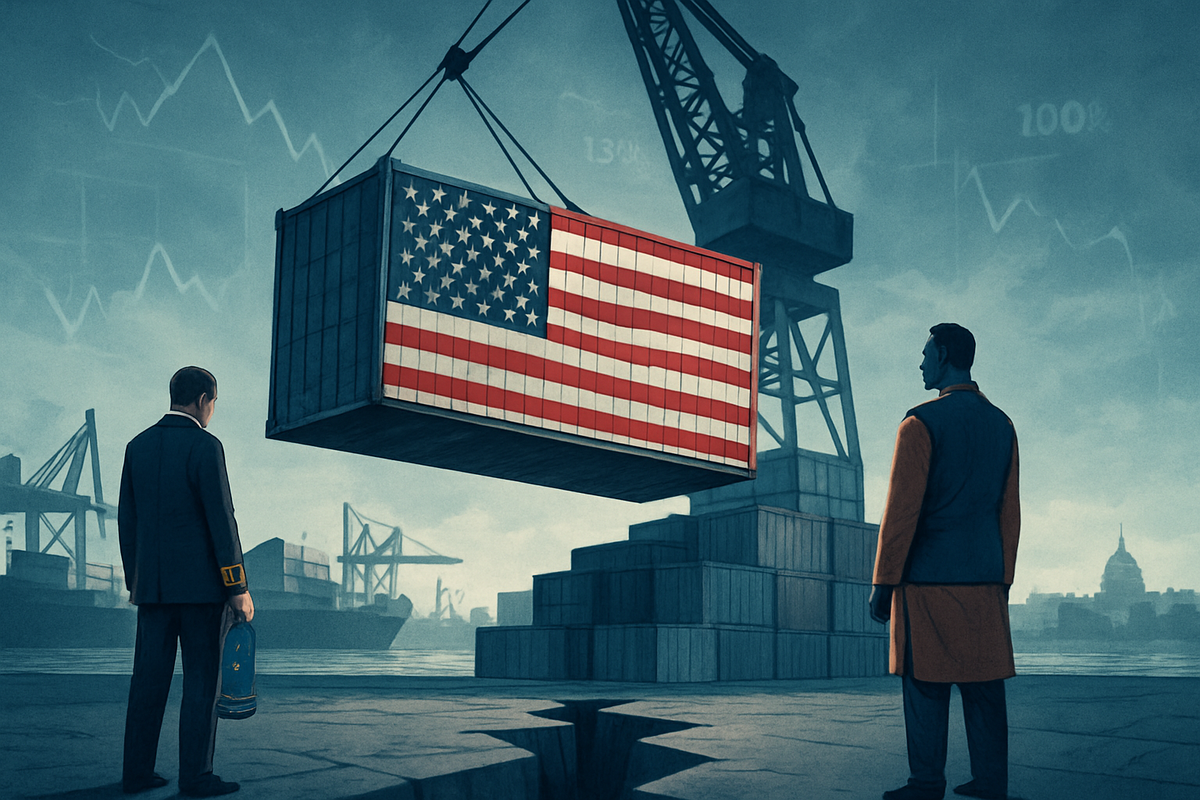
In a dramatic escalation of international trade tensions, the global economic order has been thrown into disarray this week following a series of rapid-fire developments in Washington D.C. On February 24, 2026, the European Commission officially announced the freezing of all ratification processes for the landmark "Turnberry Deal," while the Indian Ministry of Commerce indefinitely postponed high-level trade visits to the United States. These moves come as a direct response to the U.S. administration’s imposition of a new 15% global import surcharge, a policy move that has reignited fears of a full-scale global trade war.
The immediate implications of this backlash are profound: multi-billion dollar trade agreements that were years in the making are now in jeopardy, and global supply chains face a new layer of "tariff whiplash." As the U.S. shifts from previous broad-based emergency tariffs to a more targeted yet globally applied surcharge, international partners are signaling that their strategic patience has reached its limit. Markets have reacted with heightened volatility, as investors scramble to assess the damage to multinational corporations and the broader inflationary pressures this new policy regime will exert on the global economy.
A Weekend of Legal Upheaval and Executive Action
The current crisis was precipitated by a landmark U.S. Supreme Court ruling on February 20, 2026. In the case of Learning Resources, Inc. v. Trump, the court ruled 6-3 that the executive branch had exceeded its constitutional authority by using the International Emergency Economic Powers Act (IEEPA) to unilaterally impose sweeping "reciprocal" tariffs. The ruling effectively struck down the cornerstone of the administration’s trade policy, creating a temporary vacuum in the U.S. customs regime. However, the reprieve for importers was short-lived.
On February 21, the administration responded by signing a proclamation under Section 122 of the Trade Act of 1974. This statute allows the President to impose a temporary import surcharge of up to 15% for 150 days to deal with "fundamental international payments problems." By the following day, the surcharge—initially discussed at 10%—was hiked to the full 15% and applied globally. This move bypassed the legal constraints set by the Supreme Court but broke the fragile trust established with key trading partners during the 2025 negotiations.
The international response was swift and coordinated. On February 23, the European Parliament’s trade committee, led by Chair Bernd Lange, formally suspended all legislative work on the "Turnberry Deal"—an agreement signed in August 2025 intended to stabilize transatlantic commerce. Meanwhile, in New Delhi, the Indian Ministry of Commerce pulled back its high-level delegation, led by Chief Negotiator Darpan Jain, just hours before they were set to depart for Washington. Indian officials cited the need for "clarity" after the U.S. effectively ignored a framework reached only weeks prior that would have seen tariffs on Indian goods drop from 50% to 18%.
Initial market reactions have been sharply negative for companies with high exposure to international trade. The S&P 500 saw a significant pullback as the realization set in that the "tariff-free" window opened by the Supreme Court had been slammed shut within 48 hours. Industrial and consumer discretionary sectors bore the brunt of the sell-off, while domestic-focused utilities and specialized U.S.-based manufacturers saw a modest flight to safety.
Corporate Giants Caught in the Crossfire
The new 15% global surcharge creates a difficult environment for major U.S. tech and retail companies. Apple Inc. (NASDAQ: AAPL) is facing an estimated $3.3 billion in annual tariff duties on components manufactured in Asia. While the new surcharge is lower than the previous "reciprocal" rates, it remains a significant drag on margins for the iPhone maker, leading to a recent outlook downgrade from major Wall Street analysts. Similarly, Walmart Inc. (NYSE: WMT) is navigating a complex landscape; while the company may be eligible for billions in refunds from previously invalidated tariffs, the new 15% floor on imported consumer staples is expected to force price increases across its stores by mid-year.
In the automotive sector, the impact is divided. Tesla Inc. (NASDAQ: TSLA) faces approximately $4,000 in additional costs per vehicle due to imported components, yet it remains somewhat insulated by the 100% tariffs on Chinese electric vehicle competitors, which preserve its domestic market share. In contrast, General Motors (NYSE: GM) and Ford Motor Company (NYSE: F) are struggling with the rising costs of raw materials like steel and aluminum, which remain under heavy Section 232 duties. GM has already signaled a potential $1 billion hit to its first-quarter earnings for 2026, prompting a strategic pivot toward higher-margin hybrid vehicles to offset the costs of its electric transition.
European and Indian firms are also feeling the weight of the new policy. Volkswagen AG (OTC: VWAGY) reported a €1.3 billion decline in operating results as it grapples with U.S. import costs, leading the German automaker to lower its 2026 profit margin targets. In India, while tech giants like Infosys (NYSE: INFY) face indirect pressure from slowing U.S. discretionary spending, the energy sector has seen a rare winner. Reliance Industries Ltd (NSE: RELI) saw its shares surge after a specific provision in the February trade framework allowed it to resume importing cheaper crude from Venezuela in exchange for moving away from Russian oil—a deal that appears, for now, to be one of the few pieces of the U.S.-India trade puzzle still standing.
The Broader Shift: From Emergency Powers to Statutory Surcharges
This event marks a fundamental shift in how trade policy is conducted in the mid-2020s. The move from IEEPA-based "emergency" tariffs to Section 122 "surcharges" represents an attempt by the U.S. executive to find more durable legal ground for its protectionist agenda. This shift highlights a growing trend toward "managed trade," where bilateral deals and specific sector exclusions replace the broad, rules-based system overseen by the World Trade Organization (WTO). The Supreme Court's intervention in Learning Resources may have limited the method of tariff imposition, but it has not curbed the will of the administration to use trade as a primary tool of foreign policy.
The potential ripple effects are extensive. If the European Union follows through on its threat to reactivate suspended retaliatory levies on €93 billion of U.S. goods, we could see a return to the "tit-for-tat" cycles that characterized the late 2010s. This would likely impact U.S. agricultural exports and high-end machinery, further straining the relationship between the U.S. and its oldest allies. Furthermore, India’s postponement of trade visits signals that the "China Plus One" strategy—whereby Western firms look to India as a manufacturing alternative—may be at risk if the U.S. cannot offer a stable trade environment for Indian exports.
Historically, the use of Section 122 is rare, with its most famous precedent being the "Nixon Shock" of 1971. In that instance, a 10% surcharge was used to force a realignment of global currencies and the end of the gold standard. Today’s 15% surcharge appears to be serving a similar purpose: forcing a radical restructuring of global supply chains and compelling trading partners to accept terms that prioritize domestic U.S. manufacturing. The difference today is a much more integrated global economy, where such shocks can lead to rapid inflationary spikes and systemic financial instability.
What Lies Ahead: A 150-Day Countdown
The 150-day window provided by Section 122 is the new "golden hour" for global trade diplomacy. During this period, the administration must either negotiate new bilateral agreements that satisfy its "reciprocal" requirements or seek a congressional extension of the surcharge. Short-term, expect a flurry of "surgical" price increases from retailers like Target Corporation (NYSE: TGT) and industrial firms as they pass on the 15% cost floor to consumers. Strategic pivots are already underway, with companies increasingly moving toward "near-shoring" in Mexico or Canada to avoid the global surcharge, provided those goods meet strict North American content requirements.
Market opportunities may emerge for domestic-centric firms or those with highly flexible supply chains. However, the overarching challenge will be the "wait-and-see" approach adopted by foreign governments. If the European Commission remains firm in its freeze of the Turnberry Deal, we could see a permanent decoupling of the transatlantic trade relationship, leading to separate, competing regulatory blocs. For India, the stakes involve its energy security; if the deal involving Venezuelan crude and U.S. technology remains in limbo, New Delhi may be forced to pivot back toward its historical reliance on Russian energy, further complicating its relationship with Washington.
Closing Thoughts for Investors
The events of February 24, 2026, represent a watershed moment in the transition toward a more fractured global economy. The U.S. administration’s rapid pivot to Section 122 surcharges, following a Supreme Court setback, demonstrates a commitment to protectionism that transcends judicial hurdles. For the market, this means that "tariff risk" is no longer a seasonal concern but a permanent feature of the investment landscape. The freezing of the EU deal and the stalling of Indian negotiations are clear indicators that the rest of the world is no longer willing to accept unilateral U.S. trade shifts without significant pushback.
Moving forward, the market will likely reward companies with high domestic production capacity or those capable of absorbing costs through exceptional pricing power. Investors should closely monitor the "150-day clock" on the Section 122 surcharge, as well as any signs of retaliatory tariffs from the European Commission or the Indian Ministry of Commerce. Inflationary data will also be critical; if the 15% surcharge leads to a sustained spike in consumer prices, it may force the Federal Reserve into a more hawkish stance, adding another layer of complexity to an already volatile economic environment. The era of frictionless global trade is increasingly a memory, and the coming months will determine what new, more turbulent system takes its place.
This content is intended for informational purposes only and is not financial advice.