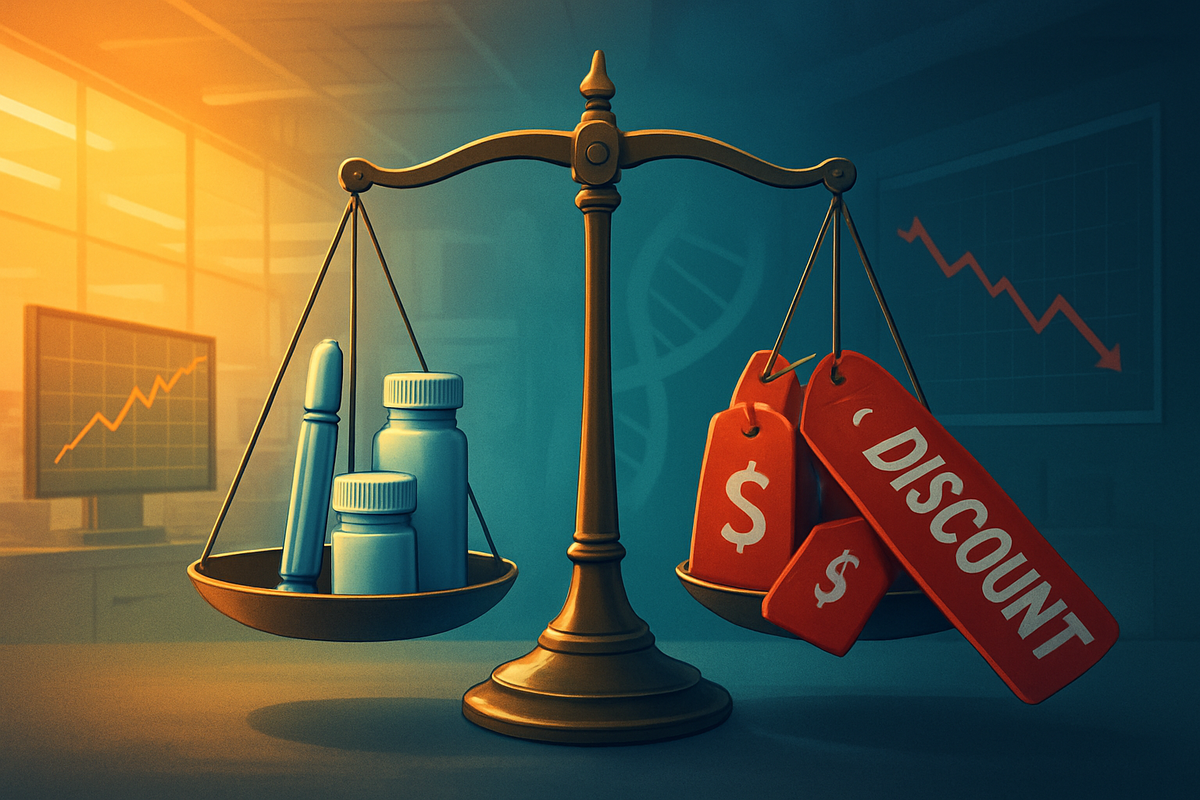
The global pharmaceutical landscape underwent a seismic shift today, February 24, 2026, as the two pioneers of the weight loss drug revolution reported vastly different outlooks for the coming year. While Eli Lilly and Co. (LLY:NYSE) raised its 2026 revenue guidance to record-breaking levels, its primary rival, Novo Nordisk A/S (NVO:NYSE), issued a stunning warning of a potential 13% drop in sales. This divergence marks the end of the "duopoly era" of high-margin scarcity and the beginning of a brutal, high-volume price war that is reshaping the $150 billion obesity market.
The contrast in fortunes highlights a critical turning point for the industry: the transition from a supply-constrained market to one defined by aggressive government-mandated pricing and a race for superior clinical efficacy. For investors, the news underscores a "winner-takes-most" dynamic, where Eli Lilly's diversified pipeline and manufacturing scale are allowing it to thrive despite the same pricing pressures that are currently eroding Novo Nordisk's bottom line.
The Shock Forecast: A 13% Slide for the Wegovy Maker
The market was caught off guard this morning when Novo Nordisk updated its 2026 financial outlook, projecting a revenue decline of 5% to 13%. This marks the first projected annual sales drop for the Danish pharmaceutical giant in over a decade. Executives pointed to a "perfect storm" of intense price competition and the late-2025 implementation of the "Most Favored Nation" (MFN) pricing policy in the United States, which effectively slashed the list price of its blockbuster drug Wegovy by nearly 50% to roughly $675 per month. The company also admitted that its newly launched "Wegovy Pill"—an oral version of semaglutide—is facing steeper-than-expected discounting to maintain market share, with some contracts pricing the daily tablet as low as $149 per month.
The timeline of this downturn began in late 2025, when a series of clinical setbacks dampened enthusiasm for Novo’s pipeline. Most notably, the REDEFINE 4 head-to-head trial results released earlier this month showed that Novo’s next-generation candidate, CagriSema, failed to beat Eli Lilly’s Zepbound in total weight loss. CagriSema delivered a 23% reduction in body weight, falling short of the 25.5% benchmark set by Lilly’s tirzepatide. This clinical "miss" has forced Novo into a defensive position, relying on price cuts to protect its shrinking piece of the metabolic market as insurance payers shift their preferences toward the more efficacious Lilly products.
Winners and Losers in the Post-Scarcity Era
Eli Lilly and Co. (LLY:NYSE) stands as the undisputed victor in this new market regime. Reporting a 2026 revenue forecast of $80 billion to $83 billion—representing 25% year-over-year growth—Lilly has managed to offset lower per-unit prices with an explosion in volume. The company’s massive $50 billion investment in manufacturing, including its 12-building "mega-site" in Lebanon, Indiana, has finally come online, allowing it to flood the market and meet the demand that its rival is struggling to serve profitably. Furthermore, Lilly’s "triple agonist" drug, Retatrutide, is currently moving toward regulatory submission with Phase 3 data showing nearly 29% weight loss, positioning the company to dominate the premium "high-efficacy" segment of the market.
Conversely, Novo Nordisk (NVO:NYSE) is navigating a difficult transition. Having lost nearly 50% of its market capitalization from its 2024 peak, the company is now being labeled by some analysts as a "value trap." While it still holds a first-mover advantage in the oral weight loss space with its Jan 2026 launch of the Wegovy Pill, that advantage is being challenged by the looming Q2 2026 launch of Lilly’s Orforglipron. Other potential beneficiaries of this market shift include health insurers and Pharmacy Benefit Managers (PBMs), such as UnitedHealth Group (UNH:NYSE), which are benefiting from the lower drug costs and expanded Medicare coverage for obesity treatments that became standard at the start of 2026.
A Broader Shift in the Pharmaceutical Industry
The diverging fortunes of these two giants reflect a broader trend toward the "commoditization" of GLP-1 therapies. For years, the obesity market was characterized by limited supply and four-figure monthly price tags. However, the intervention of U.S. federal policy in late 2025—driven by public outcry over drug costs—has forced a shift toward high-volume distribution. This event mirrors the historical trajectory of the statin market in the early 2000s, where initial blockbusters eventually faced intense price competition and regulatory pressure, leading to a market dominated by the most efficient manufacturers with the strongest second-generation pipelines.
Regulatory and policy implications are also at the forefront. The expansion of Medicare and Medicaid to cover obesity as a standalone indication has significantly increased the patient pool but has also given the government unprecedented leverage in price negotiations. This "Medicare effect" is what ultimately triggered the 13% sales drop warning from Novo Nordisk, as the company was forced to accept lower margins in exchange for access to tens of millions of newly eligible patients. Competitors like Amgen (AMGN:NASDAQ) and Viking Therapeutics (VKTX:NASDAQ) are watching closely, as they must now ensure their upcoming clinical data is not just "good," but "superior" to justify entry into this hyper-competitive landscape.
The Road Ahead: Orals and Triple Agonists
Looking toward the remainder of 2026 and into 2027, the market is entering what analysts call the "Year of the Orals." The convenience of a daily pill over a weekly injection is expected to further expand the market to patients who were previously needle-hesitant. While Novo Nordisk has the first-mover advantage here, the market will be watching the Q2 2026 launch of Eli Lilly’s Orforglipron. Unlike Novo’s pill, which requires specific fasting protocols and water intake for absorption, Lilly’s candidate lacks these dietary restrictions—a factor that could lead to rapid market share gains despite being second to market.
Strategic pivots are already underway. Novo Nordisk is expected to increase its focus on cardiovascular and kidney disease indications for its semaglutide molecule to find higher-margin "niche" applications where price competition is less fierce than in general weight loss. Meanwhile, the industry is bracing for the arrival of "triple agonists" like Retatrutide, which could push the boundaries of medical weight loss to levels previously only seen with bariatric surgery. The primary challenge for all players will be maintaining manufacturing efficiency; in a world of $350-per-month weight loss drugs, the company with the lowest cost of production will ultimately hold the most power.
Closing the Chapter on the Gold Rush
The era of easy gains in the obesity market has officially ended. Today's news serves as a sobering reminder that even the most revolutionary medical breakthroughs are not immune to the gravity of price competition and regulatory intervention. The divergence between Eli Lilly's upbeat trajectory and Novo Nordisk's cautionary tale illustrates that in the long run, manufacturing scale and a superior clinical pipeline are the only sustainable moats in the pharmaceutical industry.
For investors, the coming months will be defined by "execution risk." Watch for Lilly’s ability to successfully launch Orforglipron and whether Novo Nordisk can find a floor for its margins as it integrates its newly acquired Catalent manufacturing sites. The weight loss drug market is no longer just about who has the drug, but who can produce it most efficiently and who can prove it works the best. As the dust settles on this $150 billion market realignment, the "weight loss war" has entered a new, more mature, and significantly more aggressive phase.
This content is intended for informational purposes only and is not financial advice