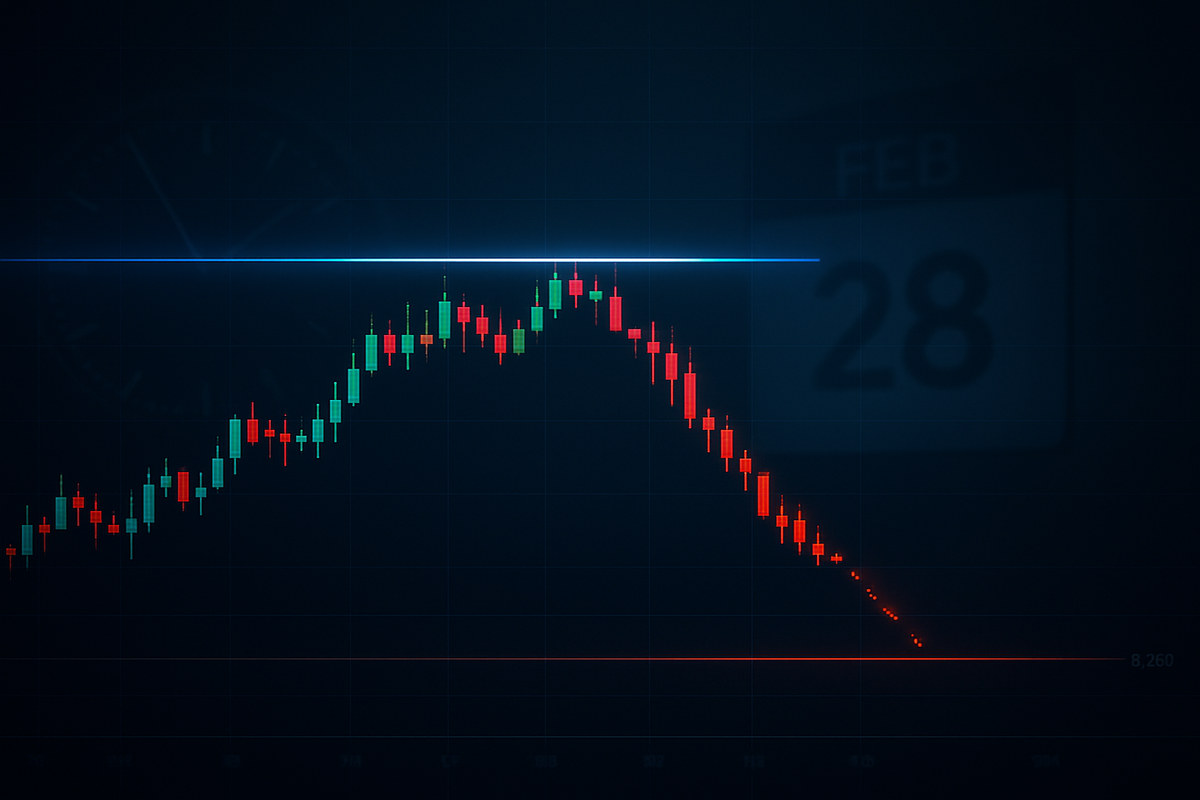
As of February 23, 2026, the S&P 500 (INDEXSP: .INX) finds itself at a critical crossroads, grappling with a formidable horizontal resistance level at the 6,900 mark. After a blistering start to the year that saw the index flirt with the psychological 7,000 milestone, the momentum has begun to stall. Investors are now closely watching the charts as technical indicators signal a potential exhaustion of the current rally, raising fears of a near-term correction.
The immediate implications of this standoff are profound for both institutional and retail traders. While the broader market sentiment remains tentatively bullish for the long term, the failure to decisively break above 6,900 has shifted the focus toward downside protection. Analysts are increasingly pointing to a "downside resolution" that could see the index retreat to the 6,730 level—a move that would align with historical seasonal weakness often observed in late February and early March.
Technical Gridlock at the 6,900 Frontier
The climb to 6,900 has been a journey characterized by high-level consolidation and a "tug-of-war" between bulls and bears. Since early January, the S&P 500 has oscillated within a tight range, struggling to maintain a foothold above 6,910. This level represents a significant technical pivot point; a sustained close above it could clear the path toward a retest of the all-time high near 7,020, while a failure to hold reinforces a bearish near-term outlook. Key upper resistance is currently pegged at 6,958, which represents a 161% Fibonacci extension of the previous minor correction.
The timeline leading to this moment has been marked by a series of "exhaustion signals." Technical analysts have noted that the DeMARK exhaustion count has reached a critical bar 9 of 9 on monthly charts—a signal that has historically preceded market pullbacks of 10% or more. This technical backdrop is further complicated by the index's proximity to its 50-day moving average, currently hovering near 6,830. A break below this support level would likely accelerate the slide toward the 6,730 target, which aligns with higher timeframe range lows established in mid-December.
Market reactions have been mixed, with a notable increase in the Volatility Index (VIX), which typically rises by an average of 5.5% during the month of February. While the SPDR S&P 500 ETF Trust (NYSEARCA: SPY) remains at elevated levels, the "positive January" momentum is clearly fading. Investors are now shifting from a "chase the rally" mentality to one of cautious observation, as the lack of a fresh fundamental catalyst leaves the index vulnerable to profit-taking.
The Magnitude of Momentum: Winners and Losers
In this high-stakes environment, the performance of the "Magnificent 7" technology giants is coming under intense scrutiny. NVIDIA Corporation (NASDAQ: NVDA), which accounts for roughly 8% of the index's weight, has begun to show signs of waning momentum. Despite its dominant position in the AI sector, the stock has lagged the broader index over the last three months, rising only 0.75% compared to the S&P 500's 4% gain. With its late-February earnings report scheduled for February 25, Nvidia is viewed as a potential "make-or-break" catalyst for the entire market.
Other heavyweights like Microsoft Corporation (NASDAQ: MSFT) and Apple Inc. (NASDAQ: AAPL) are also facing headwinds. These companies, representing nearly 11% and 12% of growth-weighted indices respectively, have seen their influence diluted by a visible rotation into "real-economy" sectors. Industrials and Energy stocks have begun to outperform, as investors seek value in sectors that are less sensitive to the high valuations currently found in the tech space. This rotation has led to an interesting phenomenon where the equal-weighted S&P 500 is actually outperforming the cap-weighted version.
On the losing end of this scenario are the high-beta growth stocks that rely on continued index expansion to justify their valuations. If the S&P 500 indeed drops to the 6,730 support level, these names could face a more aggressive sell-off than the broader market. Conversely, defensive players and companies with strong free cash flow in the Energy and Industrial sectors may act as a buffer for diversified portfolios, benefiting from the capital flight out of expensive technology names.
Seasonal Malaise and the Broader Market Context
The current technical struggle at 6,900 fits into a well-documented historical pattern of seasonal weakness. Historically, February ranks as the second worst month of the year for the S&P 500, with the index closing lower in approximately 46% of Februaries over the last 76 years. This "late-February exhaustion" often occurs as the market digests year-to-date gains and participants wait for the next wave of corporate earnings and economic data.
Beyond seasonality, this event highlights a broader industry trend toward diversification. The dominance of a few mega-cap tech stocks, which has defined much of the last decade, is being challenged by a more balanced market breadth. This shift suggests that while the "top-heavy" nature of the index may cause short-term volatility when tech leaders stumble, the underlying market health might actually be improving as more sectors participate in the gains.
There are also regulatory and policy implications to consider. With inflation data remaining "sticky" in early 2026, the Federal Reserve's stance on interest rates continues to be a primary driver of market sentiment. If the S&P 500 fails to break 6,900, it may be interpreted as the market's realization that the "higher for longer" rate environment is finally beginning to squeeze equity valuations. This historical precedent mirrors previous cycles where round-number resistance levels acted as the ultimate ceiling during periods of monetary tightening.
The Path Forward: Scenarios and Strategic Pivots
In the short term, the market's trajectory will likely be determined by the upcoming earnings reports from the semiconductor sector and the next round of labor market data. A "bullish breakout" scenario would require the index to clear 6,950 on high volume, effectively neutralizing the 6,730 downside target and setting the stage for a run at 7,100. Such a move would likely require a significant positive surprise from the tech sector and a "soft landing" confirmation from economic indicators.
However, the more probable "downside resolution" scenario involves a controlled retreat to the 6,730–6,800 range. This would allow the market to work off its current overbought conditions and provide a more attractive entry point for institutional "dip-buyers." Traders are already preparing for this possibility by tightening stop-loss orders on their growth positions and increasing their exposure to short-term treasuries or defensive equities.
Looking further ahead into the second quarter of 2026, the market may require a strategic pivot toward value and quality. As the AI-driven hype cycle matures, investors will likely demand more tangible earnings growth from the companies trading at premium multiples. The challenge for the S&P 500 will be to find a new leadership group that can push the index past the 7,000 barrier without relying solely on a handful of technology giants.
Assessing the 6,900 Standoff
The struggle at 6,900 is more than just a technical hurdle; it is a barometer for the current state of investor confidence and market health in early 2026. The key takeaways for investors are clear: technical resistance is holding firm, seasonal headwinds are blowing, and the dominance of the mega-cap tech stocks is being tested. While a retreat to 6,730 might seem discouraging in the short term, it would likely represent a healthy correction in an otherwise resilient bull market.
Moving forward, the market's ability to rotate effectively between sectors will be the most critical factor to watch. If the S&P 500 can find support at the 6,730 level, it would confirm a "higher low" on the long-term charts, setting a solid foundation for the remainder of the year. Investors should keep a close eye on the 50-day moving average and the performance of the equal-weight index as indicators of broader market participation.
In the coming months, the focus will remain on whether the 7,000 ceiling is a permanent lid or just a temporary pause. For now, the 6,900 level stands as a sentinel, guarding the gateway to further gains and reminding the market that even the strongest rallies need to catch their breath. Watching the volume and price action at these critical levels will provide the best clues for the next major move in the financial markets.
This content is intended for informational purposes only and is not financial advice.