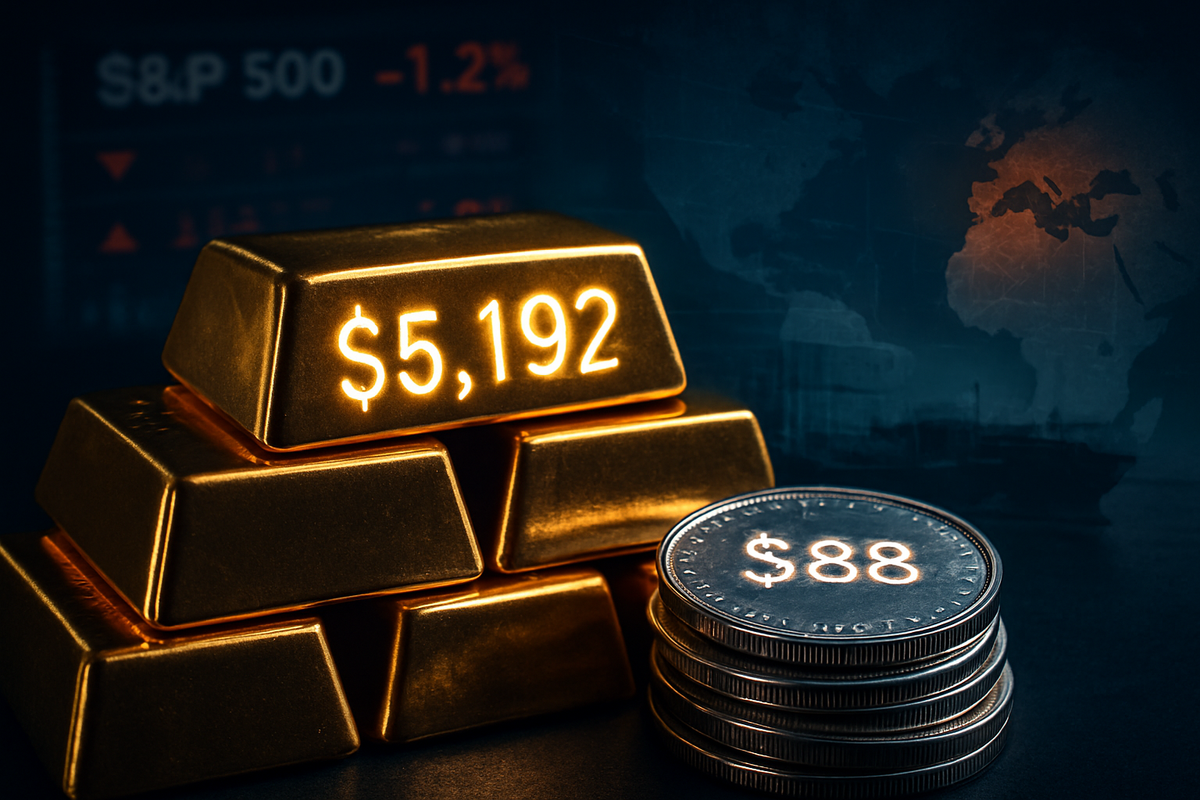
NEW YORK — In a historic week for global financial markets, precious metals have ascended to unprecedented heights as investors flee traditional equities in favor of "hard assets." On February 23, 2026, gold prices surged to an all-time record of $5,192 per ounce, while silver prices flirted with the $88 mark, levels once considered unthinkable by even the most bullish analysts. This dramatic rally comes as the United States navigates a complex "perfect storm" of legal volatility in trade policy, escalating military tensions in the Middle East, and a stubborn stagflationary environment that has left Wall Street reeling.
The immediate catalyst for the surge was a weekend of high-stakes maneuvering in Washington D.C., following a landmark Supreme Court ruling that upended the administration’s trade strategy. As the U.S. dollar faced renewed pressure and global trade partners prepared for a renewed "Trade War 2.0," the rush into safe-haven assets reached a fever pitch. Analysts suggest that the breach of the $5,000 gold threshold represents a fundamental shift in the global monetary order, signaling a deep-seated lack of confidence in fiat currencies amidst a rapidly fragmenting geopolitical landscape.
A Perfect Storm: From SCOTUS Rulings to Section 122 Tariffs
The path to $5,192 gold began in earnest on Friday, February 20, 2026, when the U.S. Supreme Court issued a 6–3 decision in Learning Resources, striking down the administration's broad use of the International Emergency Economic Powers Act (IEEPA) to impose "reciprocal" tariffs. The ruling created an immediate legal vacuum, briefly suggesting a reprieve for global trade. However, the optimism was short-lived. By Saturday, February 21, the administration pivoted to a rarely used, "dormant" provision: Section 122 of the Trade Act of 1974.
Invoking a "national economic emergency" to address a widening balance-of-payments deficit, the President imposed a flat 15% global import surcharge. This move, which bypassed the Court’s previous restrictions by utilizing a different statutory authority, sent shockwaves through international markets. The European Commission immediately warned that the new tariffs jeopardized the hard-won EU-U.S. Joint Statement of 2025, while major trading partners in Asia signaled imminent retaliation.
Compounding the trade uncertainty is a volatile geopolitical backdrop. A military standoff in the Persian Gulf reached a boiling point this month, with the U.S. executing its largest Air Force deployment to the region in decades following joint naval exercises by Russia and Iran near the Strait of Hormuz. With the threat of a global energy shock looming and a Department of Justice probe into the independence of Federal Reserve Chair Jerome Powell, the "Fear Trade" has become the dominant market narrative, driving institutional rotation out of the S&P 500 and into the SPDR Gold Shares (NYSEARCA: GLD) and iShares Silver Trust (NYSEARCA: SLV).
Winners and Losers: Miners Surge While Industrial Giants Brace for Impact
The primary beneficiaries of the metal moonshot have been the senior producers and streaming companies. Newmont Corporation (NYSE: NEM) and Barrick Gold Corporation (NYSE: GOLD) have seen their market capitalizations swell as the massive spread between production costs and spot prices promises record-breaking quarterly earnings. Similarly, Wheaton Precious Metals (NYSE: WPM), which utilizes a streaming model with fixed costs near $6.35 per ounce for silver, is capturing nearly the entire $80+ price spread as pure profit.
In the silver market, the impact is even more acute due to a persistent supply deficit. First Majestic Silver (NYSE: AG) and Pan American Silver (NYSE: PAAS) have emerged as the "darling" stocks of the month. Following its 2025 acquisition of Gatos Silver, First Majestic has become a pure-play vehicle for silver exposure, while Pan American's integration of MAG Silver assets has positioned it as the world’s leading producer just as industrial demand hits a bottleneck.
Conversely, the "silver squeeze" is creating an existential crisis for high-tech manufacturing and the green energy sector. Tesla (NASDAQ: TSLA) is reportedly engaged in a bidding war to secure physical silver for its upcoming "Model 2" launch, as the silver content in EV power electronics now adds over $1,000 in raw material costs per vehicle. Consumer electronics titan Apple (NASDAQ: AAPL) and solar giant Jinko Solar (NYSE: JKS) are also facing severe margin compression. With silver being an irreplaceable component in high-efficiency solar cells and AI-grade semiconductors, these companies are being forced to choose between passing massive price hikes to consumers or halting production lines.
The Resurrection of the "Hard Asset" Era
The current surge is more than just a temporary spike; it represents a significant departure from the market trends of the early 2020s. For decades, Section 122 of the Trade Act remained an obscure footnote in economic history, unused since the "Nixon Shock" era of the early 1970s. Its sudden resurrection in 2026 signifies a return to aggressive economic nationalism, where trade tools are used as weapons of foreign policy. This "Trade War 2.0" is unfolding against a backdrop of classic stagflation, with U.S. Q4 GDP slowing to 1.4% while Core PCE inflation remains stubbornly high at 3.0%.
This environment mirrors the late 1970s, where gold served as the ultimate hedge against a devaluing dollar and stagnant growth. However, the 2026 version is complicated by the "Green Transition." Unlike the 70s, silver is now a critical industrial commodity required for the global energy shift. The dual-demand for silver—as both a monetary safe-haven and an industrial necessity—has created a "demand-driven price spiral" that has outpaced gold’s percentage gains.
The ripple effects are reaching beyond the U.S. Central banks in emerging markets, led by China and India, have reportedly accelerated their diversification away from U.S. Treasuries, opting instead to bolster their physical gold reserves. This institutional "de-dollarization" is providing a structural floor for prices, suggesting that even if trade tensions ease, the floor for gold may have permanently shifted above the $4,000 level.
Looking Ahead: A Volatile Path to $6,000?
In the short term, markets should expect extreme volatility. The 150-day limit on Section 122 tariffs means that by July 2026, the administration will either need to negotiate a series of new trade deals or find a more permanent legislative solution to avoid a "tariff cliff." Any sign of a de-escalation in the Persian Gulf could lead to a sharp, albeit likely temporary, correction in the "geopolitical risk premium" currently baked into metal prices.
However, the long-term outlook remains bullish for many analysts. If the Federal Reserve’s independence continues to be questioned or if the DOJ probe leads to a leadership vacuum at the central bank, the dollar’s status as the world’s primary reserve currency could face its greatest challenge yet. Strategic pivots are already underway; industrial giants like Tesla are exploring "silver-thrifting" technologies, and mining companies are reinvesting record profits into deep-crust exploration to address the 800-million-ounce silver deficit.
Investors should watch for the next round of retaliatory tariffs from the European Union and China. If a full-scale global trade war erupts, some analysts have not ruled out gold testing $6,000 by the end of 2026. The key will be whether physical supply can keep up with the "panic buying" of both nations and corporations.
Summary: A New Reality for Global Markets
The ascent of gold to $5,192 and silver to $88 marks a definitive end to the era of low-volatility trade. The "perfect storm" of the February 2026 SCOTUS ruling, the subsequent Section 122 tariff hike, and Middle Eastern instability has fundamentally re-priced risk for every asset class. For the first time in a generation, the "hard asset" is no longer just a fringe hedge but a central component of institutional portfolios.
Moving forward, the market will likely remain in a "Two-Tier" state, where the spread between paper futures and physical metal premiums remains wide. Investors should keep a close eye on the weekly "Commitment of Traders" reports and the updates on U.S. Treasury yields. As long as the "tax on global growth" from tariffs remains in place and geopolitical tensions simmer, the flight to safety is expected to continue.
The lasting impact of this month's events will be measured by how quickly the global supply chain can adapt to $88 silver and whether the U.S. can stabilize its trade relations without further eroding the dollar's value. For now, the "Golden Age" of the mid-2020s has arrived, though it brings with it a level of uncertainty not seen in decades.
This content is intended for informational purposes only and is not financial advice