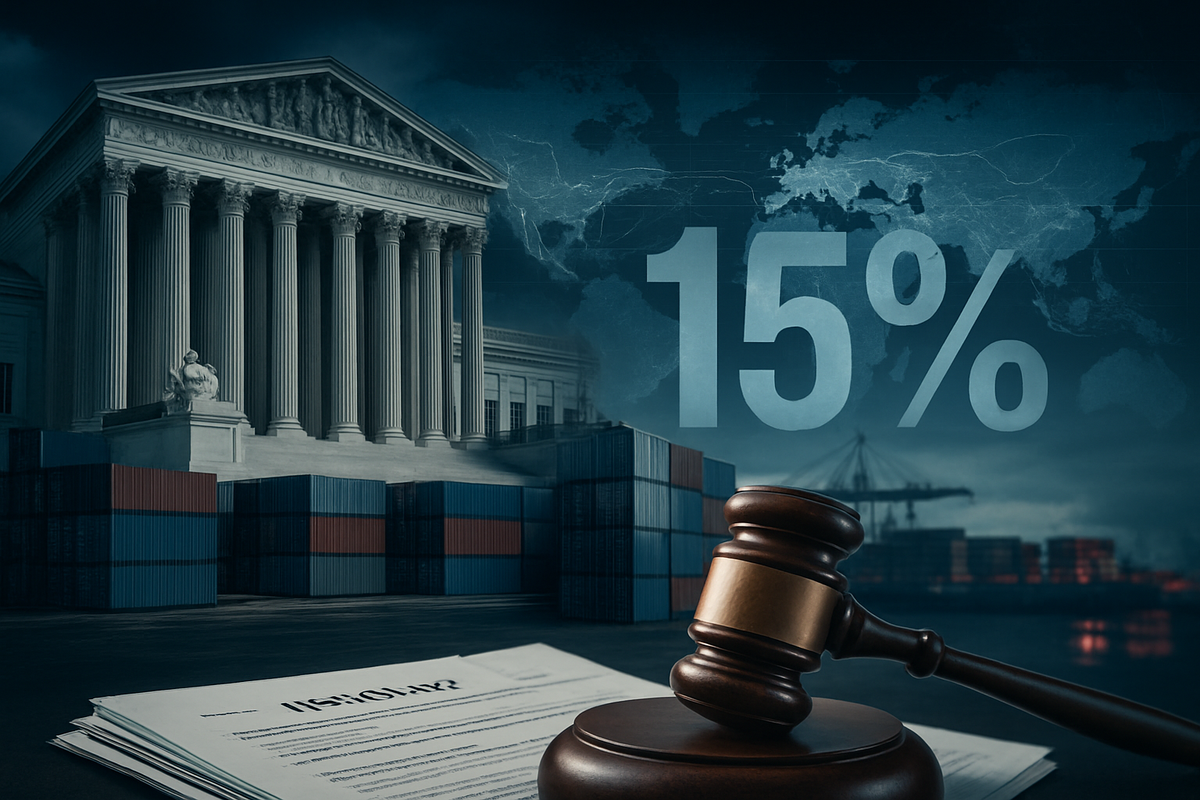
WASHINGTON D.C. — In a weekend that has fundamentally reshaped the American economic landscape, President Trump has officially signed an executive proclamation raising global tariffs to a uniform 15%. This aggressive maneuver follows a Friday afternoon bombshell from the Supreme Court, which struck down the administration's previous "reciprocal" tariff framework. By pivoting to Section 122 of the Trade Act of 1974, the White House has invoked an emergency "balance-of-payments" authority to bypass the judicial blockade, setting a 150-day clock for a high-stakes confrontation with Congress.
The immediate market reaction has been swift and volatile. Futures for the S&P 500 and Nasdaq plummeted in Sunday night trading as investors grappled with the reality of a "universal" tax on imports. Economists warn that the 15% surcharge—the maximum allowed under the statute—could represent the largest single-day tax increase in decades, threatening to reignite inflationary pressures just as the Federal Reserve signaled a potential end to its rate-hiking cycle. With the current date of February 23, 2026, the global trade community is now bracing for a summer of legal and legislative warfare that will determine the future of U.S. commercial policy.
The Legal Pivot: From Reciprocity to Section 122
The road to this morning’s 15% tariff began on February 20, 2026, when the Supreme Court issued its landmark 6-3 ruling in Learning Resources, Inc. v. Trump. The Court held that the administration's use of the International Emergency Economic Powers Act (IEEPA) to impose "reciprocal" tariffs was unconstitutional, citing the "major questions doctrine." Chief Justice John Roberts wrote that such a vast expansion of executive power over trade required a "clear statement" from Congress, which the IEEPA lacked. The ruling effectively wiped out nearly a year of trade policy, briefly threatening to return the U.S. to its pre-2025 tariff levels.
However, the administration’s response was nearly instantaneous. By Saturday morning, February 21, the President had invoked Section 122 of the Trade Act of 1974. Unlike the now-defunct reciprocal tariffs, Section 122 specifically grants the President the power to impose a temporary import surcharge of up to 15% for a period of 150 days to address "large and serious" U.S. balance-of-payments deficits. By shifting the legal justification from "national security" or "reciprocity" to "international payments problems," the White House has found a narrow but potent statutory needle to thread.
The 150-day window created by Section 122 is the critical variable for markets. Unless Congress passes an act to extend these measures, they will expire automatically on July 24, 2026. This has created an immediate lobbying frenzy on Capitol Hill, as the administration seeks a permanent legislative fix while the opposition maneuvers to let the clock run out. The move has been met with sharp criticism from trading partners in the EU and Asia, who have already begun drafting retaliatory lists targeting American agricultural and aerospace exports.
Market Fault Lines: Winners and Losers in the New Tariff Era
The shift to a 15% universal tariff has created a stark divide in the equity markets. The primary "losers" are concentrated in the tech and retail sectors, where global supply chains are most integrated. Apple (NASDAQ: AAPL) saw its shares dip in early trading as analysts estimated a $33 billion impact on annual sales if costs are passed to consumers. Similarly, hardware giants like Nvidia (NASDAQ: NVDA) are facing a double-edged sword: while demand for AI chips remains high, the 15% surcharge on advanced components and specialized materials is expected to drive up data center construction costs significantly.
In the retail space, Walmart (NYSE: WMT) and Target (NYSE: TGT) are under intense pressure. Walmart, which has spent years diversifying its sourcing away from China, still faces significant exposure to Southeast Asian manufacturing. While Walmart’s scale allows it to negotiate some cost-sharing with suppliers, smaller retailers are expected to face a more immediate margin crunch. Conversely, Boeing (NYSE: BA) represents a different kind of risk; as a major exporter, it is highly vulnerable to the retaliatory tariffs already being announced by China and the European Union, which could lead to canceled orders for its 737 Max and 787 Dreamliner programs.
On the other side of the ledger, domestic manufacturers are seeing a resurgence. Nucor (NYSE: NUE) and U.S. Steel (NYSE: X) have both seen a surge in order backlogs as the 15% surcharge makes foreign steel significantly less competitive. Domestic furniture makers, long battered by cheap imports, are also emerging as surprise victors. Ethan Allen (NYSE: ETD), La-Z-Boy (NYSE: LZB), and Bassett Furniture (NASDAQ: BSET)—all of which maintain significant manufacturing footprints in North Carolina and Virginia—are outperforming the broader market. These firms are positioned to capture market share from import-heavy competitors like Wayfair (NYSE: W), who must now navigate a 15% increase in their cost of goods sold.
The Macroeconomic Ripple: Inflation and the Fed
This event marks a significant departure from previous trade wars. By using Section 122, the administration is focusing on the "Balance of Payments," a macro-financial metric that ties trade policy directly to the strength of the dollar and the national debt. Analysts at Goldman Sachs (NYSE: GS) suggest this could lead to a "stagflationary trap" for the Federal Reserve. With core inflation already hovering near 3.0%, the sudden 15% surcharge is expected to push consumer prices higher, making it nearly impossible for the Fed to cut interest rates even as manufacturing growth potentially slows.
Historically, Section 122 has been a "dormant" statute, last used in spirit during the "Nixon Shock" of 1971. Its revival signals a return to a more protectionist era where trade is used not just as a tool for foreign policy, but as a primary engine for domestic industrial realignment. The regulatory implications are profound; the Court of International Trade is expected to be flooded with petitions for exemptions, though the "global and uniform" nature of Section 122 makes such carve-outs legally difficult to obtain.
The ripple effects are also being felt in the energy sector. While Kinder Morgan (NYSE: KMI) and other midstream players remain resilient due to domestic demand for natural gas, the broader energy market is watching for a slowdown in global industrial activity. Renewable energy players like First Solar (NASDAQ: FSLR) are seeing a boost, as the 15% tariff on imported Asian solar panels makes domestic modules more price-competitive, further accelerating the "green reshoring" trend that began earlier this decade.
The 150-Day Countdown: What Comes Next?
The focus now shifts to the 150-day window, which expires in July 2026. This period will be characterized by intense political maneuvering as the 2026 midterm elections approach. There are two primary scenarios: in the first, a divided Congress fails to act, and the tariffs expire, potentially causing a massive deflationary shock and market volatility. In the second, the administration uses the threat of expiration to force a "Grand Bargain" on trade, codifying the 15% rate into permanent law in exchange for other legislative concessions.
For public companies, the short-term strategy is "inventory hoarding" and "supply chain regionalization." We expect to see a surge in import volumes over the next 30 days as companies try to get goods through customs before the full administrative weight of the 15% surcharge is felt. Long-term, many companies will be forced to accelerate their exit from global hubs, potentially moving production to Mexico or back to the United States to take advantage of the North American trade protections that remain partially insulated from these global surcharges.
Investor Takeaway: A Summer of Volatility
The revival of Section 122 is a watershed moment for the 2026 market. Investors must move beyond the "trade war" headlines and look at the underlying legal and statutory limits. The key takeaway is the temporary nature of this authority; the 150-day clock means that every piece of news coming out of the House Ways and Means Committee or the Senate Finance Committee will have an outsized impact on the daily movement of the S&P 500.
Moving forward, the market will likely reward companies with high "domestic value-added" and penalize those with "just-in-time" global dependencies. Watch for the April inflation print as the first real indicator of how much of this 15% tax is being passed directly to the American consumer. In the coming months, the ability of firms like Walmart to maintain margins will be the bellwether for the broader economy’s resilience in the face of this unprecedented trade shock.
This content is intended for informational purposes only and is not financial advice.