As of February 19, 2026, the U.S. energy sector has emerged as the clear leader in the global financial markets, staging a massive rally that has caught many institutional investors off guard. Driven by a volatile mix of escalating military tensions in the Middle East and a sudden tightening of global supply, the Energy Select Sector SPDR ETF (XLE) has surged approximately 23% year-to-date. This dramatic turnaround comes after a period of relative stagnation in late 2025, re-establishing fossil fuel giants as the primary "macro hedge" for a world once again teetering on the edge of major conflict.
The immediate catalyst for this week’s price action is a sharp escalation in rhetoric and military positioning between the United States and Iran. With Brent crude climbing to $71.70 per barrel and West Texas Intermediate (WTI) surpassing $66, investors are flocking to domestic energy majors like Exxon Mobil, Chevron, and Occidental Petroleum. These companies are being viewed as safe havens that benefit directly from a rising "war premium" in oil prices, even as other sectors of the economy grapple with the inflationary pressures of higher fuel costs.
The Escalation of Conflict and the Return of the War Premium
The surge in energy valuations is the direct result of a rapidly deteriorating security situation in the Middle East. On February 18, 2026, U.S. Vice President JD Vance issued a stern warning, stating that Iran had crossed critical "red lines" regarding its nuclear program and regional proxy activities. Following these remarks, the U.S. military confirmed the deployment of two carrier strike groups and over 50 combat jets to the region. This military buildup has put markets on high alert for potential strikes that could disrupt the Strait of Hormuz—a maritime chokepoint responsible for the passage of nearly 30% of the world’s daily oil supply.
The timeline leading to this moment has been swift. Throughout early 2026, what began as a series of diplomatic disagreements quickly spiraled into a tactical standoff. By mid-February, the physical oil market began to show signs of extreme tightness, exacerbated by severe snowstorms in North America that hampered domestic production and export constraints in Kazakhstan. When the geopolitical risk was layered on top of these supply constraints, oil prices broke out of their long-standing range, leading to a 10.45% increase in Brent crude in just the last 30 days.
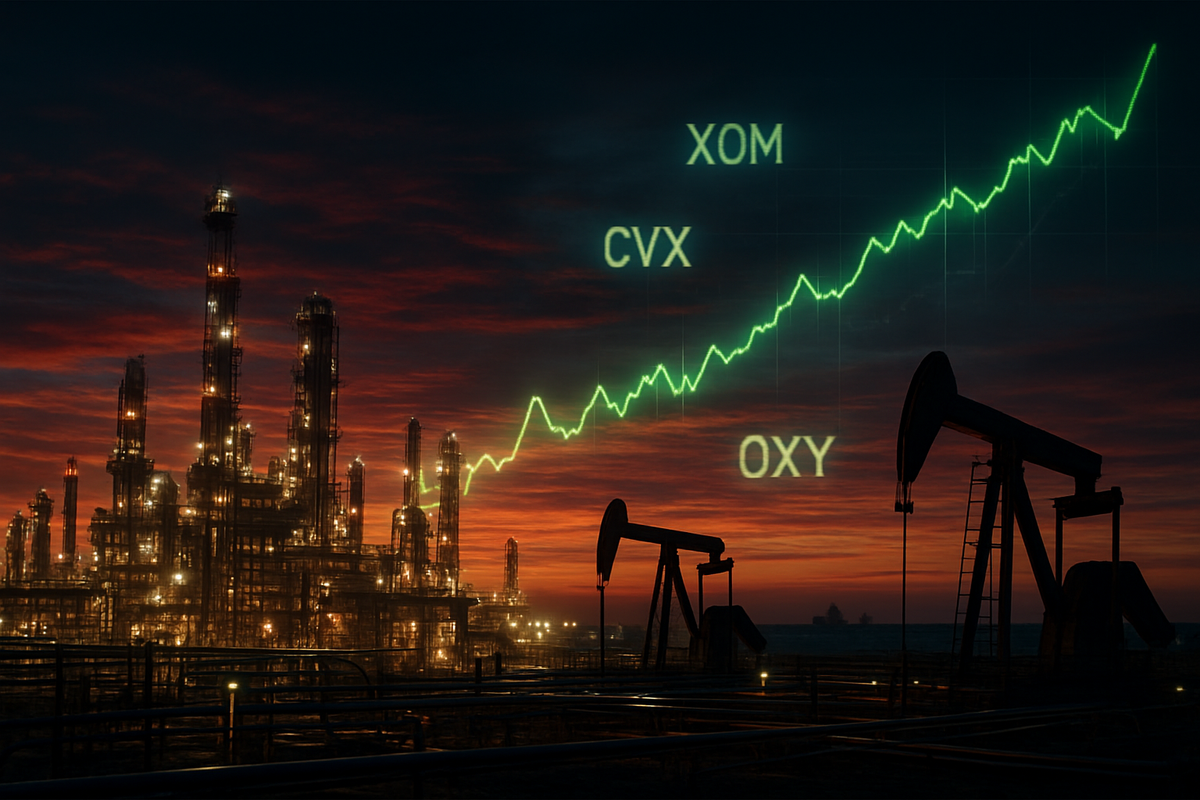
Initial market reactions have been concentrated in the "Big Three" of American oil. Exxon Mobil Corp. (NYSE: XOM) shares reached record highs above $150 this week, reflecting a 22.9% return since the start of the year. Similarly, Chevron Corp. (NYSE: CVX) is trading near its all-time peak at approximately $184. The reaction from the trading floor suggests that investors are less concerned with long-term energy transition goals and are focused squarely on the immediate cash flow advantages of $70+ oil in a high-demand environment.
The Winners: Profit Surges and Strategic De-leveraging
While the entire sector is rising, Occidental Petroleum Corp. (NYSE: OXY) has drawn particular attention following its fourth-quarter 2025 earnings report, released on February 18, 2026. The company delivered a significant earnings beat, reporting an adjusted earnings per share (EPS) of $0.31, far outpacing the consensus estimate of $0.19. Although total revenue of $5.42 billion slightly missed expectations due to lower year-over-year contributions from its oil and gas segment, the market focused on the company's operational efficiency and aggressive debt management.
Occidental’s success is largely attributed to its dominant position in the Permian Basin, where production reached a staggering 818,000 barrels of oil equivalent per day (boepd). Furthermore, the company successfully reduced its principal debt to $15 billion after finalizing the $9.7 billion sale of its OxyChem division to Berkshire Hathaway (NYSE: BRK.A) in early January. This move, combined with an 8% increase in its quarterly dividend to $0.26 per share, has solidified Occidental as a favorite among value investors who prize capital discipline and shareholder returns.
Exxon Mobil and Chevron are also benefiting from a shift in investor sentiment toward "energy security." Exxon’s massive footprint in the Permian and its expanding offshore projects in Guyana have made it a primary beneficiary of the supply squeeze. Chevron, meanwhile, continues to lure investors with its robust 4.1% dividend yield and a balance sheet that remains among the strongest in the industry. Both companies are also eyeing potential expansion into Venezuela following rumors of a U.S.-led shift in regional policy, which could unlock access to the world’s largest proven oil reserves at a time when traditional supply chains are under threat.
Wider Significance and Historical Precedents
This rally represents a significant shift in the broader industry trend. In 2024 and 2025, the narrative was dominated by the "global glut" and the rapid rise of renewable energy. However, the events of early 2026 serve as a stark reminder that the global economy remains tethered to hydrocarbons, especially during times of geopolitical instability. The current situation mirrors the oil price shocks of the late 1970s and the early 2000s, where geopolitical events acted as a catalyst for a sustained re-rating of energy assets.
The potential ripple effects are vast. For competitors and mid-sized shale producers, the high-price environment provides a much-needed lifeline to fund new drilling programs that were previously considered uneconomical. However, for the broader market, the surge in energy costs threatens to reignite inflationary pressures that central banks have spent years trying to cool. Regulatory bodies are already beginning to scrutinize the windfall profits of these energy giants, with renewed calls for "excess profit" taxes surfacing in both Washington and Brussels.
Historically, periods of high geopolitical tension have led to a permanent shift in energy policy toward domestic self-reliance. This event is likely to accelerate the trend of "reshoring" energy production, as Western nations seek to decouple their economies from Middle Eastern volatility. For the public companies involved, this means a likely increase in capital expenditures toward domestic offshore and shale projects, potentially at the expense of international ventures in high-risk zones.
The Path Ahead: Strategic Pivots and Market Risks
In the short term, the trajectory of energy stocks will be almost entirely dictated by the movements in the Strait of Hormuz. Should military conflict break out, analysts predict oil could easily spike toward $100 per barrel, providing another leg up for XOM and CVX. Conversely, any sign of a diplomatic de-escalation could lead to a swift "profit-taking" sell-off as the war premium evaporates.
Long-term, these companies face the challenge of balancing their current windfall with the ongoing pressure to transition toward low-carbon technologies. Occidental Petroleum is already attempting this pivot by investing heavily in Direct Air Capture (DAC) and carbon sequestration, funded by the profits from its fossil fuel operations. Investors will need to watch whether these companies use their current excess cash to further reduce debt and buy back shares, or if they will double down on fossil fuel expansion to capitalize on the current supply vacuum.
Summary and Investor Outlook
The February 2026 energy rally has redefined the market landscape for the year. The key takeaways for investors are clear: geopolitical risk is back as a primary driver of asset prices, and the U.S. energy majors have successfully positioned themselves as the ultimate beneficiaries of global instability. The combination of Exxon Mobil’s scale, Chevron’s yield, and Occidental’s operational excellence in the Permian has created a powerful trifecta for energy-focused portfolios.
As we move forward, the market will be hyper-focused on two things: the status of Iran’s nuclear "red lines" and the sustainability of U.S. shale production levels. While the current environment favors the bulls, investors should remain cautious of the inherent volatility in the energy sector. The coming months will determine whether this is the start of a new multi-year commodity super-cycle or a temporary spike driven by the drums of war. For now, the energy giants are back in the driver's seat, reaping the rewards of a world that, despite its best efforts, cannot yet function without them.
This content is intended for informational purposes only and is not financial advice