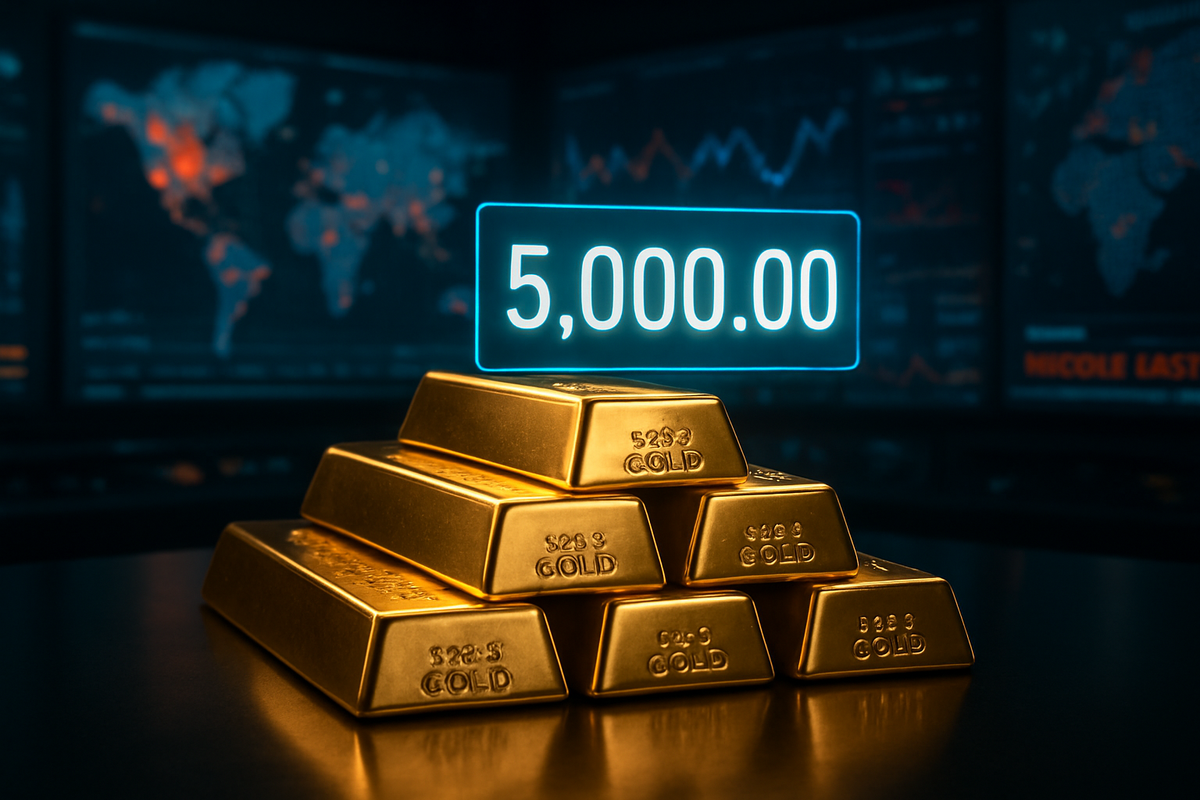
In a historic milestone that has sent shockwaves through global financial markets, the price of spot gold officially breached the $5,000 per ounce mark during early morning trading on February 19, 2026. The surge represents a psychological and economic watershed moment, as the "ultimate safe haven" has nearly doubled in value in less than two years. This unprecedented rally is being driven by a "perfect storm" of escalating geopolitical tensions in the Middle East and a structural shift in global finance that has seen gold rise in tandem with a strengthening U.S. dollar—a phenomenon rarely seen in modern market history.
The immediate implications are profound: central banks are scrambling to revalue their reserves, while retail investors have flooded precious metals exchanges, causing widespread shortages of physical bullion. As the $5,000 barrier fell, the SPDR Gold Shares (NYSEARCA:GLD) saw record-breaking intraday volume, reflecting a massive shift in institutional capital allocation. Analysts suggest that the breach of this historic level marks the beginning of a new "Gold Era," where the metal is no longer viewed merely as an inflation hedge, but as a primary global settlement asset.
A Convergence of Crises: The Road to $5,000
The catalyst for the final push above $5,000 was a dramatic escalation of hostilities in the Persian Gulf. Reports of a direct naval confrontation near the Strait of Hormuz, involving U.S. carrier strike groups and Iranian fast-attack craft, triggered a 4% intraday spike on February 18, leading into today's record high. This followed a breakdown in diplomatic negotiations in Geneva regarding the ongoing Ukraine-Russia conflict, which has entered a volatile new phase involving long-range strategic assets. The geopolitical "risk premium" on gold, which had hovered around $500 throughout 2025, effectively doubled overnight as markets priced in the possibility of a major regional or even global conflict.
This rally did not happen in a vacuum. Since late 2024, a "structural re-rating" of gold has been underway. Starting in February 2025, when gold first crossed $3,000, central banks—led by the People’s Bank of China and the Reserve Bank of India—began an aggressive diversification campaign away from U.S. Treasuries. By early 2026, these institutions had collectively purchased over 1,200 tonnes of gold for the third consecutive year. Furthermore, the traditional inverse correlation between gold and the U.S. Dollar Index (DXY) has fractured. Both assets have risen together as investors flee "systemic anxiety" regarding the massive U.S. national debt and the perceived erosion of Federal Reserve independence.
The timeline of this ascent has been remarkably steep. In January 2025, gold was trading at approximately $2,850. By July 2025, it reached $3,500 following a series of disappointing U.S. jobs reports and a pivot by the Federal Reserve toward aggressive rate cuts to stave off a cooling economy. The momentum became unstoppable in late 2025 as Western institutional investors, who had been net sellers of gold for years, returned to the market in droves. Today’s breach of $5,000 is the culmination of eighteen months of relentless accumulation by both sovereign states and private wealth offices.
The Gilded Winners and the Industrial Losers
The primary beneficiaries of this price explosion are the world’s largest gold mining corporations, which are now generating unprecedented levels of free cash flow. Newmont (NYSE: NEM), the world’s largest gold producer, has seen its margins expand to historic levels. With an All-In Sustaining Cost (AISC) hovering around $1,760 per ounce, Newmont is effectively generating over $3,000 in profit for every ounce pulled from the ground. Similarly, Agnico Eagle Mines (NYSE: AEM) has emerged as a sector favorite due to its lower cost profile and focus on low-risk jurisdictions, reporting record quarterly cash flows that have enabled significant dividend hikes and share buybacks.
Barrick Gold (NYSE: GOLD) has also capitalized on the rally, recently announcing plans to spin off its North American assets into a separate entity to maximize shareholder value. However, the windfall for miners is partially offset by rising royalty payments and the increasing cost of energy and labor, which are also being driven higher by the same geopolitical tensions fueling the gold price. Franco-Nevada (NYSE: FNV), a leading royalty and streaming company, has seen its stock price soar as it captures the upside of $5,000 gold without the direct operational risks and inflationary pressures faced by traditional miners.
On the other side of the ledger, the "Golden Squeeze" is hitting industrial users and luxury retailers hard. Apple (NASDAQ: AAPL) and other high-end electronics manufacturers are facing rising "Bill of Materials" (BOM) costs, as gold is a critical component in semiconductor packaging and high-conductivity circuitry. Analysts estimate that the surge to $5,000 could add up to $60 to the manufacturing cost of a flagship smartphone. Meanwhile, jewelry giant Signet Jewelers (NYSE: SIG) has reported a significant drop in sales volume as "sticker shock" deters middle-market consumers. Many retailers are being forced to pivot toward 10-karat gold or silver alternatives to maintain price points, as a standard 18-karat wedding band has now become a luxury inaccessible to many.
Broader Significance and Historical Precedents
The breach of $5,000 per ounce is more than just a price milestone; it signifies a potential shift in the global monetary order. Historically, gold’s greatest rallies have occurred during periods of deep mistrust in fiat currency or extreme geopolitical instability, such as the late 1970s. However, the current environment is unique because gold is rising alongside the U.S. dollar. This suggests that the market is no longer betting against the dollar specifically, but against the entire "central bank era" of debt-fueled growth. Gold is being re-monetized in real-time as a hedge against a systemic failure of the global financial architecture.
This event mirrors the 1971 "Nixon Shock" when the U.S. moved off the gold standard, but in reverse. Today, the world appears to be moving toward a "de facto" gold standard, where gold serves as the only neutral reserve asset that cannot be sanctioned or devalued by a single government. Regulatory bodies are already taking note; there are growing discussions in the Eurozone and among BRICS+ nations about creating new settlement mechanisms backed by physical gold. This could have long-term ripple effects on the liquidity of the U.S. Treasury market, as the world’s "risk-free" asset is increasingly seen as being gold rather than government debt.
The Road Ahead: $7,000 or a Volatile Peak?
As the dust settles on the $5,000 milestone, the debate has shifted to how much higher the "Yellow Metal" can climb. Some of the most respected voices on Wall Street have revised their targets upward. Analysts at J.P. Morgan and Bank of America suggest that if central bank demand remains at current levels and private wealth allocation to gold moves from 2% toward 5%, a price of $7,000 is mathematically probable by early 2027. More aggressive forecasts, such as those from Saxo Bank, suggest that a "Black Swan" event—such as a major cyber-attack on digital financial infrastructure or a collapse of the sovereign debt market—could push gold toward $10,000.
However, the market should prepare for extreme volatility. A price of $5,000 acts as a massive incentive for "scrap gold" to flood the market, as individuals sell heirlooms and jewelry to capitalize on the high prices. Furthermore, if the Federal Reserve is forced to raise interest rates back toward 6% or 7% to combat the secondary inflationary effects of high energy and gold prices, the "opportunity cost" of holding gold could finally trigger a major correction. Investors should watch for any signs of de-escalation in the Middle East, as a "peace dividend" could quickly shave hundreds of dollars off the gold price.
Summary and Market Outlook
The ascent of gold to $5,000 per ounce on February 19, 2026, marks the end of an era of low-volatility precious metals trading. It is a stark reflection of a world grappling with deep-seated geopolitical divisions, unsustainable debt levels, and a fundamental questioning of the fiat money system. While gold miners like Newmont and Barrick Gold are currently in a "golden age" of profitability, the broader economy is beginning to feel the inflationary pressure of the metal’s rise.
Investors should remain vigilant. In the coming months, the key indicators to watch will be the volume of central bank purchases, the stability of the Strait of Hormuz, and any shifts in U.S. fiscal policy. While the momentum is clearly on the side of the bulls, the $5,000 level is uncharted territory that will likely invite both massive speculative inflows and significant profit-taking. Whether gold is headed for $10,000 or a sharp retracement, one thing is certain: the global financial landscape has been permanently altered by today's historic surge.
This content is intended for informational purposes only and is not financial advice