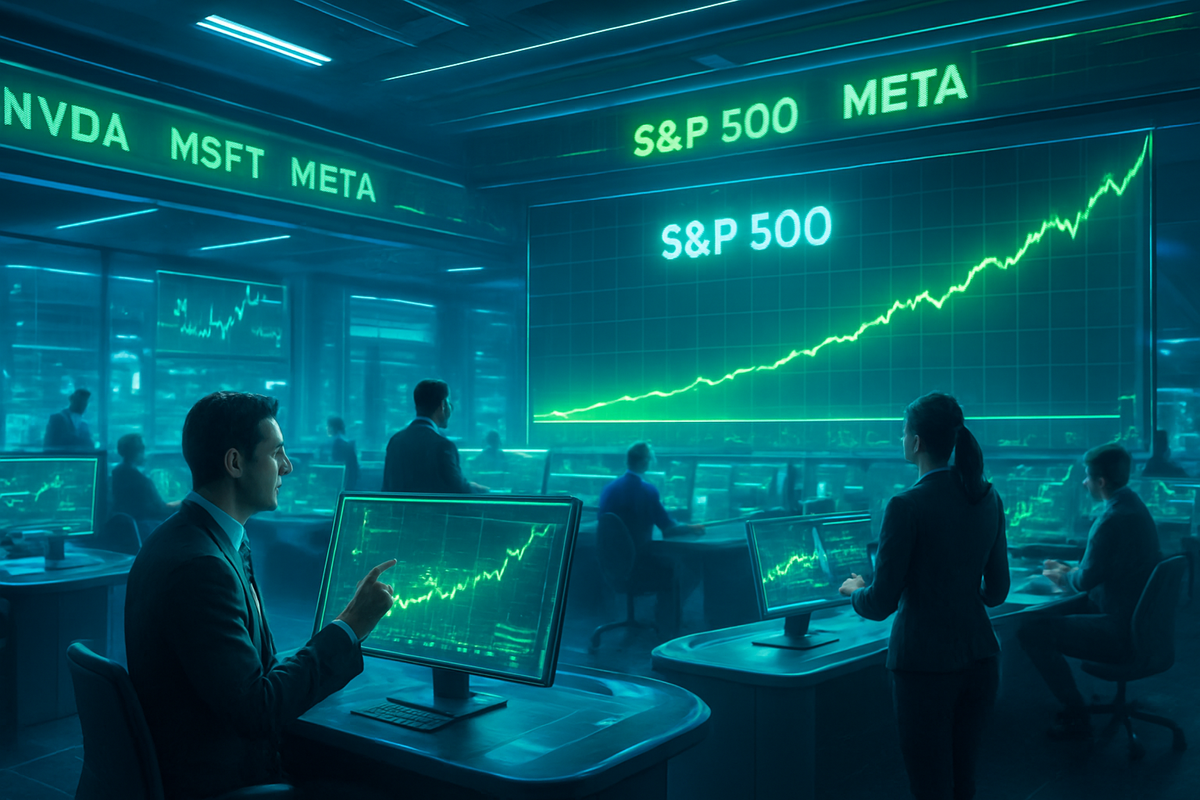
Equities rallied on Wednesday as a powerful rebound in megacap technology stocks and a robust slate of corporate earnings propelled major indices higher. The S&P 500 finished the day just 1.4% shy of its record closing high, fueled by investor optimism that the "Infrastructure Reset" of 2026—characterized by massive autonomous AI spending—is finally beginning to yield tangible bottom-line results for the world’s largest companies.
The day’s gains were broad-based but led by the Nasdaq Composite, which outpaced its peers as dip-buyers returned to the semiconductor and software sectors. With the Federal Reserve currently in a "wait-and-see" pause following the January policy meeting, market participants appear increasingly comfortable with a "higher-for-longer" rate environment, provided that corporate productivity continues to scale through agentic AI integration.
Markets Rebound as Earnings Momentum Ignites Growth Stocks
The trading session on February 18, 2026, was defined by a steady climb from the opening bell. The Dow Jones Industrial Average (DJI) rose approximately 222 points, or 0.5%, while the S&P 500 (SPX) climbed 0.6%. The tech-heavy Nasdaq Composite (IXIC) led the charge, finishing 0.8% higher. This upward move follows a period of localized volatility earlier in the month, as investors grappled with sticky inflation data and uncertainty regarding the transition of leadership at the Federal Reserve.
The primary catalyst for Wednesday’s strength was a series of better-than-expected quarterly reports from the enterprise software and hardware sectors. Analysts noted that the "empty capex" fears that haunted the market in late 2025 have begun to dissipate. Instead, the focus has shifted to the successful deployment of "Agentic AI"—autonomous systems capable of handling complex workflows—which is driving a reported 25% productivity boost in logistics and manufacturing sectors. As these efficiencies manifest in corporate margins, the S&P 500 has moved within 1.4% of its all-time high, a level not seen since the peak of the late-2025 rally.
Tech Giants and Infrastructure Players Lead the Charge
The day's winners were dominated by the heavyweights of the "Infrastructure Reset." NVIDIA Corporation (NASDAQ: NVDA) saw its shares climb nearly 2% as anticipation builds for its upcoming pipeline updates regarding the "Rubin" platform. Similarly, Meta Platforms, Inc. (NASDAQ: META) continued its February hot streak, with investors applauding the company’s ability to prove that its multi-billion dollar AI investments are directly translating into record-high ad conversion rates.
On the software side, Microsoft Corporation (NASDAQ: MSFT) and Alphabet Inc. (NASDAQ: GOOGL) both saw modest gains as they navigated the high-capital-expenditure environment. While Alphabet had previously faced pressure over its $175 billion infrastructure spend, today's move suggests the market is beginning to price in the long-term defensive moat created by such investments. Conversely, the traditional retail sector lagged slightly, as Amazon.com, Inc. (NASDAQ: AMZN) faced neutral sentiment despite a strong AWS showing, as investors remain wary of the massive $200 billion capex guidance for the remainder of the year.
A New Chapter in the Post-Inflationary Bull Market
The current market rally sits at a fascinating intersection of historical cycles and technological revolution. Today’s performance mirrors the "26-year cycle" often cited by technical analysts, drawing parallels to the late-1990s productivity boom. However, unlike the dot-com era, the 2026 rally is supported by double-digit earnings growth for the fifth consecutive quarter across the S&P 500. This fundamental backing has allowed the market to absorb a Federal Funds rate that remains steady at 3.50%–3.75%.
The broader significance of this move toward an all-time high lies in the "broadening" of the market. While tech led today, sectors such as industrials and materials have also shown resilience, acting as a hedge against the 35% recession probability forecasted for later in the year. The looming nomination of Kevin Warsh to succeed Jerome Powell as Fed Chair in May has introduced a layer of policy uncertainty, but for now, the market is choosing to focus on the "Real Economy" benefits of the AI transition rather than the potential for hawkish shifts in monetary policy.
The Road to 7,000: What Lies Ahead for Investors
Looking forward, the path for the S&P 500 toward the psychologically significant 7,000 level appears clear, though not without hurdles. The release of the FOMC Meeting Minutes tomorrow, February 19, will be a critical litmus test for market sentiment. Investors will be scouring the notes for any indication of how "sticky" the Fed perceives current inflation to be, especially with the PCE Price Index data looming on February 26.
In the short term, strategic pivots are expected as companies move from building AI infrastructure to monetizing it. The "Physical AI" trend—the convergence of robotics and autonomous agents—is likely to provide the next leg of growth for industrial giants. However, the market remains "fragile" to geopolitical shocks, particularly the ongoing trade tensions between the EU and China over industrial overcapacity. Investors should remain vigilant for a potential Q2 correction, which historically follows the type of strength seen in mid-February.
Market Wrap-Up: Bullish Sentiment Prevails
As the closing bell rang on February 18, 2026, the sentiment on the floor was one of cautious exuberance. The S&P 500’s proximity to its all-time high suggests that the bull market, which many feared would stall in 2025, has found a second wind. The combination of massive corporate investment and a stabilized interest rate environment has created a "Goldilocks" scenario for the time being—neither too hot to trigger aggressive Fed tightening, nor too cold to signal a recession.
Moving forward, the key indicators to watch will be the magnitude of earnings "beats" and the guidance provided for the second half of 2026. While the "Magnificent Seven" continue to provide the index's backbone, the long-term health of this rally will depend on the continued participation of the "Other 493" companies. For now, Wall Street remains in a "buy-the-dip" mentality, waiting to see if the S&P 500 can finally shatter its previous ceiling and claim a new historical peak.
This content is intended for informational purposes only and is not financial advice.