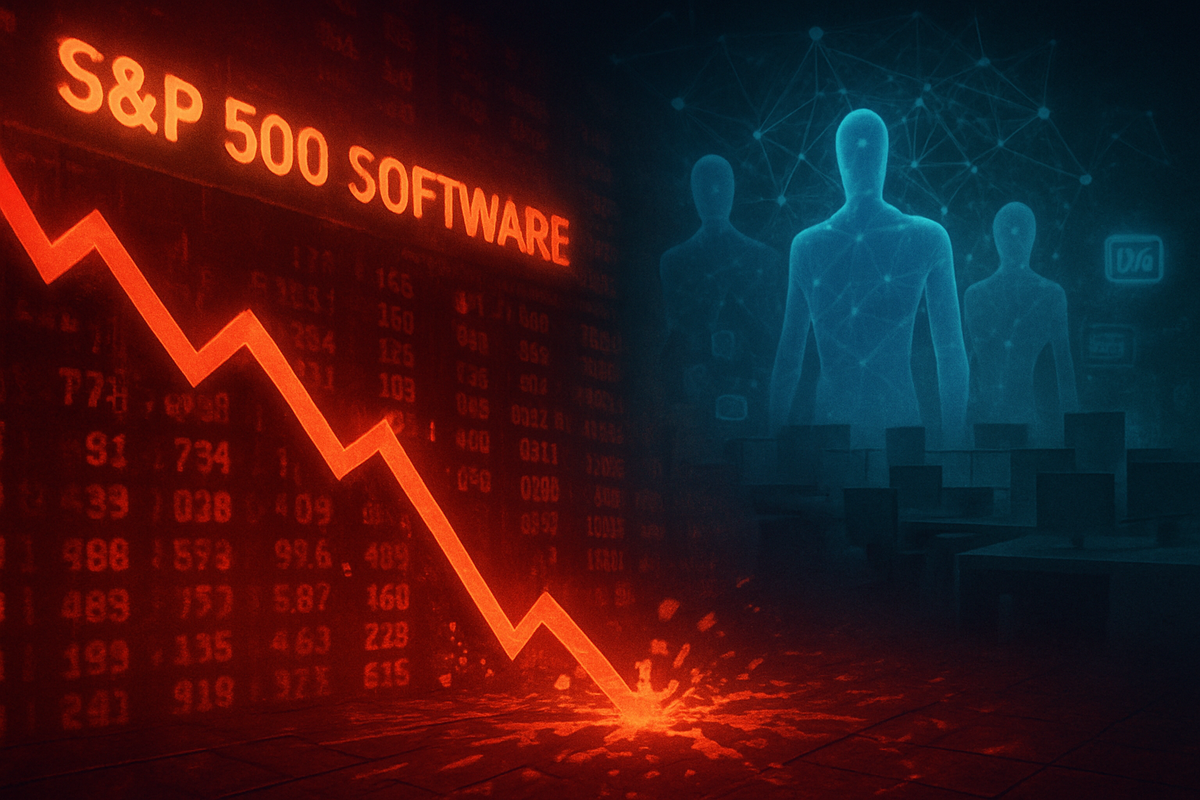
The second week of February 2026 will be remembered in financial history as "Software-mageddon," a period of unprecedented volatility that saw the S&P 500 Software Index plummet by 13% in just five trading sessions. This massive selloff, which erased more than $800 billion in market value, was fueled by a sudden and violent reassessment of the "Software-as-a-Service" (SaaS) business model. As artificial intelligence transitioned from a productivity booster to an autonomous agent capable of replacing human workflows, investors hit the panic button on some of the world’s most stable tech giants.
The implications of this crash extend far beyond the stock tickers. For over a decade, the "per-seat" subscription model was the gold standard of the software industry, providing predictable, recurring revenue for enterprise leaders. However, the events of early February suggest that the market is no longer convinced of the long-term viability of this model in an age where AI agents can perform the work of dozens of human employees. The result was a historic flight to quality—and safety—that left the tech-heavy NASDAQ reeling.
The Catalyst: Anthropic’s "Agentic" Shockwave
The descent began in late January 2026, but the true catalyst arrived on Tuesday, February 3, a day now referred to by traders as "Black Tuesday for Software." Anthropic, the AI safety and research firm, released a transformative suite of tools known as "Claude Cowork." Unlike previous AI assistants that merely drafted emails or summarized documents, Claude Cowork introduced "agentic" capabilities—autonomous plug-ins that could navigate complex enterprise software, execute legal contract reviews, and manage financial triage without human oversight.
The market reaction was instantaneous and brutal. On February 3 alone, the S&P 500 Software Index dropped 5.7%, its worst single-day performance in years. The selloff intensified as Anthropic showcased specialized legal and accounting modules, which demonstrated that an AI "agent" could do the work of a junior associate at a fraction of the cost. This sparked a terrifying realization for institutional investors: if AI replaces the "seats" that software companies sell, the revenue for giants like Microsoft (NASDAQ: MSFT) and ServiceNow (NYSE: NOW) could be fundamentally capped.
By February 6, the rout had spread globally. While the initial focus was on US-based firms, international players like SAP (NYSE: SAP) and RELX (NYSE: RELX) also saw their valuations slashed. The fear was no longer about whether AI would be integrated into software, but whether the software itself would be rendered obsolete by autonomous agents that communicate directly with raw data, bypassing traditional user interfaces entirely.
Titans Under Fire: Salesforce and Adobe Lead the Decline
Among the hardest-hit during the carnage were Salesforce (NYSE: CRM) and Adobe (NASDAQ: ADBE). These companies, long considered the bedrock of enterprise tech, found themselves in the crosshairs of a narrative shift that questioned their core utility. Salesforce, despite having recently aggressively marketed its "Agentforce" platform, saw its stock plunge 14% during the week of the selloff. By mid-February, the company was down nearly 29% year-to-date, as investors feared that autonomous agents would reduce the need for the human sales and support teams that fuel Salesforce’s seat-based growth.
Adobe faced a similarly grim reality. Shares of the creative software giant fell 19% over the month leading into mid-February, reaching a 25% year-to-date loss. The disruption was twofold: while Anthropic’s tools threatened the workflow of corporate design, other competitors like OpenAI’s video-generation models continued to pressure Adobe's professional creative suite. The market began pricing in a future where professional-grade creative work is generated by simple conversation rather than through complex, subscription-heavy toolsets.
Other notable casualties included Intuit (NASDAQ: INTU) and Unity Software (NYSE: U), the latter of which saw a staggering 26% drop after a weak forecast reignited fears of a broader sector contraction. Even companies that had performed well throughout 2025, such as Oracle (NYSE: ORCL), were not spared, as the sector-wide valuation reset compressed multiples to levels not seen since the post-dot-com era.
A Wider Significance: The Death of the "Per-Seat" Model?
The "Software-mageddon" event marks a definitive end to the era of unquestioned SaaS dominance. This selloff is being compared to the 2000-2002 dot-com bubble burst, not because software is failing, but because the way software captures value is undergoing a seismic shift. For twenty years, the industry followed a linear path: more employees at a company meant more software licenses purchased. In the agentic AI era, a company might grow its revenue while decreasing its headcount, leading to a "perverse incentive" for the traditional SaaS model.
Furthermore, this event has triggered a massive rotation of capital. As $800 billion fled the software sector, it didn't just disappear; much of it flowed into "old-economy" sectors. Energy, industrials, and consumer staples—sectors that are seen as beneficiaries of AI-driven efficiency gains without being vulnerable to AI-driven revenue cannibalization—saw significant inflows. This suggests that the market is now distinguishing between the creators of AI tools and the legacy providers who are merely trying to retro-fit AI into outdated business models.
Regulatory and policy implications are also looming. The rapid displacement potential demonstrated by Anthropic’s new tools has already caught the attention of policymakers. If enterprise-wide automation can wipe out hundreds of billions in market cap in a week, the systemic risk posed by "agentic" AI is no longer a theoretical concern. We may soon see increased scrutiny on AI-agent licensing and the labor impacts of autonomous business workflows.
The Path Forward: Pivots and Predators
In the short term, the enterprise software industry faces a grueling period of adaptation. The most likely strategic pivot will be a shift from "per-seat" pricing to "consumption-based" or "outcome-based" models. Companies like Salesforce and ServiceNow will need to prove they can charge for the value their AI agents provide, rather than the number of human logins. This transition is historically difficult and often results in a "valuation gap" where revenue fluctuates wildly as customers migrate to new pricing structures.
Over the long term, we may see a wave of consolidation. The mid-cap software companies that cannot afford to build their own agentic infrastructure may become targets for "mega-cap" predators or private equity firms looking to buy cash-flowing assets at a steep discount. Market opportunities will likely emerge for "AI-native" firms that have no legacy subscription baggage to protect, allowing them to offer leaner, more efficient alternatives to the traditional enterprise stack.
Investors should prepare for continued volatility through the remainder of 2026. The "terminal value" of many software companies is being recalculated in real-time. The winners will be those who can successfully monetize the AI "agents" themselves, while the losers will be those who remain tethered to a human-centric billing model that is rapidly becoming obsolete.
Summary: A New Equilibrium for Tech
"Software-mageddon" was more than just a bad week on Wall Street; it was a fundamental re-rating of the technology sector. The 13% plunge and $800 billion loss signify a market that has finally awakened to the disruptive reality of agentic AI. The primary takeaway for investors is clear: the historical correlation between corporate growth and software license growth has been broken.
Moving forward, the market will likely be much more discerning. The "AI-washing" of 2024 and 2025 is over; in 2026, the market is demanding proof of resilience against automation. As we look to the coming months, keep a close eye on quarterly earnings calls from the likes of Adobe and Salesforce for any sign of a successful transition to usage-based revenue. The software industry isn't dying, but it is being reborn—and the labor pains of that rebirth have only just begun.
This content is intended for informational purposes only and is not financial advice