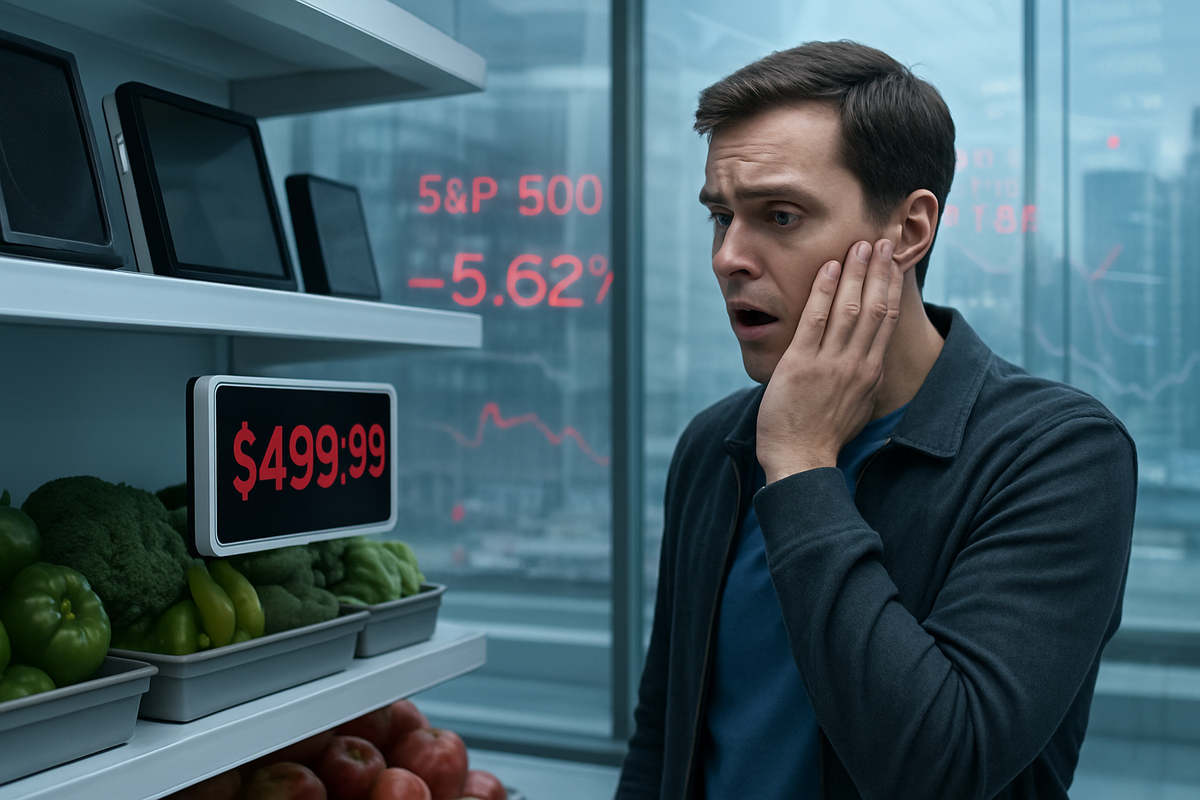
As of February 13, 2026, the American consumer is signaling a profound state of distress that stands in stark contrast to the resilient spending patterns seen just two years ago. The latest reading of the University of Michigan’s Consumer Sentiment Index has plummeted to 57.3, its lowest level in over a decade, while the Conference Board’s Consumer Confidence Index dropped to 84.5 in January. This sharp downturn is primarily driven by "shelf shock"—a sudden spike in the cost of household goods following the implementation of sweeping 25% tariffs on imports from Canada, Mexico, and China earlier this year.
The immediate implications for the stock market are palpable, with the CNN Fear & Greed Index sliding into "Fear" territory at 36.87. While broader economic indicators like GDP growth remained surprisingly high at 4.4% in the final quarter of 2025, the "psychological recession" currently gripping households suggests a looming contraction in discretionary spending. For Wall Street, the focus has shifted from the Federal Reserve's interest rate path to the volatile intersection of trade policy and consumer psychology, leaving investors in a state of cautious indecision.
A Timeline of Turbulence: From Resilience to Retrenchment
The erosion of consumer trust did not happen overnight. In early 2024, the U.S. consumer was remarkably upbeat; the Conference Board’s index sat at a comfortable 110.9 in January 2024 as inflation appeared to be cooling. However, throughout 2025, a series of systemic shocks began to chip away at this foundation. A historic 43-day government shutdown in late 2025 disrupted federal paychecks and public services, leading to a stagnant retail sales report in December 2025 (0.0% growth). By the time the new year arrived, the introduction of aggressive trade tariffs served as the final catalyst for a sentiment freefall.
The current atmosphere is defined by what economists are calling a "sentiment chasm." Recent data highlights a radical partisan divide in economic perception: Republican-leaning consumers report a "boom-time" confidence level of 120, optimistic about long-term domestic industrial revitalization. Conversely, Democratic and Independent respondents have seen their confidence crater to 70, citing the immediate impact of rising costs for produce, electronics, and automotive parts. This 50-point gap is the largest ever recorded, complicating the efforts of retailers to forecast demand across different regional demographics.
Key stakeholders, including the American Association of Individual Investors (AAII), report a market that is essentially split down the middle. The latest AAII survey for the week ending February 11, 2026, shows 38.5% bulls and 38.1% bears. This "sentiment schism" reflects a market waiting for the next Consumer Price Index (CPI) release to determine if the 2.4% inflation rate will hold or if the "shelf shock" from tariffs will trigger a secondary inflationary spike.
The industry reaction has been one of defensive positioning. Institutional traders are closely watching the Relative Strength Index (RSI) for the S&P 500, which currently hovers near 50. This technical neutrality suggests that while retail investors are fearful, institutional money is staying on the sidelines, waiting to see if the drop in "soft data" (sentiment) eventually drags down "hard data" (corporate earnings and employment).
Winners and Losers in the Age of Anxiety
In this environment of heightened price sensitivity, the retail sector is undergoing a massive realignment. Historically, deep discounters like Walmart Inc. (NYSE: WMT) and Costco Wholesale Corporation (NASDAQ: COST) tend to thrive as consumers trade down from premium brands. Walmart, in particular, is positioned to leverage its massive supply chain to absorb some tariff costs, potentially gaining market share from smaller competitors who lack the margin flexibility to keep prices stable. Similarly, Dollar General Corporation (NYSE: DG) may see a surge in traffic as lower-income households struggle with the 25% price hikes on imported essentials.
Conversely, the automotive and high-end consumer electronics sectors are facing significant headwinds. Ford Motor Company (NYSE: F) and General Motors Company (NYSE: GM) are highly susceptible to the new 25% tariffs on Mexican-made components and finished vehicles. With auto loan rates still elevated from the previous year’s tightening cycle, the added burden of tariff-driven price increases could lead to a dramatic slowdown in new car sales. Investors have already begun pricing in these risks, with both stocks underperforming the broader index since the start of the year.
Tech giants like Apple Inc. (NASDAQ: AAPL) are also in the crosshairs. With a significant portion of its hardware assembly still reliant on Chinese infrastructure, the 25% tariff poses a direct threat to margins or retail pricing. While Amazon.com, Inc. (NASDAQ: AMZN) benefits from its diverse revenue streams, its third-party marketplace—heavily populated by sellers of Chinese-manufactured goods—faces a "inventory crisis" as sellers struggle to pass on costs without losing volume.
The Psychological Recession and Historical Precedents
The current situation fits into a broader trend of "geopolitical volatility" replacing "monetary policy" as the primary driver of market sentiment. We are seeing a shift from the 2022-2023 era, where the Federal Reserve was the main protagonist, to a 2026 landscape dominated by trade protectionism and fiscal uncertainty. This event mirrors the "Stagflationary" fears of the 1970s, but with a modern twist: the labor market remains relatively tight, yet consumers feel poorer due to the rapid change in the cost of living.
The "sentiment chasm" also signals a breakdown in traditional economic forecasting. When consumer confidence is driven more by political affiliation than by actual bank balances, standard metrics like the "Expectations Index" become harder to interpret. However, the current Expectations Index reading of 65.1 is well below the threshold of 80 that has historically signaled a recession within six to twelve months. If history is any guide, the gap between high GDP and low confidence will eventually close, often with the hard data "catching down" to the sentiment.
Regulatory and policy implications are significant as the current administration faces pressure to mitigate the "shelf shock." There is growing talk on Capitol Hill about targeted subsidies or tax credits for domestic manufacturers to offset tariff costs, but such measures take years to implement. In the meantime, the ripple effects are being felt by international partners in Canada and Mexico, who are already seeing their own domestic currencies fluctuate wildly against the dollar in response to the US trade stance.
Looking Ahead: Strategic Pivots and Scenarios
In the short term, the market is bracing for the mid-February CPI report. If inflation shows even a minor uptick, it could validate the "sticky inflation" narrative and lead to a further sell-off in growth stocks. Long-term, however, the primary challenge for public companies will be supply chain reshoring. Corporations that have already diversified their manufacturing away from tariff-heavy regions will emerge as the new "safe havens" for investors.
Market opportunities may emerge in the "Onshoring" sector. Companies involved in industrial automation and US-based logistics, such as Rockwell Automation, Inc. (NYSE: ROK), could see increased demand as retailers and manufacturers look to bypass international trade hurdles. This strategic pivot requires significant capital expenditure, but for companies with strong balance sheets, it represents a chance to build a more resilient, tariff-proof business model for the late 2020s.
Potential scenarios range from a "Soft Landing 2.0," where consumer sentiment recovers as trade negotiations stabilize, to a "Hard Reality" scenario. In the latter, the sustained low confidence leads to a self-fulfilling prophecy: consumers stop spending, leading to inventory gluts, followed by layoffs in the retail and manufacturing sectors, finally dragging the US into a formal recession by late 2026.
Navigating the Sentiment Storm
The key takeaway for the early 2026 market is that the "soft data" is shouting a warning that the "hard data" has yet to acknowledge. The 12-year low in consumer sentiment, fueled by the "shelf shock" of 25% tariffs and a deep partisan divide, suggests that the American consumer is at a breaking point. While the stock market remains in a state of "fearful neutrality," the divergence between corporate earnings and household outlook is a tension that cannot persist indefinitely.
Moving forward, investors should prioritize defensive positions in companies with pricing power and domestic supply chains. The days of relying on cheap global imports to drive retail margins are, at least temporarily, over. Monitoring the "Expectations Index" will be crucial; if it remains below 70 for the next two quarters, the likelihood of a significant market correction increases substantially.
As we move through the first quarter of 2026, the resilience of the US consumer will be tested like never before. Investors should watch for any signs of "expenditure fatigue" in upcoming quarterly reports from major retailers. The sentiment may be low, but the ultimate direction of the market will be determined by whether the American shopper continues to open their wallet or finally decides to close it in protest of the new economic reality.
This content is intended for informational purposes only and is not financial advice.