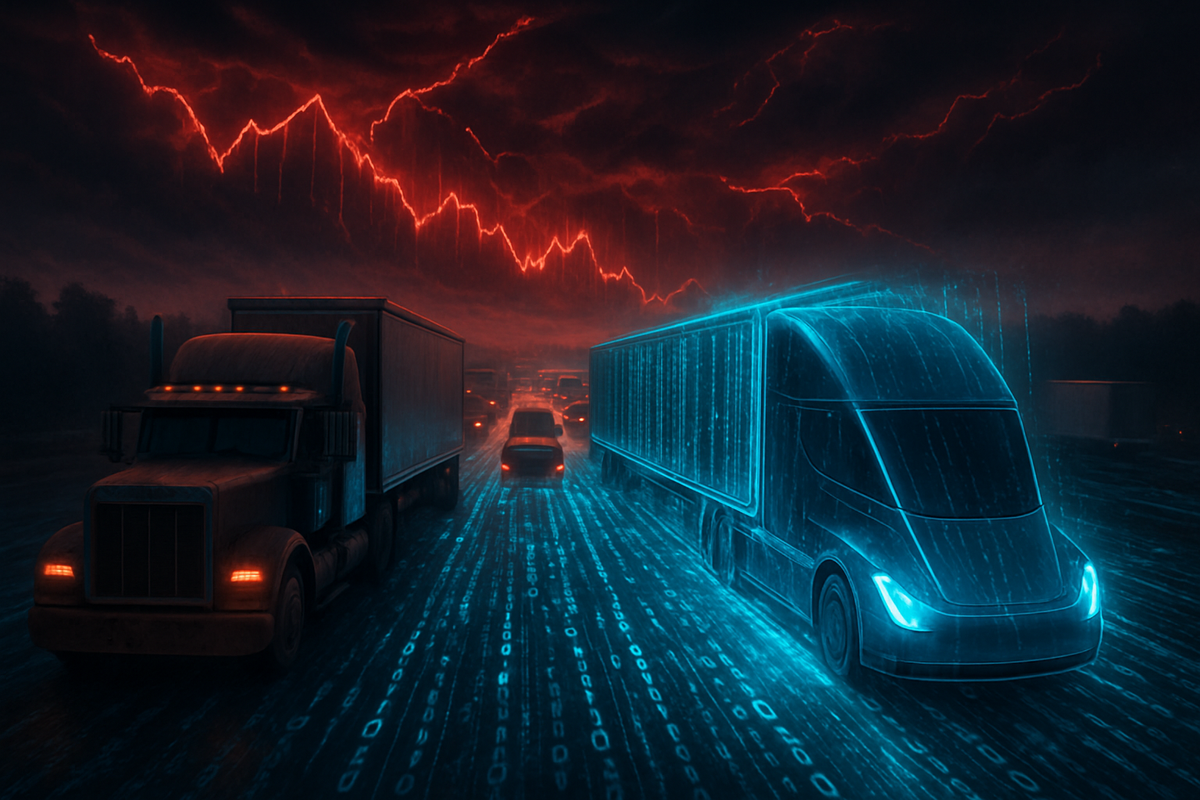
The U.S. trucking and logistics sector is reeling this morning following a brutal 48-hour sell-off that has been described by market analysts as a "Category 5" level of industry paranoia. What began as a technical white paper release on February 12, 2026, by a relatively obscure tech firm has transformed into a full-scale rout for legacy freight powerhouses. As of today, February 13, 2026, the industry is grappling with a fundamental question: Has the age of the traditional freight broker officially met its "AI Grim Reaper"?
The catalyst for this unprecedented market movement was the unveiling of a new AI-driven orchestration platform by Algorhythm Holdings (NASDAQ: RIME). The company, which recently completed a total strategic pivot away from consumer electronics, released data suggesting its platform could effectively automate the core functions of freight brokerage at a scale previously thought impossible. The resulting shockwave saw double-digit percentage drops in the share prices of industry titans, erasing billions in market capitalization in a matter of hours and signaling a potential paradigm shift in how goods move across the American highway system.
The 'Apex' Moment: A White Paper Triggers a Rout
The chaos was ignited yesterday when Algorhythm Holdings released a detailed performance report for its SemiCab and Apex SaaS platforms. The data was nothing short of revolutionary: the company claimed that in live U.S. deployments, the AI tool allowed logistics operators to scale freight volumes by 300% to 400% without adding a single member of staff. Even more jarring for Wall Street was the efficiency metric: Algorhythm’s AI enabled individual operators to manage over 2,000 loads annually—dwarfing the long-standing industry standard of roughly 500 loads per broker.
This technological leap targets the "empty mile" problem—the efficiency vacuum where trucks drive without cargo. Algorhythm reported its platform could slash these empty miles by over 70%, potentially recapturing hundreds of billions in lost industry value. The irony of the situation was not lost on traders; Algorhythm, formerly known as The Singing Machine Company, had only recently exited the karaoke business, selling those assets to Stingray Group Inc. (TSX: RAY.A) in 2025 to focus entirely on logistics AI.
By mid-afternoon on February 12, the Russell 3000 Trucking Index was in freefall. The panic was fueled by a "shoot first, ask questions later" mentality that has characterized the 2026 market, as investors increasingly fear that AI is no longer just an efficiency tool, but a business model destroyer. Analysts noted that the speed of the sell-off was exacerbated by the sector’s historical reliance on human-intensive brokerage desks—a model that now appears dangerously vulnerable to Algorhythm’s "automated orchestration."
Winners and Losers: A Tale of Two Tickers
The immediate "losers" in this shift were the asset-light brokerage giants that have dominated the middle-man economy for decades. C.H. Robinson Worldwide, Inc. (NASDAQ: CHRW) saw its stock plummet by as much as 24% intraday before closing down nearly 15%. Landstar System, Inc. (NASDAQ: LSTR), known for its vast network of independent agents, recorded its worst single-day performance in history, dropping 16%. The sell-off was even more severe for RXO Inc. (NYSE: RXO), which fell 20.5% as investors questioned whether its own "tech-forward" brokerage model could compete with the raw efficiency of the Algorhythm platform.
Even asset-heavy carriers, which own their own fleets, were not immune. J.B. Hunt Transport Services, Inc. (NASDAQ: JBHT) saw its shares slide 9%, as the market realized that even with physical trucks, the ability to price and route those trucks using superior AI would dictate future profit margins. The contagion even spread across the Atlantic, dragging down European logistics leaders like DHL Group (XETRA: DHL) and DSV A/S (CPH: DSV), both of which saw declines between 5% and 11%.
On the flip side, Algorhythm Holdings (NASDAQ: RIME) saw its own stock price surge nearly 30% in a single session. While the company’s market capitalization remains a fraction of the giants it has disrupted, the "David vs. Goliath" narrative has captured the imagination of retail and institutional investors alike. For Algorhythm, the win is not just in its stock price, but in the immediate validation of its SaaS model as it seeks to license its technology to the very companies it is currently devaluing.
The 'Category 5' Paranoia: A Broader Industry Crisis
The phrase "Category 5 level of paranoia," coined by Joseph Shaposhnik of Rainwater Equity, accurately captures the existential dread now permeating the logistics world. This event fits into a broader 2026 trend—often dubbed "Software-mageddon"—where AI platforms are moving from creative tasks to deep industrial processes. In the trucking industry, the fear is "disintermediation": the possibility that AI will connect shippers directly to carriers with such precision that the traditional broker becomes obsolete.
Historically, the logistics industry has survived technological shifts by absorbing them, but the Algorhythm sell-off feels different. Unlike the gradual adoption of GPS or Electronic Logging Devices (ELDs), this AI shift targets the high-margin "brains" of the operation rather than the "muscles." If a $6 million micro-cap can prove that its algorithms can outperform the institutional knowledge of a legacy firm like C.H. Robinson, the "moats" of proprietary data and established relationships may be thinner than previously believed.
Regulatory eyes are also beginning to turn toward this disruption. With the potential for AI to drastically reduce the number of people required to manage the nation's freight, labor unions and transport policymakers are raising concerns about the future of work in the logistics sector. However, the environmental "win" of reducing empty miles by 70% provides a powerful ESG (Environmental, Social, and Governance) counter-narrative that may make it difficult for regulators to stifle the technology’s growth.
What Comes Next: Pivot or Perish?
In the short term, the market expects a period of extreme volatility as the "scare trade" settles. We are likely to see a wave of defensive M&A (mergers and acquisitions), as legacy players like Expeditors International of Washington, Inc. (NASDAQ: EXPD)—which fell 13% in the wake of the news—look to acquire AI startups to bolster their internal tech stacks. The strategic pivot required is no longer optional; every major logistics firm must now demonstrate a credible "AI-first" roadmap or face permanent valuation compression.
Long-term, the industry may split into two camps: the "Orchestrators" and the "Haulers." The orchestrators will be pure-play tech platforms like Algorhythm’s Apex, while the haulers will be those who own the physical assets and provide the "boots on the ground." The middle ground—the manual freight brokerage—is where the greatest risk lies. We may see the emergence of a "unified freight grid," where AI platforms manage the entire national fleet as a single, optimized entity.
Market opportunities will emerge for those who can integrate these AI tools into existing physical networks. Investors should watch for partnership announcements between the "Big Three" trucking firms and AI developers. If a company like C.H. Robinson can successfully integrate an Algorhythm-style efficiency gain into its existing $20 billion network, the rebound could be just as dramatic as the sell-off.
A New Reality for Logistics Investors
The events of February 12 and 13, 2026, will likely be remembered as the moment the logistics industry’s "digital transformation" turned into "digital disruption." The massive sell-off of C.H. Robinson and Landstar serves as a stark warning: in the AI era, size and history are no longer guaranteed protections against technological obsolescence. The "Category 5" paranoia reflects a market that has finally recognized the destructive potential of hyper-efficient algorithms.
Moving forward, the market will demand more than just "AI-lite" features. Investors will be looking for hard data on load-to-broker ratios, empty mile reductions, and headcount efficiency. The era of the labor-intensive brokerage desk is under siege, and the companies that survive will be those that embrace the very technology currently causing their stocks to tank.
For investors, the coming months will require a discerning eye. Watch for the "bounce-back" of legacy players who announce genuine technological pivots, but remain wary of those who claim their human-centric "relationships" are an unbreakable moat. As Algorhythm Holdings has shown, in the 2026 economy, a better algorithm can sometimes beat a century of tradition in a single afternoon.
This content is intended for informational purposes only and is not financial advice.