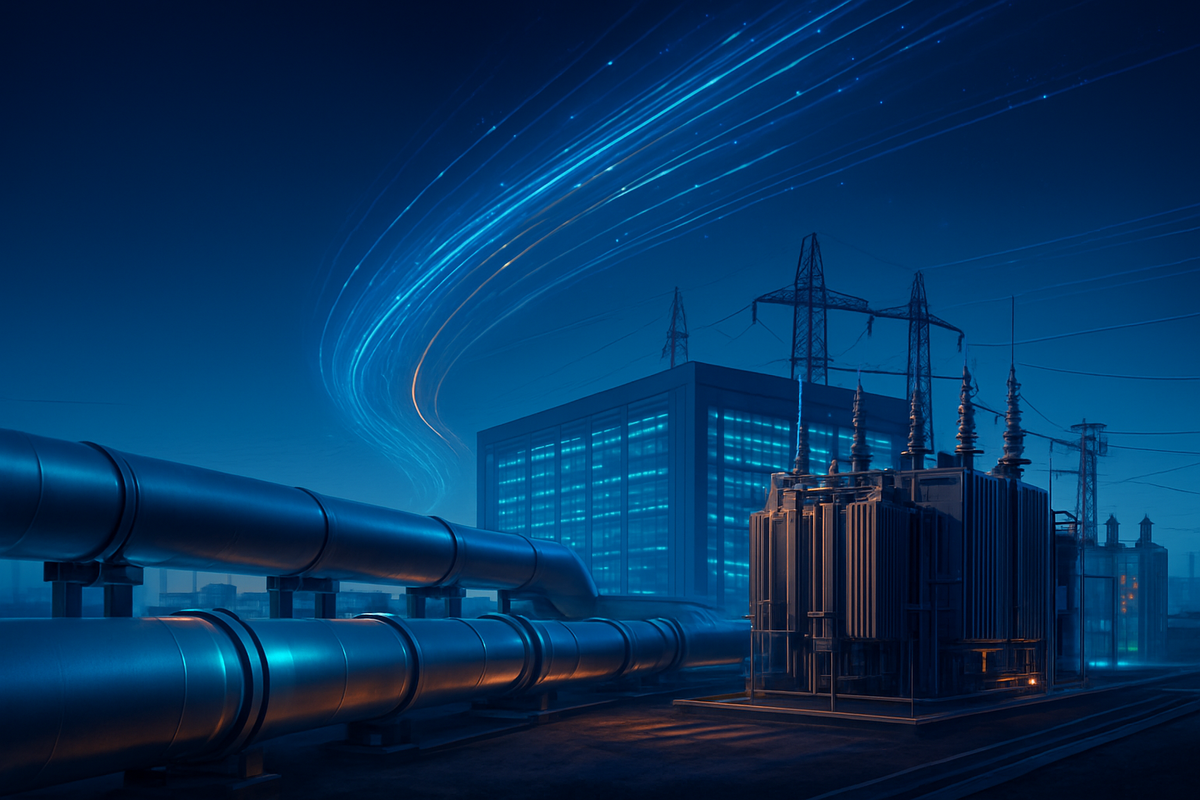
CALGARY — The era of artificial intelligence has moved from silicon chips to steel pipes and nuclear reactors. On February 13, 2026, North America’s two largest midstream energy giants, Enbridge Inc. (NYSE: ENB) and TC Energy Corp. (NYSE: TRP), reported blockbuster fourth-quarter earnings for 2025 that blew past Wall Street estimates. The primary driver behind these record-breaking results was a decisive strategic pivot toward supporting the massive power requirements of the AI data center "supercycle."
The market’s reaction was swift and positive, as investors recognized that the "always-on" nature of generative AI requires a level of energy reliability that only diversified infrastructure players can provide. By positioning themselves as the backbone of the tech industry’s expansion, both companies have successfully transitioned from traditional oil and gas transporters to indispensable partners in the global digital infrastructure race.
The AI Power Supercycle: A Breakdown of the Q4 Surge
On the morning of February 13, 2026, TC Energy Corp. (NYSE: TRP) kicked off the earnings session by reporting a fourth-quarter comparable EBITDA of CAD 3 billion, a 13% increase year-over-year. The company posted an adjusted earnings per share (EPS) of $0.98, comfortably beating the consensus forecast of $0.96. CEO François Poirier emphasized that TC Energy’s existing footprint is now proximate to 60% of the projected data center growth in the United States. This geographical advantage has allowed the company to break records, with January 2026 seeing an all-time high delivery of 39.9 billion cubic feet per day (Bcf/d) on its U.S. natural gas system.
Shortly after, Enbridge Inc. (NYSE: ENB) followed with an equally impressive report. The company delivered an adjusted EPS of $0.88, significantly outperforming the $0.79 estimate. Revenue for the quarter reached $8.46 billion, supported by a massive $39 billion project backlog. Enbridge CEO Greg Ebel revealed during the earnings call that the company is currently advancing over 50 potential data center opportunities across the continent. These projects, if fully realized, represent a staggering potential load of 10 Bcf/d of natural gas demand, highlighting the sheer scale of the energy infrastructure needed to sustain the AI boom.
The timeline leading to this moment has been defined by a shift in how "hyperscalers"—the massive tech companies building AI—view energy. Throughout 2025, it became clear that the public utility grid was becoming too congested to support the rapid rollout of new data centers. In response, Enbridge and TC Energy aggressively marketed their ability to provide "behind-the-meter" power and direct pipeline connections, allowing tech giants to bypass the 5-to-10-year wait times for traditional grid interconnections.
Winners in the New Energy Landscape
The clear winners in this environment are the diversified midstream operators who can offer a "multi-prong" energy solution. Enbridge Inc. (NYSE: ENB) has distinguished itself by pairing its natural gas prowess with renewable investments. A key highlight from their Q4 report was the sanctioning of the "Cowboy Solar + Storage" project in Wyoming, a 365 MW solar facility with 135 MW of battery storage designed specifically for data center loads. Furthermore, their "Clear Fork Solar" project in Texas is now backed by a long-term agreement with Meta Platforms, Inc. (NASDAQ: META), proving that tech giants are willing to pay a premium for dedicated, carbon-aware energy sources.
TC Energy Corp. (NYSE: TRP) is winning through its "nuclear-plus-gas" strategy. The company’s move to advance the "Bruce C" development at its Bruce Power nuclear facility in Ontario provides the carbon-free, baseload power that AI firms crave for their ESG commitments. Meanwhile, their Columbia and ANR gas systems are being expanded to serve "stressed" parts of the Mid-Atlantic and Midwest grids where data center density is highest.
Conversely, pure-play renewable companies that lack "firming" capacity—the ability to provide power when the sun isn't shining or wind isn't blowing—are finding it harder to compete for these high-stakes data center contracts. Hyperscalers like Amazon.com, Inc. (NASDAQ: AMZN) and Microsoft Corp. (NASDAQ: MSFT) are increasingly prioritizing "dispatchable" energy, which has revived the valuation of companies with large natural gas and nuclear portfolios.
The "Reliability Shock" and Broader Industry Shifts
The 2026 earnings season has highlighted what analysts are calling the "Reliability Shock." As the energy demand for AI training and inference skyrocketed, the limitations of the aging North American power grid were laid bare. This has forced a rethink of natural gas, now widely accepted as the "AI Bridge." Market projections for AI-driven natural gas demand were revised upward in early 2026 to 6 Bcf/d by 2030, a significant jump from 2024 estimates.
This trend is also triggering a shift in regulatory and policy landscapes. In regions like Texas and the PJM Interconnection (covering the Mid-Atlantic), data centers now account for over 70% of large-load interconnection requests. This has led to the emergence of "uninterruptible" gas supply contracts, where midstream companies like Enbridge and TC Energy are essentially functioning as de-facto power producers, building generation facilities directly on their pipeline routes to serve adjacent data center campuses.
Historical precedents for this are rare; the last time energy infrastructure saw such a concentrated demand spike was the industrial electrification of the early 20th century. However, the speed of the AI transition is unprecedented, requiring infrastructure that can be deployed in 18 to 24 months rather than decades.
What Lies Ahead: From Pipelines to Power Plants
In the short term, investors should expect a surge in capital expenditures (CAPEX) from both Enbridge and TC Energy as they race to build out "behind-the-meter" generation. The strategic pivot from being mere "transporters" to "energy solution providers" will require these companies to navigate new regulatory hurdles, particularly regarding local permitting for on-site gas turbines and small modular reactors (SMRs).
Long-term, the most significant opportunity lies in the convergence of gas and renewables. Enbridge’s success with its solar-plus-storage model suggests a future where data centers are powered by a hybrid of on-site renewables for "green" credentials, backed by natural gas for 99.999% reliability. Challenges may emerge if environmental regulations tighten further or if the cost of battery storage drops so low that it negates the need for natural gas firming, though as of February 2026, that remains a distant prospect.
A New Chapter for Midstream Giants
The Q4 2025 earnings from Enbridge and TC Energy mark a definitive turning point for the energy sector. These companies are no longer just cyclical plays on commodity prices; they are now structural plays on the growth of the global digital economy. The "AI Power Supercycle" has provided a massive tailwind that justifies their multi-billion dollar project backlogs and supports their decades-long track records of dividend growth.
Moving forward, the market will be watching for more "direct-to-tech" contracts and the progress of major infrastructure expansions like the Mainline Optimization and the Bruce C nuclear project. For investors, the takeaway is clear: the AI revolution is as much about the "pipes" as it is about the "pixels." As long as the demand for intelligence grows, the demand for the infrastructure that powers it will remain insatiable.
This content is intended for informational purposes only and is not financial advice.