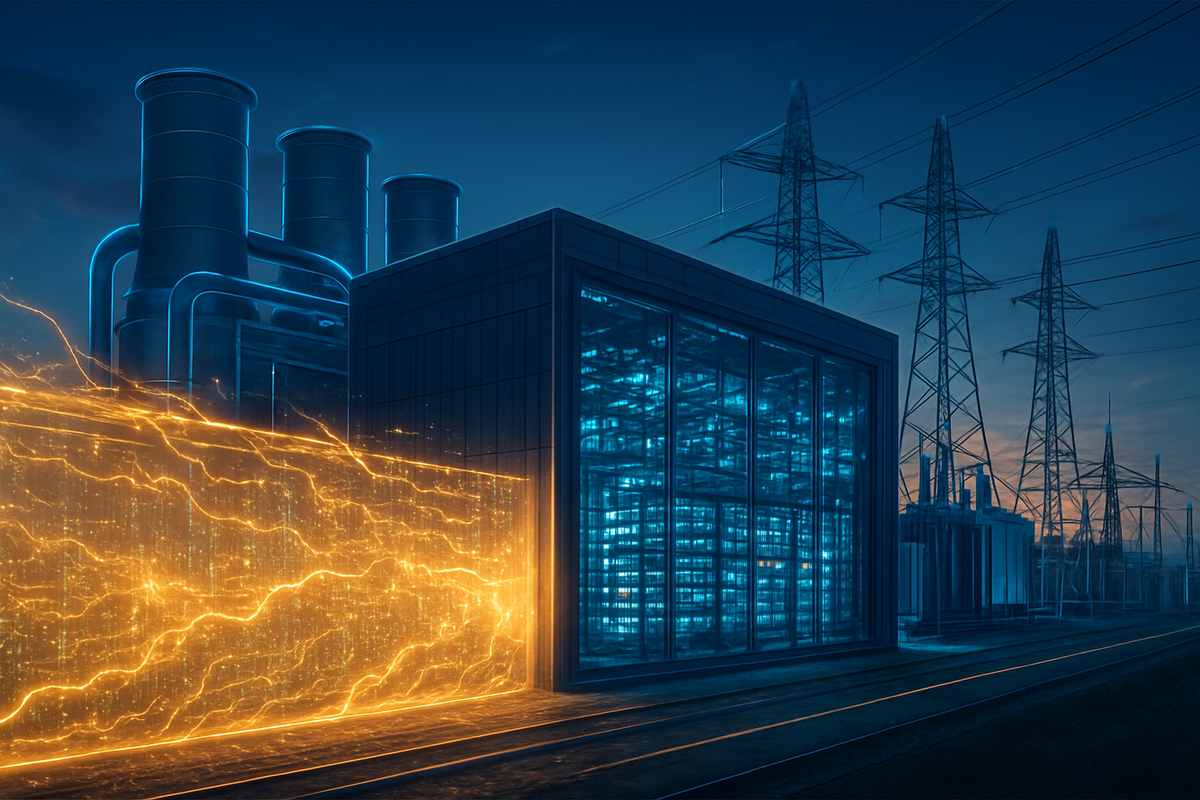
The era of worrying about chip shortages has officially ended, only to be replaced by a far more daunting physical constraint: the "Energy Wall." As of February 13, 2026, the artificial intelligence sector has hit a critical juncture where the availability of raw electrical power—not silicon—is the primary bottleneck for global expansion. In a landmark move to bypass this hurdle, Nvidia (NASDAQ: NVDA) has reportedly deepened its strategic partnership with utility titan Duke Energy (NYSE: DUK), signaling a shift where tech giants are now forced to co-engineer the power grid to sustain their growth.
This collaboration, centered around the "Open Power AI Consortium" (OPAI), aims to secure dedicated energy streams for the next generation of massive data centers. As Nvidia prepares to deploy its power-hungry "Rubin" architecture later this year, the deal with Duke Energy highlights a new reality for the market: the most valuable asset in the AI race is no longer just the GPU, but the guaranteed megawatt. This shift is transforming the utility sector from a sleepy, defensive dividend play into a high-octane growth engine, with investors recalibrating the value of companies that can bridge the gap between digital demand and physical supply.
The Dawn of the Direct-to-Grid Partnership
The partnership between Nvidia and Duke Energy reached a fever pitch in early 2026 following the unveiling of Duke’s staggering $103 billion capital investment plan. This five-year strategy is almost entirely driven by the "unprecedented" load growth from AI data centers in the Carolinas and surrounding regions. Central to this collaboration is the DCFlex initiative, a project where Nvidia-powered software is integrated directly into Duke’s grid management systems. This allows data centers to act as "dynamic loads," potentially scaling their power consumption up or down in milliseconds to help stabilize the grid during peak demand—essentially turning a data center into a virtual battery.
Timeline-wise, the groundwork was laid in late 2025 when Nvidia CEO Jensen Huang noted that "the next thousand-fold increase in AI will require a total re-architecture of the energy stack." Following this, the OPAI consortium was formed to use Large Language Models (LLMs) to solve the "interconnection crisis." Historically, getting a new data center connected to the grid could take up to five years due to bureaucratic study cycles. By using Nvidia’s AI to simulate grid stress and optimize placement, Duke Energy has reportedly slashed these wait times by nearly 80%, allowing new AI clusters to come online in record time.
The market reaction has been swift and decisive. Upon reports of the formalized dedicated power agreements, Duke Energy’s stock saw a significant surge, reflecting investor confidence in the company’s "Accelerating Clean Energy" (ACE) tariff. This new financial structure allows tech companies to directly fund the construction of carbon-free generation, such as Small Modular Reactors (SMRs), in exchange for long-term power guarantees. For Nvidia, the deal ensures that its newest Blackwell and Rubin-based clusters won't sit idle due to local brownouts or grid constraints.
Winners and Losers in the Search for Megawatts
The clear winners in this landscape are the "Big Three" of the AI-utility nexus: Duke Energy, NextEra Energy (NYSE: NEE), and Constellation Energy (NASDAQ: CEG). Constellation Energy has already set a precedent by successfully restarting units at Three Mile Island to power Microsoft (NASDAQ: MSFT) facilities, and similar nuclear-to-AI deals are expected to proliferate in 2026. These companies are no longer just selling a commodity; they are selling the "right to compute," which commands a significant premium in a power-constrained market.
Conversely, traditional industrial manufacturers and residential consumers may find themselves on the losing end of this energy scramble. As hyperscalers like Alphabet (NASDAQ: GOOGL) and Meta (NASDAQ: META) lock up gigawatts of capacity through 20-year Power Purchase Agreements (PPAs), there are growing concerns about "crowding out." Small to medium-sized enterprises (SMEs) that rely on the spot market for electricity could face higher volatility and rising costs as the grid’s surplus is swallowed by massive AI clusters. Furthermore, utility companies that have been slow to modernize their grids or transition to nuclear and renewable sources are finding themselves bypassed by tech giants looking for "clean and constant" power.
Hardware competitors to Nvidia also face a new challenge. While companies like AMD (NASDAQ: AMD) and Intel (NASDAQ: INTC) are producing highly efficient chips, the "Energy Wall" favors the player who has the closest relationships with the power providers. By embedding itself into the utility infrastructure via the DCFlex and OPAI initiatives, Nvidia is creating a vertical moat that extends from the software layer all the way down to the high-voltage transformer.
A Fundamental Shift in Industrial Strategy
This event fits into a broader trend of "physicalization" in the tech industry. For three decades, the software and hardware industries operated with the assumption that the physical infrastructure—the grid, the roads, the water—was an infinite resource that would always be there. In 2026, that assumption has collapsed. The significance of the Nvidia-Duke partnership lies in the recognition that the "AI Factory" is a heavy industrial site, more akin to a steel mill or an aluminum smelter than a traditional office-bound tech company.
The ripple effects are already reaching the regulatory level. Federal and state regulators are now being forced to fast-track permits for nuclear restarts and new transmission lines to prevent a national "computing deficit." We are seeing a historical precedent similar to the early 20th century, where industrial giants like Ford or Carnegie built their own power plants to ensure their factories could run 24/7. The difference today is that the "product" being manufactured is intelligence, and the fuel is clean electricity.
Furthermore, this trend is reshaping the ESG (Environmental, Social, and Governance) landscape. Tech companies are no longer just buying "offsets" to claim carbon neutrality; they are becoming the primary financiers for the next generation of carbon-free energy. This partnership model could serve as a blueprint for how the world accelerates the transition to a carbon-free grid, funded not by taxpayers, but by the massive capital reserves of the AI industry.
The Road Ahead: SMRs and the 600kW Rack
In the short term, the market should expect a flurry of similar announcements as other hyperscalers race to secure their own "power islands." We are likely to see the first operational Small Modular Reactors (SMRs) break ground specifically to power dedicated AI zones within the next 24 months. These "behind-the-meter" solutions will allow Nvidia and its partners to operate independently of the public grid, mitigating the risk of political or social backlash over rising energy costs for the general public.
Long-term, the challenge will scale with the hardware. Nvidia’s upcoming "Vera Rubin" platform is projected to require racks that draw upwards of 600 kW—a five-fold increase from just two years ago. This will necessitate a total redesign of data center cooling and power delivery, moving from air-cooled systems to direct-to-chip liquid cooling and potentially high-voltage DC power feeds directly into the server floor. The "strategic pivot" for the industry is moving from maximizing "FLOPs per dollar" to "FLOPs per watt."
Strategic challenges will emerge if the grid cannot keep up. We may see a scenario where AI compute is "sharded" or moved to regions with vast, untapped energy reserves—such as the geothermal fields of Iceland or the hydro-rich regions of Canada—creating a new map of global AI power centers. The winners will be those who can innovate not just in the microchip, but in the power transformer and the cooling manifold.
Summary and Investor Outlook
The partnership between Nvidia and Duke Energy marks the definitive end of the "unconstrained growth" phase of AI. The "Energy Wall" is real, and it is the new defining metric for the tech and utility sectors. Key takeaways for investors include the transformation of utility stocks like Duke, NextEra, and Constellation into essential AI infrastructure plays and the realization that Nvidia’s dominance now extends into the very grid that powers its chips.
As we move forward in 2026, the market will be characterized by a "speed to power" race. Investors should watch for the approval of new ACE-style tariffs, progress in SMR licensing, and any signs of regulatory pushback regarding grid equity. The ability to secure gigawatts of power is now a competitive advantage as significant as the ability to design a 4-nanometer chip.
In the coming months, keep a close eye on the "interconnection queues" in data center hubs like Northern Virginia and the Carolinas. A company’s position in that queue may be the best leading indicator of its future earnings potential in the AI era. The AI revolution has found its new frontier, and it is humming with the sound of high-voltage lines.
This content is intended for informational purposes only and is not financial advice.