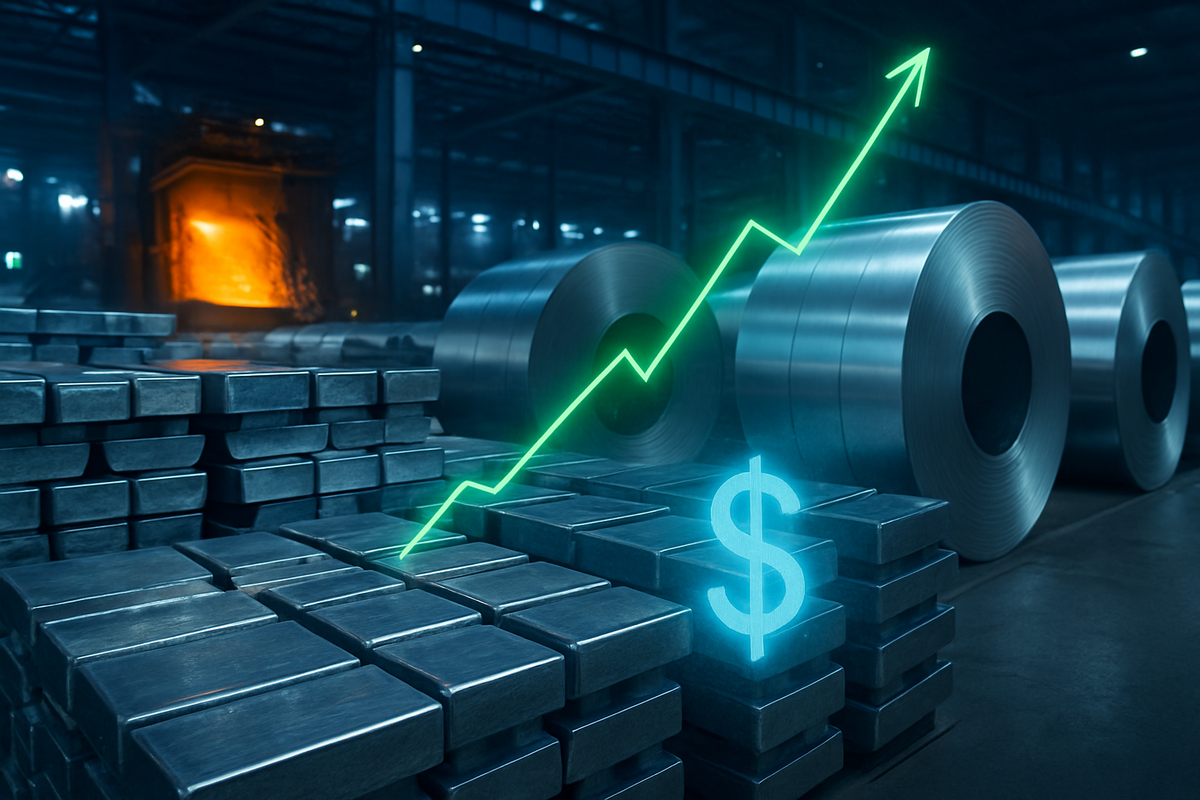
Industrial markets reached a major inflection point this week as aluminum prices surged to a fresh multi-year peak, driven by a perfect storm of tightening global supply and a plummeting U.S. currency. On January 28, 2026, the light metal hit $3,289.55 per tonne on the London Metal Exchange (LME), a level not seen in years, marking an 11% climb in the first month of 2026 alone. This rally coincides with the U.S. Dollar Index (DXY) slipping to a four-year low of 96.16, its weakest level since early 2022, effectively supercharging the purchasing power of international commodity buyers.
The immediate implications are profound for global manufacturing and the construction sector. As the greenback weakens, dollar-denominated commodities like aluminum become cheaper for holders of foreign currencies, triggering a massive inflow of capital into base metals. However, the surge is not merely a currency play; a critical supply squeeze, exacerbated by structural production caps in Asia and dwindling global inventories, has left the market vulnerable to price spikes. With warehouse stocks at historic lows, industrial consumers are scrambling to secure physical metal, often paying steep premiums to ensure their production lines remain operational.
The Convergence of Scarcity and Currency
The current price explosion is the result of a long-simmering supply-demand imbalance that reached a boiling point in late 2025. Leading up to this moment, China—the world’s largest aluminum producer—strictly enforced its 45-million-tonne annual production ceiling to meet environmental targets, removing a significant buffer from the global market. Simultaneously, LME warehouse inventories plummeted to just 505,275 tonnes by late January 2026, a dangerously low level that has historically preceded extreme price volatility.
The decline of the U.S. dollar acted as the final catalyst for the January breakout. Following recent signals from the current administration regarding a preference for a softer dollar to aid manufacturing competitiveness, the DXY broke through key support levels. This shift in currency policy, combined with geopolitical uncertainty and questions regarding the long-term trajectory of Federal Reserve independence, sent investors fleeing from the greenback and into "hard assets." The inverse relationship between the dollar and metals is now on full display: as the unit of measurement (the dollar) shrinks, the nominal price of the asset it measures (aluminum) must rise to maintain its intrinsic value.
Initial market reactions have been swift and decisive. Trading volume in industrial metal futures has tripled over the last week as hedge funds and institutional investors pivot back into the commodities space. In the United States, the situation is even more acute due to 50% import tariffs implemented in mid-2025. American manufacturers are currently paying premiums of up to 68% over the global LME benchmark, with domestic delivered prices for aluminum exceeding $5,000 per metric ton in some regional hubs.
Corporate Winners and Industrial Losers
The primary beneficiary of this environment is Alcoa (NYSE: AA), which recently posted a blowout fourth-quarter earnings report. The company saw its revenue climb to $3.45 billion, with earnings per share (EPS) of $1.26 comfortably beating analyst expectations of $0.95. For Alcoa, the high realized prices for aluminum—averaging $3,749 per ton in late 2025—have translated into massive cash flow, allowing the producer to shore up its balance sheet and consider enhanced capital returns. While some analysts maintain a "Hold" rating due to the stock's rapid appreciation into the $60 range, the fundamental backdrop for Alcoa remains the strongest it has been in half a decade.
Rio Tinto (NYSE: RIO) is also emerging as a major winner in the current metals supercycle. While the company is diversified across iron ore and copper, its aluminum division is reaping the rewards of high premiums and global supply constraints. Rio Tinto's stock recently hit 52-week peaks above $85, supported by a 47% rally over the preceding six months. Analysts at Erste Group recently upgraded the company to a "Buy," highlighting its high return on equity and attractive dividend yield, which currently sits near 3.38%. The company’s operational momentum, particularly in its low-carbon smelting operations, has made it a preferred vehicle for investors looking to play the industrial recovery.
On the other hand, heavy consumers of aluminum in the automotive and aerospace industries are facing significant margin compression. Publicly traded firms in these sectors are struggling to pass on the 25% year-over-year increase in raw material costs to consumers. Meanwhile, the Invesco DB Base Metals Fund (NYSEARCA: DBB) has become a primary beneficiary for investors who do not want to pick individual mining stocks. The ETF is trading near $24.43, gaining 25% over the past year as it tracks the broader rise in aluminum, copper, and zinc. Similarly, the SPDR S&P Metals & Mining ETF (NYSEARCA: XME) has seen an extraordinary 83.5% gain since the start of 2025, buoyed by its heavy weighting in aluminum and precious metals producers.
A New Era for Commodity Markets
This event fits into a broader global trend of "resource nationalism" and the green energy transition. Aluminum is a critical component for electric vehicles (EVs) and renewable energy infrastructure, meaning demand is structural rather than cyclical. The current supply squeeze is a direct consequence of the "green premium"—where the cost of producing low-carbon aluminum in the West is significantly higher, and the production of high-carbon aluminum in Asia is being capped by environmental mandates. Historical precedents from the 2008 and 2021 commodity booms suggest that when aluminum enters a deficit of this magnitude, prices can remain elevated for years rather than months.
The ripple effects extend far beyond the exchange floor. Competitors in the recycling space are seeing a surge in activity as secondary aluminum becomes a more viable and cost-effective alternative to primary smelting. Furthermore, the regulatory landscape is shifting; the U.S. administration’s "soft dollar" stance is a double-edged sword. While it helps exporters like Alcoa (NYSE: AA), it also risks stoking domestic inflation, as the cost of imported components for the broader manufacturing sector continues to rise. This may eventually force a policy pivot if the dollar’s slide becomes too disorderly.
Comparing this to the 2022 market, the roles have reversed. In 2022, a surging dollar suppressed metal prices despite supply disruptions from the Ukraine conflict. In 2026, the narrative has flipped: even as global geopolitical tensions persist, it is the currency de-valuation that is providing the "floor" for commodity prices. This suggests that the market has entered a "debasement trade" where investors view industrial metals not just as manufacturing inputs, but as a store of value against a declining greenback.
The Road Ahead: Supply Chain Friction
In the short term, market participants should expect continued volatility as the LME tries to find a price level that will eventually "destroy" enough demand to balance the market. We may see aluminum test the $3,500 level if the dollar continues its downward trajectory toward the 95.00 mark on the DXY. For producers like Alcoa (NYSE: AA) and Rio Tinto (NYSE: RIO), the strategic pivot will likely involve accelerating investments in smelting capacity or acquisitions of smaller, secondary recyclers to bypass the primary production caps.
Long-term, the industry must adapt to a "high-cost, high-reward" environment. If the dollar remains weak for a prolonged period, we could see a permanent shift in where aluminum is processed. Smelters in regions with lower energy costs and weaker currencies relative to the dollar will become the new hubs of global production. The primary challenge for the market will be managing the inflationary pressures that come with a 4-year low in the currency, as central banks may eventually be forced to intervene with higher interest rates, which could abruptly end the metals party.
Market Outlook and Investor Strategy
The surge in aluminum prices to a fresh peak alongside a four-year low in the U.S. dollar marks a defining moment for the 2026 financial year. The inverse correlation between the greenback and base metals has reasserted itself with a vengeance, providing a massive tailwind for mining giants and industrial ETFs. Key takeaways for the market include the reality of a structural supply deficit that cannot be easily fixed by policy alone, and a fundamental shift in the U.S. currency regime that favors manufacturers at the expense of importers.
Moving forward, the market will likely remain in a "Buy the Dip" mode for industrial metals as long as the DXY stays below the 98.00 level. Investors should watch for the upcoming Q1 2026 production reports from major miners and any signs of a technical "short squeeze" on the LME, which could propel prices even higher. While the immediate outlook is bullish for producers, the broader economic impact of sustained high commodity prices will be the second-half challenge for 2026.
This content is intended for informational purposes only and is not financial advice