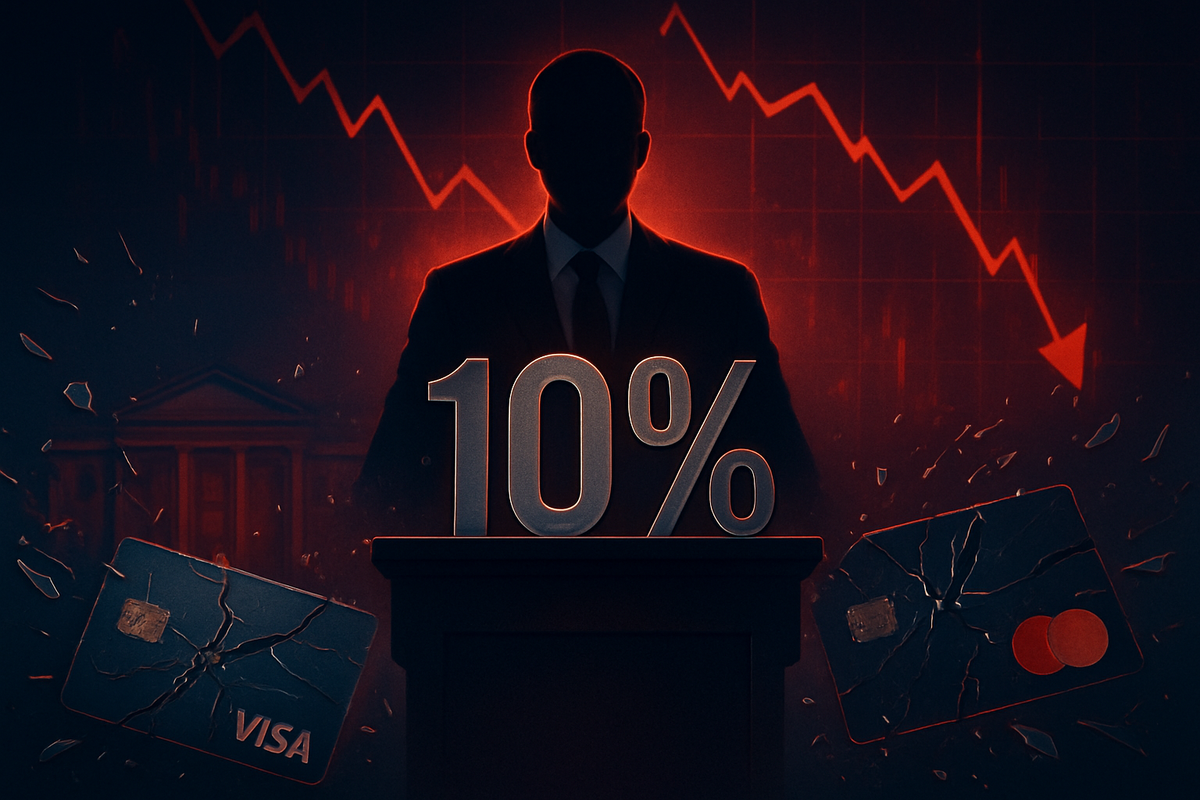
WASHINGTON D.C. — In a series of sweeping policy declarations that have sent shockwaves through the financial corridors of Wall Street, President Trump has set the stage for a radical restructuring of the American credit system. As of January 19, 2026, the administration has doubled down on its pledge to dismantle what it describes as the "extortionary" practices of major financial institutions, specifically targeting the interest rates charged to consumers and the processing fees levied against merchants.
The immediate fallout has been a historic rout for the world’s largest payment networks. Shares of Visa (NYSE: V) plummeted approximately 7% over the past week, while Mastercard (NYSE: MA) saw its market capitalization erode by over 5%. The dual-pronged attack—combining a proposed 10% ceiling on credit card interest rates with a formal endorsement of the Credit Card Competition Act (CCCA)—marks one of the most significant regulatory shifts in the financial sector since the 2008 financial crisis, leaving investors and analysts scrambling to price in a new era of government intervention.
The Mandate: From Campaign Trail to Executive Policy
The current market turmoil traces back to a pivotal week in early January 2026, but the seeds were sown during the final months of the 2024 presidential campaign. In September 2024, Donald Trump first proposed a 10% cap on credit card interest rates, framing it as a necessary relief for families struggling with a combined $1.2 trillion in revolving debt. While many dismissed the proposal as campaign rhetoric at the time, the President’s January 9, 2026, announcement on Truth Social—calling for a "one-year mandate" to cap rates—transformed a theoretical threat into an imminent reality for the banking sector.
The timeline accelerated rapidly on January 13, 2026, when the President formally endorsed the reintroduced Credit Card Competition Act. This legislation, championed by a bipartisan coalition including Senators Roger Marshall (R-KS) and Dick Durbin (D-IL), seeks to break the Visa-Mastercard dominance by requiring large banks with over $100 billion in assets to offer at least two different routing networks for credit card transactions. The endorsement from the Oval Office effectively shattered the long-standing Republican opposition to the bill, providing the political momentum necessary for its potential passage in both the House and Senate.
Industry stakeholders have reacted with a mix of alarm and advocacy. While the American Bankers Association (ABA) has decried the 10% interest cap as "unconstitutional" and "economically catastrophic," merchant groups like the National Retail Federation (NRF) have hailed the CCCA as a victory for small businesses. The administration’s aggressive stance is further bolstered by an ongoing Department of Justice (DOJ) antitrust lawsuit against Visa, initiated in late 2024, which alleges that the company maintains an illegal monopoly over the debit card market through exclusionary agreements and penalties.
Winners and Losers: A Seismic Shift in Profitability
The primary "losers" in this regulatory pivot are undoubtedly the incumbent giants, Visa (NYSE: V) and Mastercard (NYSE: MA). These companies have long enjoyed a lucrative duopoly, facilitating over 80% of U.S. credit card transactions. The CCCA directly threatens their "swipe fee" revenue—the roughly 2% charge on every transaction—by forcing them to compete on price with smaller, lower-cost networks like NYCE, Star, or Shazam. For Visa, the 7% share price decline reflects investor fears that the high-margin "moat" around its network is being systematically dismantled by federal policy.
Beyond the networks, credit card issuers that cater to subprime and middle-income borrowers face an existential threat from the 10% interest rate cap. Firms such as Capital One (NYSE: COF) and Bread Financial (NYSE: BFH) rely heavily on the interest spread to offset the higher default risks associated with these segments. Following the President’s announcement, Bread Financial saw its stock plunge over 12%, as analysts warned that a 10% cap would make most subprime lending mathematically unfeasible, likely leading to a massive contraction in credit availability for millions of Americans.
Conversely, the "winners" include the nation’s largest retailers, such as Walmart (NYSE: WMT) and Target (NYSE: TGT), which could save billions of dollars annually in transaction fees if the CCCA passes. These savings could theoretically be passed on to consumers, though market skeptics argue they may simply bolster corporate margins. Additionally, smaller domestic payment networks and fintech innovators stand to gain a foothold in a market that has been historically closed to them, potentially sparking a new wave of competition in the "plumbing" of the financial system.
The Broader Significance: Regulatory Interventionism Reborn
This event represents a fundamental departure from the traditional market-driven approach of the Republican party, signaling a new era of "populist economics" that prioritizes "Main Street" over "Wall Street." By targeting interest rates and network fees, the administration is moving toward a utility-style regulation of the financial sector. This fits into a broader global trend of increased scrutiny on "Big Tech" and "Big Finance" platforms that act as gatekeepers to the modern economy.
Historically, the closest precedent to this move was the 2010 Durbin Amendment, which capped debit card interchange fees. While that measure successfully reduced costs for some merchants, it also led to the disappearance of free checking accounts and the elimination of debit card rewards programs. Critics of the current 10% cap and the CCCA warn of similar unintended consequences, including a "credit crunch" where banks stop issuing cards to anyone without a pristine credit score, effectively cutting off low-income earners from the formal financial system.
Furthermore, the synergy between the President’s populist rhetoric and the DOJ’s legal maneuvers indicates a coordinated effort to reshape the financial landscape. The 2024 DOJ lawsuit against Visa was just the opening salvo in what has become a multi-front war. By attacking both the pricing (interest rates) and the infrastructure (network routing), the government is attempting to forcibly redistribute billions of dollars in economic value from financial institutions to consumers and retailers.
What Comes Next: Legal Battles and Strategic Pivots
The immediate future will likely be dominated by the courts. The American Bankers Association and other trade groups are widely expected to file lawsuits challenging the President’s authority to mandate an interest rate cap without an explicit Act of Congress. If the administration attempts to implement the cap via Executive Order on January 20, 2026—the one-year anniversary of the inauguration—a flurry of temporary restraining orders and legal stays is almost certain to follow, creating a period of intense legal uncertainty for the markets.
Strategically, banks and payment networks are already beginning to pivot. Large issuers may look to compensate for lost interest income by introducing annual fees, reducing reward levels, or tightening credit standards to a degree not seen since the Great Recession. For Visa (NYSE: V) and Mastercard (NYSE: MA), the focus will likely shift toward international growth and diversifying into value-added services like fraud detection and data analytics to mitigate the impact of domestic fee compression.
In the short term, the volatility in financial stocks is expected to persist as the market awaits the first concrete steps of implementation. If the CCCA passes and the 10% cap survives legal challenges, we may witness the most significant contraction of the consumer credit market in decades. However, if the measures are stalled in court, the current dip in share prices for the payment giants may eventually be viewed by contrarians as a massive overreaction to political "jawboning."
Wrap-Up: Navigating the New Financial Frontier
The events of January 2026 mark a watershed moment for the U.S. financial system. President Trump’s aggressive move to cap interest rates and break the Visa-Mastercard duopoly has challenged the fundamental economics of the credit industry. The 7% drop in Visa’s share price is a clear indicator that the market no longer views these financial networks as untouchable utilities, but rather as entities vulnerable to the shifting tides of populist politics.
Moving forward, investors must keep a close watch on two critical fronts: the legislative progress of the Credit Card Competition Act in the Senate and the potential for a "credit crunch" in the subprime market. If the 10% cap becomes a reality, the traditional business model of credit card lending will need to be entirely rebuilt. For now, the "Visa-Mastercard duopoly" remains under heavy fire, and the outcome of this battle will define the cost of credit and the flow of transactions for the next generation.
Ultimately, the lasting impact of this event will be measured by whether it truly lowers costs for consumers or simply forces a redistribution of fees and a reduction in credit access. As the effective date of the "mandate" approaches, the financial world is holding its breath, waiting to see if this is a temporary political storm or a permanent climate shift in the American economy.
This content is intended for informational purposes only and is not financial advice.