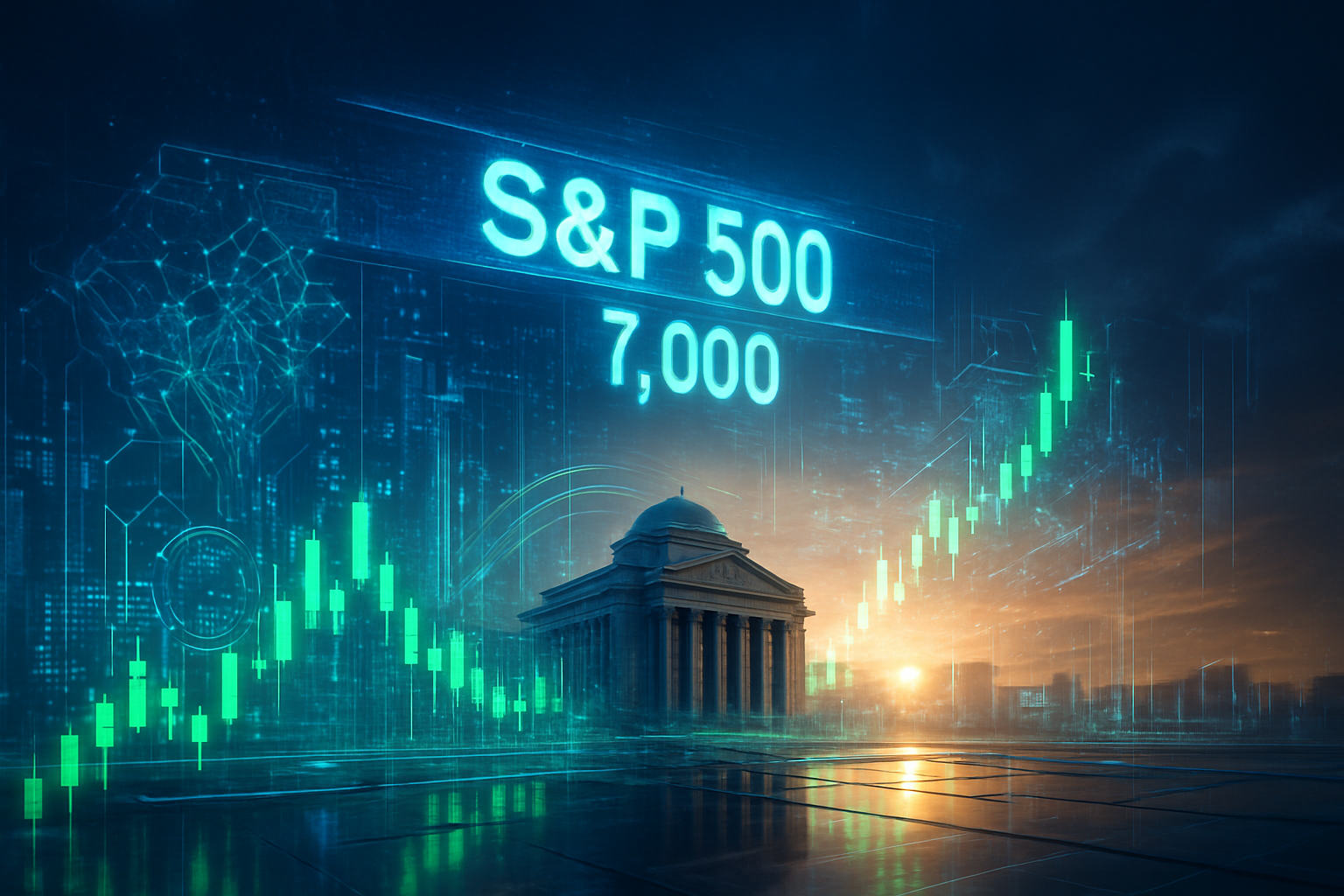
As of mid-January 2026, the equity markets have defied the skeptics once again. The S&P 500 has surged to unprecedented heights in the first two weeks of the year, closing at a record 6,977.32 on January 12 and currently flirting with the psychologically momentous 7,000-point milestone. This rally, building on a robust 16.4% gain in 2025, represents one of the strongest starts to a calendar year in decades, driven by a "perfect storm" of technological breakthroughs in artificial intelligence and a resilient, if complicated, macroeconomic backdrop.
However, the record-breaking performance is not without its paradoxes. Even as the headline index soars, a high-stakes standoff between the Federal Reserve and the White House has introduced a layer of volatility that is keeping institutional investors on edge. With inflation cooling to 2.7% and the "AI supercycle" moving from speculative hype to tangible infrastructure builds, the market is currently caught in a tug-of-war between stellar corporate fundamentals and unprecedented political pressure on monetary policy.
The Path to 7,000: A Timeline of the 2026 Surge
The momentum for this historic run began in the final weeks of 2025, but the acceleration in early January 2026 was catalyzed by the Consumer Electronics Show (CES) in Las Vegas. There, NVIDIA (NASDAQ: NVDA) CEO Jensen Huang electrified the market by announcing that the next generation of AI-native chips had entered full-scale production. This announcement triggered a massive wave of capital into the semiconductor and storage sectors, as the market pivoted from software-centric AI hype to the "physical infrastructure" phase of the cycle. Within the first seven trading days of the year, the S&P 500 gained approximately 1.9%, while the Nasdaq 100 outpaced it with a 2.2% jump.
By January 13, the rally received further fuel from the December 2025 Consumer Price Index (CPI) report. Headline inflation was recorded at 2.7%, with core inflation at 2.6%—both figures coming in slightly cooler than consensus estimates. This "Goldilocks" data suggested that the Federal Reserve’s restrictive cycle might finally be nearing its end, providing a green light for investors to bid up valuations. The broader market participation has been a hallmark of this period; the Russell 2000 small-cap index surged 4.6% in the first week of January, suggesting that the rally is no longer just a "top-heavy" phenomenon driven by a few tech giants.
However, the optimism was shadowed by a dramatic political development on January 11, when the Department of Justice launched a criminal investigation into Federal Reserve Chair Jerome Powell regarding his past testimony on a $2.5 billion renovation of the Fed’s headquarters. Powell publicly denounced the move as "unprecedented political pressure" aimed at forcing interest rate cuts. This friction between the executive branch and the central bank has created a bizarre market environment where record highs are being achieved against a backdrop of potential constitutional and regulatory crises.
Winners and Losers in the New Year Rally
The primary beneficiary of the early 2026 surge remains the technology sector, but the leadership has broadened. Alphabet (NASDAQ: GOOGL) made headlines by reaching a historic $4 trillion valuation as its Gemini AI models achieved competitive parity with its rivals, solidifying its position in the AI ecosystem. Meanwhile, the physical hardware providers are seeing a resurgence; Western Digital (NASDAQ: WDC) saw double-digit gains following reports of a "perfect storm" in demand for AI flash storage, as data centers struggle to keep up with the data-intensive requirements of generative models.
On the banking front, results have been a mixed bag of operational success and regulatory fear. JPMorgan Chase (NYSE: JPM) and Bank of America (NYSE: BAC) both kicked off the Q4 earnings season by beating analyst estimates, with JPMorgan reporting an adjusted EPS of $5.23. However, their stock prices have faced headwinds due to a looming policy proposal from the White House to cap credit card interest rates at 10%, scheduled to take effect on January 20. This populist regulatory shift has created a ceiling for financial stocks, which otherwise would likely be participating more aggressively in the record-breaking rally.
Other winners include the industrial and utility sectors, which are being repriced as "AI-adjacent" plays. As data centers consume massive amounts of power, utilities are seeing renewed investor interest, moving away from their traditional status as "defensive" stocks to become growth vehicles. Conversely, companies in high-interest-rate sensitive sectors, such as traditional retail and mid-tier real estate, have struggled to keep pace with the S&P 500 as the "higher for longer" narrative—coupled with the Fed-DOJ tension—keeps borrowing costs elevated despite the cooling inflation.
Wider Significance and Historical Context
The S&P 500's record start to 2026 is more than just a numbers game; it represents a significant shift in the market’s character. For the past two years, the rally was dominated by the "Magnificent Seven," but we are now seeing a "narrowing of the gap" as the "Other 493" companies in the index catch up. Analysts now project that while the tech giants will grow earnings by 22.7% in 2026, the rest of the index is expected to grow by a respectable 12.5%. This broadening is historically a sign of a more durable bull market, reminiscent of the mid-1990s expansion before the late-stage excesses of the dot-com bubble.
Furthermore, the escalation of the conflict between the Fed and the Executive Branch is a historical anomaly that has major implications for market stability. Never before has a sitting Fed Chair been the subject of a DOJ probe while simultaneously managing a pivot in monetary policy. This tension introduces a "political risk premium" that could lead to heightened volatility in the bond markets, even as stocks continue to climb. Investors are essentially betting that corporate earnings growth is strong enough to decouple from political instability.
The global energy landscape is also playing a role. The recent U.S. geopolitical maneuvers regarding oil supply from South America have helped stabilize energy prices, providing an indirect subsidy to U.S. consumers and corporations alike. This has helped keep the "no-landing" scenario alive—a situation where the economy avoids a recession entirely despite the most aggressive tightening cycle in 40 years. The historical precedent for such a scenario is rare, often cited only in the mid-1960s and mid-1990s, making the current performance of the S&P 500 a subject of intense academic and professional debate.
The Road Ahead: Potential Strategic Pivots
Looking toward the remainder of 2026, the market faces a series of critical inflection points. In the short term, the January 20 implementation of the credit card rate cap will be a major test for the financial sector and consumer spending. If the cap leads to a contraction in credit availability, we could see a slowdown in the very consumption that has fueled the 2025-2026 rally. Investors will need to watch for signs of "credit rationing" by major lenders like Citigroup (NYSE: C) or American Express (NYSE: AXP).
Long-term, the focus will remain on the Federal Reserve’s leadership transition. Chair Powell’s term expires in May, and the current DOJ probe suggests a high likelihood of a radical shift in Fed leadership. A more "dovish" or politically aligned Fed appointee could initially spark a massive equity rally as rate cuts are accelerated, but it also risks reigniting inflation or damaging the long-term credibility of the U.S. dollar. Strategic pivots for investors may involve moving toward "real assets" or international equities if the domestic political situation begins to weigh on the greenback.
Final Assessment and Key Takeaways
The S&P 500’s historic start to 2026 is a testament to the power of the AI revolution and the resilience of the American corporate sector. The index’s trek toward 7,000 is backed by double-digit earnings growth and a labor market that remains in a steady "no hiring, no firing" stasis. However, the disconnect between soaring stock prices and the volatile political climate is a warning sign that the rally, while fundamentally supported, is walking a tightrope.
Moving forward, the market’s sustainability will depend on whether the "Other 493" can continue to shoulder the burden of growth as the tech sector’s valuations face the gravity of higher-for-longer rates. Investors should closely monitor the late January Fed meeting and the fallout from the DOJ probe. While Oppenheimer has set a bullish year-end target of 8,100, the path there will likely be marked by the "data dysfunction" of a post-shutdown economy and the unpredictable whims of a highly charged regulatory environment. For now, the bulls remain in control, but the margin for error is thinner than the record highs suggest.
This content is intended for informational purposes only and is not financial advice.