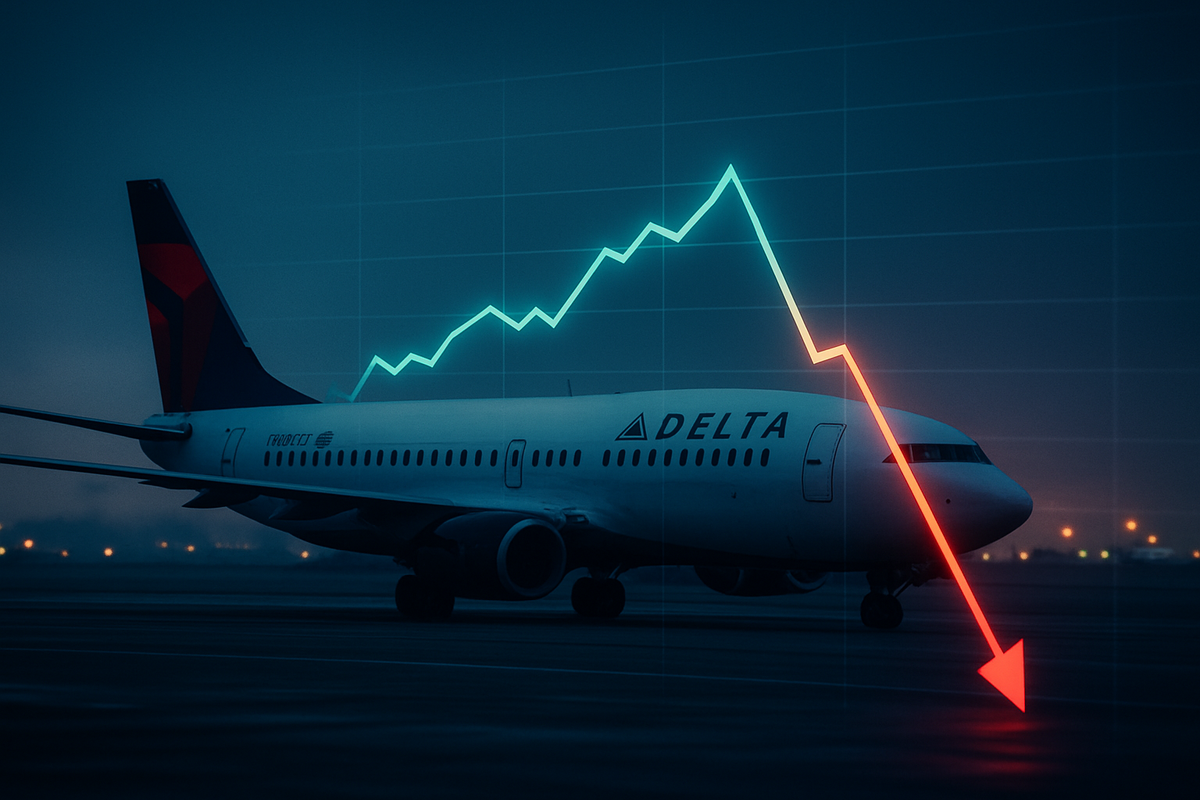
ATLANTA — Delta Air Lines (NYSE: DAL) kicked off the fourth-quarter earnings season for the aviation industry today, reporting financial results that exceeded analyst expectations on the bottom line but failed to ignite investor confidence. Despite a record-breaking 2025 and a resilient premium travel market, the carrier’s stock tumbled more than 5% in early trading on January 13, 2026. The primary culprit behind the sell-off was a conservative 2026 outlook and the lingering financial scars of a massive U.S. government shutdown that paralyzed domestic travel in late 2025.
The quarterly report highlights a widening "K-shaped" divide in the travel sector, where affluent flyers continue to splurge on luxury experiences while budget-conscious travelers are pulling back. For Delta, which has staked its reputation on being a premium carrier, this shift is both a strategic win and a looming risk. As the first major airline to report, Delta's results are being scrutinized as a bellwether for how the broader industry will navigate a 2026 landscape defined by rising labor costs and a fragile recovery from domestic political instability.
A Beat Overshadowed by a Historic Shutdown
For the fourth quarter of 2025, Delta reported adjusted earnings per share (EPS) of $1.55, comfortably ahead of the $1.52 to $1.54 consensus forecast. Total revenue for the quarter reached $16.0 billion, a 3% increase year-over-year. For the full year of 2025, the airline achieved a staggering $58.3 billion in revenue and a pre-tax income of $5 billion. However, these record numbers were tempered by the disclosure of a $200 million revenue hit directly attributed to the 43-day U.S. government shutdown that occurred in October and November 2025.
The shutdown caused a 10% decline in air traffic during its peak, as federal workers stayed home and business travel associated with government contracts evaporated. Delta management noted that the disruption forced a recalibration of domestic schedules and hit the "Main Cabin" segment particularly hard. While the airline managed to navigate the immediate crisis, the operational friction led to an 11% surge in labor-related expenses in Q4, driven by overtime pay and the ongoing implementation of the high-value pilot contracts signed back in 2023.
Market reaction was swift and negative, with shares of Delta falling nearly 6% within the first hour of the New York Stock Exchange opening. Investors were less concerned with the "past" performance of Q4 and more focused on the "future" guidance for 2026. Delta projected its full-year 2026 adjusted EPS to be between $6.50 and $7.50. The midpoint of $7.00 fell significantly short of the $7.32 that Wall Street analysts had modeled, suggesting that the "growth engine" of the post-pandemic travel boom may finally be downshifting.
Industry Winners and Losers: A Mixed Flight Path
The ripple effects of Delta’s report were felt immediately across the sector. United Airlines (NASDAQ: UAL) saw its stock price decline in sympathy, falling 3.5% as investors feared that United’s own Q4 report, scheduled for January 20, might echo Delta's conservative tone. United is currently in the middle of an aggressive cabin retrofit program to compete with Delta’s premium offerings, and analysts are now questioning whether the "premiumization" of the industry can sustain its momentum if the broader economy continues to soften.
In contrast, American Airlines (NASDAQ: AAL) appeared to weather the storm more effectively. On the same day as Delta’s report, American issued a strategic pre-announcement, raising its own 2025 profit forecast by 12%. American’s focus on disciplined capacity management and its smaller relative exposure to the international premium markets that Delta dominates seemed to provide a temporary hedge against the industry-wide sell-off. American is set to release its full results on January 27, and it is currently positioned as a potential "winner" if domestic demand stabilizes faster than international demand.
The aerospace manufacturing sector saw a rare bright spot amidst the airline volatility. Boeing (NYSE: BA) shares remained stable following Delta’s announcement of a major fleet modernization deal. Delta committed to purchasing 30 Boeing 787-10 Dreamliners, with options for 30 more, with deliveries beginning in 2031. This order signals Delta’s long-term commitment to high-margin international routes and provides Boeing with a much-needed backlog boost as it seeks to move past its own historical production and quality control challenges.
The K-Shaped Demand Curve and Macroeconomic Pressures
The divergence in Delta’s revenue streams offers a fascinating look into the 2026 consumer. While "Main Cabin" revenue—typically associated with price-sensitive economy travelers—actually declined by 7% in the fourth quarter, premium revenue surged by 9%. This suggests that while the "squeezed middle class" is opting for staycations or cheaper alternatives like Southwest Airlines (NYSE: LUV), high-net-worth individuals are still willing to pay for business class and Delta One suites. This "K-shaped" demand profile is a significant shift from the broad-based "revenge travel" seen in 2023 and 2024.
This trend is forcing a broader industry shift toward capacity discipline. Delta has announced a disciplined capacity growth plan of just 3% for 2026, a move intended to preserve pricing power in a market where seats are no longer being filled by default. The historical precedent for this occurred in the mid-2010s, when airlines similarly pulled back on expansion to combat rising fuel costs and economic uncertainty. However, in 2026, the primary pressure is not fuel—which has remained relatively stable—but the rising "floor" of labor costs.
The broader significance of the late-2025 government shutdown also cannot be overstated. Industry experts estimate that the 43-day impasse cost the U.S. travel industry a total of $6.1 billion. For an industry that operates on razor-thin margins, such a massive domestic shock has led to calls for more robust federal protections for the national airspace system. As Delta’s guidance suggests, the recovery from such a policy failure is not instantaneous; it leaves a "long tail" of reduced consumer confidence and operational inefficiencies that can take quarters to resolve.
Looking Ahead: Strategic Pivots and Potential Scenarios
As Delta enters 2026, the company is at a crossroads. Its short-term strategy involves "weathering the storm" by leaning into its lucrative partnership with American Express and its loyalty program, which remains a primary profit driver. However, the long-term challenge is whether the airline can find a way to re-engage the economy traveler without diluting its premium brand. If the $0.50 to $0.90 EPS range projected for Q1 2026 proves too optimistic, Delta may be forced to consider more aggressive cost-cutting measures, including the early retirement of older, less fuel-efficient narrow-body aircraft.
Potential strategic pivots could include a renewed focus on international expansion, particularly in the Trans-Pacific and Trans-Atlantic markets, where premium demand is least elastic. The Boeing 787-10 order is a clear signal that Delta believes its future lies in long-haul, high-yield routes rather than fighting for market share in the low-cost domestic segment. A key scenario for investors to watch is whether the 2026 "disciplined capacity" approach will lead to a industry-wide "fare floor," where prices remain high despite lower demand, effectively sacrificing volume for margin.
Another critical factor will be the labor market. With pilot and flight attendant contracts now settled at record highs, airlines have very little "give" in their cost structures. If the 2026 revenue environment underperforms the already lowered guidance, the industry could see a wave of consolidation or a renewed push for automation in ground operations. Market opportunities may emerge for carriers like Southwest or Frontier that can capture the "leaked" demand from Delta’s increasingly expensive economy seats.
Conclusion: Navigating the 2026 Skies
The mixed results from Delta Air Lines serve as a sobering reminder that record revenues do not always translate to stock market gains. While the airline is arguably in its strongest operational shape in years, the combination of a $200 million shutdown hit, rising labor costs, and a cooling economy has left investors wary. The primary takeaway from the Q4 earnings kick-off is that "good" is no longer "good enough" in an environment where the bar for 2026 growth has been set so high.
Moving forward, the market will be hyper-focused on the earnings calls of United and American to see if Delta’s conservative guidance is a company-specific caution or an industry-wide alarm. For Delta, the success of 2026 will depend on its ability to maintain its premium "moat" while managing the inflationary pressures of its own success. Investors should watch for updates on international booking trends and any signs of a rebound in the economy-class segment during the spring travel season.
Ultimately, Delta remains the "gold standard" of U.S. carriers, but even the best-run companies are not immune to the gravity of macroeconomic shifts and political instability. As the 2026 fiscal year takes flight, the industry is bracing for a journey that promises to be far more turbulent than the clear skies of the post-pandemic era.
This content is intended for informational purposes only and is not financial advice.