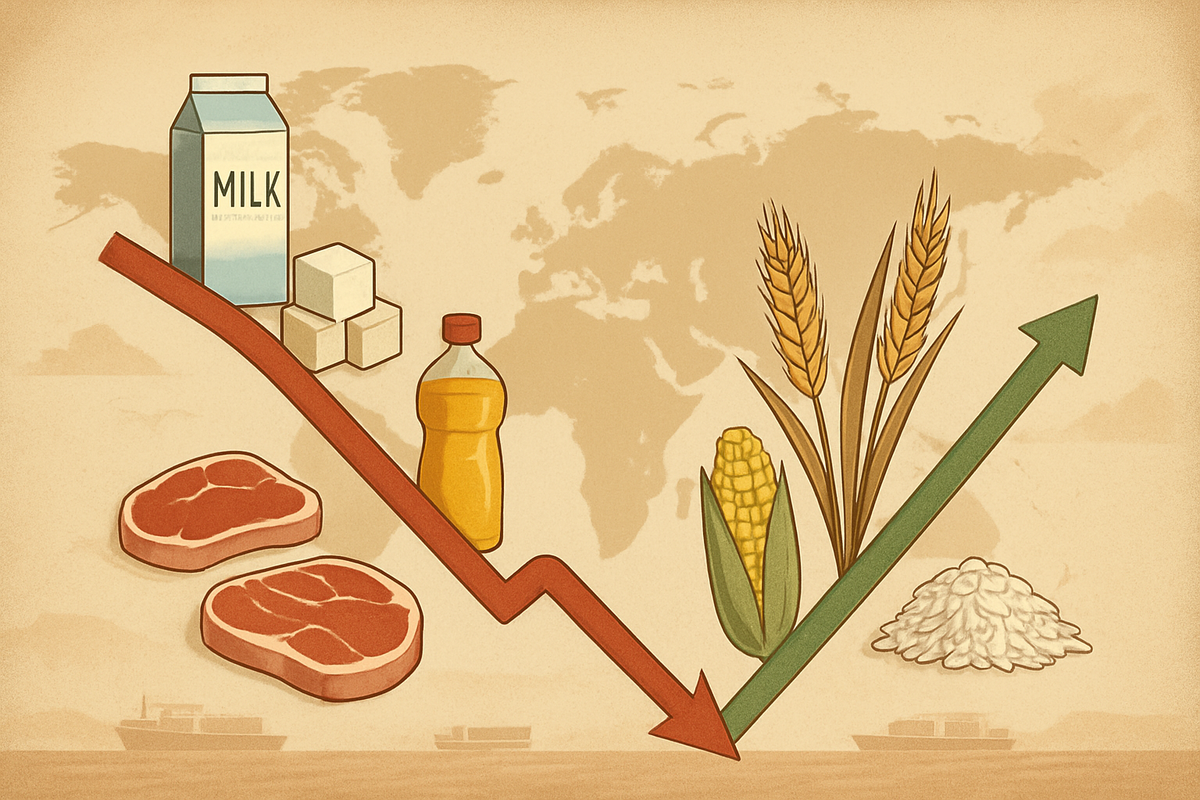
Global food commodity prices have registered a significant decline for the third consecutive month, signaling a potential easing of inflationary pressures and offering a degree of relief to consumers worldwide. The downturn, largely driven by improved supply conditions across several key agricultural sectors, saw most major categories experience a drop, though cereal prices notably bucked the trend with an increase.
This sustained fall, reflected in the FAO Food Price Index (FFPI) which averaged 125.1 points in November 2025 – its lowest point since January 2025 and a striking 21.9% below its March 2022 peak – marks a crucial moment in the global economy. While the immediate implication is cheaper food imports for many nations and a dampening effect on overall inflation, particularly in emerging markets, the benefits may not uniformly reach local consumers due to persistent domestic challenges.
A Closer Look at the Market Shift
The recent decline in global food prices is a complex phenomenon, primarily attributed to robust global supplies and easing inflationary pressures. The FAO Food Price Index's consistent drop over three months, with November 2025 figures being the latest available, underscores a broader trend of market recalibration after a period of extreme volatility.
Specific categories have contributed significantly to this overall downturn:
- Dairy Products: The FAO Dairy Price Index recorded its fifth consecutive monthly decline, dropping by 3.1% in November 2025. Butter and whole milk powder saw the sharpest decreases, driven by increased export availability and heightened competition among suppliers.
- Sugar: Prices tumbled by 5.9% month-on-month, reaching a four-year low. This significant reduction was largely due to strong production in Brazil and optimistic harvest forecasts in key producing nations like India and Thailand.
- Vegetable Oils: The Vegetable Oil Price Index fell by 2.6%, hitting a five-month low, with substantial declines observed in palm, rapeseed, and sunflower oils.
- Meat Prices: The FAO Meat Price Index eased by 0.8%, primarily influenced by abundant supplies of pig and poultry meat from Brazil and increased export competition.
However, the trend was not universal. Cereals stood out as a notable exception, with the FAO Cereal Price Index rising by 1.8% month-on-month. Wheat prices climbed by 2.5%, influenced by potential Chinese demand, renewed geopolitical tensions in the Black Sea region and expectations of reduced plantings in Russia. Maize, barley, and sorghum also saw increases, supported by firm Brazilian demand and rain-disrupted harvests in Argentina and Brazil. Within the meat complex, ovine meat (lamb/mutton) prices increased due to strong global demand, while cheese prices remained relatively resilient within the dairy sector.
Initial market reactions have been mixed. While food processors and retailers welcome the prospect of lower input costs, primary agricultural producers, especially in the dairy and sugar sectors, face the challenge of reduced profit margins. The broader implication for global inflation is positive, but the persistent high costs within the supply chain (energy, labor, logistics) mean that farm-level price changes do not always fully translate to consumer savings, particularly in regions with weak currencies or logistical hurdles.
Companies Navigating the Shifting Tides
The fluctuating global food prices create a divergent landscape for public companies, with clear winners and losers emerging from the latest trends. Companies operating further down the value chain – processors, retailers, and restaurants – generally stand to benefit from lower input costs in most categories, while primary producers face significant financial pressure.
Potential Winners:
Food manufacturers and processors that rely heavily on dairy, sugar, vegetable oils, and meats as raw materials are poised for improved profitability. For instance, diversified food companies like The Kraft Heinz Company (NASDAQ: KHC) and Nestlé (OTC: NSRGY), with their extensive dairy-containing product lines, could see reduced costs for milk and milk derivatives. Similarly, confectionery and beverage giants such as Mondelez International (NASDAQ: MDLZ), The Hershey Company (NYSE: HSY), and The Coca-Cola Company (NYSE: KO) will benefit from lower sugar prices, potentially boosting their margins. Agribusiness firms like Archer-Daniels-Midland (NYSE: ADM) and Bunge Limited (NYSE: BG), which process vegetable oils, could also see reduced raw material expenses.
Restaurant chains and food service providers, whose menu costs are directly tied to meat prices, will experience significant relief. Companies like McDonald's Corporation (NYSE: MCD) or Yum! Brands, Inc. (NYSE: YUM) could see an uplift in their profitability.
Food retailers, including supermarket giants such as Tesco PLC (LSE: TSCO) and J Sainsbury plc (LSE: SBRY), are well-positioned to capitalize on lower wholesale costs across multiple categories. They can either pass some savings to consumers to attract more customers or retain the savings to boost their profit margins.
On the other hand, cereal producers could see increased revenues due to rising cereal prices. Major players like General Mills (NYSE: GIS) and W.K. Kellogg Co. (NYSE: K) (the cereal-focused entity spun off from Kellogg) might experience improved financial performance from higher selling prices for their core products.
Potential Losers:
Primary agricultural producers, especially in the dairy, sugar, vegetable oil, and meat sectors, will face declining revenues and squeezed margins. For instance, large integrated agricultural companies with significant dairy farming operations, such as Adecoagro S.A. (NYSE: AGRO), could see negative impacts. Sugar producers, including Brazilian giant Cosan (NYSE: CSAN), may face headwinds from lower selling prices. Meat processing enterprises that heavily rely on selling raw or minimally processed meat, such as JBS S.A. (OTC: JBSAY), Tyson Foods, Inc. (NYSE: TSN), and Hormel Foods Corporation (NYSE: HRL), would face direct negative impacts on their revenues and margins.
Agricultural input suppliers, such as companies providing feed, seed, and fertilizer, could also experience reduced demand and pressure on selling prices as struggling farmers cut back on spending.
Conversely, companies that use cereals as major inputs, such as animal feed producers or some processed food manufacturers, could face increased production costs due to rising cereal prices, potentially squeezing their margins if they cannot pass these costs on to consumers. The ultimate impact on stock performance will depend on each company's specific exposure, ability to manage costs, and pricing strategies.
Wider Significance and Broader Trends
The global food price decline, while a welcome development for many, fits into a broader narrative of an increasingly complex and interconnected global food system. It reflects improved supply conditions for several commodities but also highlights persistent challenges and underlying vulnerabilities that prevent a complete translation of these savings to the end consumer.
This trend is indicative of a potential shift towards greater stability in global food markets after a period of unprecedented volatility. However, a "decoupling" effect is evident: while international commodity prices fall, consumer food prices often remain stubbornly high due to persistent high costs within the supply chain, including energy, labor, and logistics. This suggests that future food price stability will be increasingly dependent on global energy and labor markets rather than solely on farm yields.
The ripple effects are far-reaching. Farmers and upstream producers face reduced profitability, potentially leading to financial distress and consolidation within the agricultural sector. Commodity trading firms might see reduced volatility and narrower margins. For consumers, particularly in low- and middle-income countries, the decline offers significant relief, though the full extent of these savings may not materialize at the retail level.
From a regulatory and policy perspective, governments face pressure to support domestic producers during periods of low prices, potentially leading to increased tariff protection or state aid. A sustained decline could also trigger a resurgence of trade-restrictive policies and increased government subsidies, hindering international efforts towards agricultural trade reform. Policymakers are also advised to remain focused on global uncertainties and risks to proactively manage food price fluctuations, emphasizing integrated approaches that encompass the entire value chain and prioritize food security. Historically, government attempts to suppress food prices through direct intervention, while offering short-term benefits, have often led to shortages and unsustainable budgetary costs.
The current situation contrasts with the record high FAO Food Price Index in March 2022, largely triggered by Russia's invasion of Ukraine. While current food commodity inventories are decreasing, they remain higher than during major price spikes in 2007 and 2011. Historical precedents show that periods of sustained low food prices have prompted government intervention with subsidies, while high food prices have been linked to widespread social unrest.
Supply chain stability remains paramount. Disruptions from pandemics, natural disasters, and geopolitical conflicts continue to cause delays, increase costs, and reduce availability. Despite recent commodity price declines, consumer prices remain elevated due to these persistent costs within global supply chains. Geopolitical factors, such as the Russia-Ukraine war, have been major contributors to food price volatility, impacting transport, energy prices, and local agricultural production. Climate change, with its increasing frequency of extreme weather events, is a persistent long-term driver of food price volatility and upward trends, projected to amplify food inflation significantly in the coming years.
What Comes Next: Navigating Future Scenarios
The trajectory of global food prices in the coming months and years will be shaped by a dynamic interplay of economic, environmental, and geopolitical forces. While short-term forecasts suggest continued stabilization or a slight decline, the long-term outlook points to persistent volatility and the need for strategic adaptation across the industry.
In the short term (2025-2026), global food prices are generally anticipated to continue their downward trend or stabilize. The World Bank forecasts a 6% decrease in food prices in 2025, followed by a further 0.3% decline in 2026. This softening is largely attributed to improved supply conditions for major grains, sugar, dairy, and vegetable oils. However, the slight increase in cereal prices, driven by Black Sea tensions and strong export demand, indicates that not all commodities will follow a uniform path. Specific commodities like coffee and cocoa have also seen significant price surges due to extreme weather.
Looking to the long term (beyond 2026-2027), the global food market is expected to remain volatile. Commodity prices are projected to stay approximately 30% higher than their pre-pandemic five-year average. Climate change will be a dominant factor, with extreme weather events expected to add up to 3 percentage points to annual global food inflation by 2035 and significantly reduce crop yields. Evolving consumer demand for healthier, sustainably sourced, and alternative proteins will also drive market changes. A fundamental transformation of current food production systems is deemed necessary to meet global food needs within planetary boundaries by 2030.
Strategic pivots and adaptations for industry players are crucial. Companies must prioritize supply chain diversification and resilience to mitigate risks from regional crop failures or geopolitical disruptions. Investment in agricultural technology, such as precision farming and drought-resistant crops, will enhance productivity and reduce resource dependence. Optimizing efficiencies and sustainable practices across the supply chain will be key for manufacturers and retailers to leverage lower input costs. Product innovation, focusing on utilizing lower-cost ingredients and adapting to changing consumer preferences, will also be vital.
Emerging market opportunities and challenges will be significant. Rapid urbanization, rising disposable incomes, and evolving consumer habits in regions like Southeast Asia, South Asia, Africa, and Latin America are driving demand for diverse food products, convenience foods, and healthier options. However, infrastructure gaps, regulatory hurdles, and consumer price sensitivity in these markets pose considerable challenges. Geopolitical crises disproportionately impact import-dependent emerging economies, exacerbating food insecurity.
Potential scenarios for the global food market range from continued volatility to a shift towards abundance (contingent on mitigating climate and geopolitical risks) or even exacerbated inequality. The World Economic Forum and BCG have outlined scenarios from "Survival of the Richest" to "Coordinated Step Forward," highlighting the divergent paths the global food system could take based on collective action and policy choices. The ongoing influence of geopolitical events, climate change, and economic policies will be the primary determinants of which scenario unfolds.
A Comprehensive Wrap-Up: Navigating the Future of Food
The global food market is at a critical juncture, characterized by a recent easing of commodity prices alongside persistent underlying complexities. The third consecutive month of declining global food prices, primarily driven by improved supplies in dairy, sugar, vegetable oils, and most meats, offers a much-needed respite from inflationary pressures. However, the notable exception of rising cereal prices and the continued stickiness of consumer-level food inflation underscore the fragmented nature of this relief.
Moving forward, the market will likely remain volatile. While the short-term outlook suggests continued stabilization, the long-term picture is heavily influenced by the escalating threats of climate change, persistent geopolitical tensions, and the effectiveness of global and national economic policies. These factors will continue to shape supply chain dynamics, production costs, and ultimately, consumer prices.
For investors, the coming months will require careful observation of several key indicators. Monitoring the FAO Food Price Index and its sub-indices will provide insights into commodity-specific trends. Attention should also be paid to geopolitical developments, particularly in major agricultural regions and trade routes, as well as weather patterns globally. Furthermore, tracking corporate earnings reports from food manufacturers, retailers, and agricultural firms will reveal how companies are adapting their strategies—be it through supply chain diversification, technological investments, or pricing adjustments—to navigate this evolving landscape. The divergence in performance between primary producers and downstream processors will be a critical theme to watch.
The current environment demands agility and strategic foresight from all stakeholders. While the recent price declines offer a glimmer of hope for a more stable food system, the underlying vulnerabilities to climate change and geopolitical shocks necessitate proactive measures. A sustainable and resilient global food system will require collaborative efforts, innovative solutions, and responsive policies that balance economic stability with food security and environmental stewardship.
This content is intended for informational purposes only and is not financial advice