As the final bells ring on 2025, investors are looking back at a year for Tesla, Inc. (NASDAQ: TSLA) that can only be described as a high-stakes rollercoaster. It was a year where the laws of financial gravity seemed to bend; while the company’s core automotive business faced its first prolonged annual contraction in history, its market valuation surged to record heights. This "decoupling" of stock price from vehicle deliveries has redefined Tesla not as a car company, but as a speculative barometer for the future of Artificial Intelligence and robotics.
The immediate implications of 2025 are profound. Tesla has successfully transitioned its narrative away from being the "king of EVs"—a title it officially ceded to Chinese rival BYD (OTC:BYDDY) this year—and toward becoming an AI powerhouse. However, this pivot has come at a cost. The company’s heavy reliance on the personal brand of Elon Musk and the speculative promise of "unsupervised" autonomy has introduced a level of volatility that now poses a systemic risk to the broader Nasdaq Composite (NASDAQ: IXIC).
The Year of the "Demand Cliff" and the Robotaxi Pivot
The 2025 timeline for Tesla was marked by extreme highs and sobering lows. The year began in a "stagnation phase," with the company struggling to maintain the breakneck growth of previous years. By the end of the fourth quarter, the "demand cliff" became a reality: annual deliveries were estimated at 1.64 million units, an 8.3% decline from 2024. This contraction was punctuated by a record-breaking Q3, where customers rushed to purchase vehicles before the expiration of federal tax credits, only to see interest plummet in the final months of the year.
The centerpiece of the year was the long-awaited Robotaxi launch on June 22, 2025, in Austin, Texas. While the event initially sent the stock soaring, the reality was more nuanced. Tesla was forced to include safety drivers in its pilot fleet, failing to achieve the "Level 5" unsupervised autonomy that Musk had promised for the year. This led to an official postponement of the "unsupervised" rollout to 2026, yet the market largely looked past the delay, choosing instead to price in the massive potential of the "AI Moat" that Tesla is building through its Full Self-Driving (FSD) data.
Key players this year extended beyond the boardroom. Elon Musk’s dual role as Tesla CEO and a lead figure in the newly formed Department of Government Efficiency (DOGE) under the Trump administration created a unique "partisan effect." On November 6, 2025, shareholders approved a revised $1 trillion compensation package for Musk, a move that signaled total alignment with his vision, despite vocal concerns from institutional investors about his distractions with X (formerly Twitter) and political ventures.
Winners and Losers in the Great EV Shift
The clear winner of the 2025 fiscal year was Tesla Energy. While the car business stalled, the energy segment became the "quiet giant," deploying a record 12.5 GWh of energy storage in Q3 alone—an 81% year-over-year increase. With gross margins exceeding 30%, Tesla Energy now contributes nearly 25% of the company’s total profit, providing a critical safety net for the balance sheet as automotive margins were squeezed to 17% by persistent price wars.
On the losing side, Tesla’s dominance in the global EV market has officially been broken. BYD (OTC:BYDDY) finished 2025 as the world’s top seller of electric vehicles, leveraging its vertical integration to undercut Tesla’s pricing by as much as 50% in European and Southeast Asian markets. Meanwhile, legacy automakers like Ford Motor Company (NYSE: F) and Hyundai Motor Company (KRX:005380) have successfully chipped away at Tesla’s U.S. market share, which fell below 50% for the first time this year.
The consumer base also saw a significant shift. Data from the latter half of 2025 suggests a "Musk Partisan Effect," where Tesla lost an estimated 1 million potential sales in the U.S. due to Musk’s political polarization. While favorability rose among Republican buyers, it collapsed among Democrats—the demographic that historically formed the core of the early EV adopter market.
Broader Industry Trends and the AI Narrative
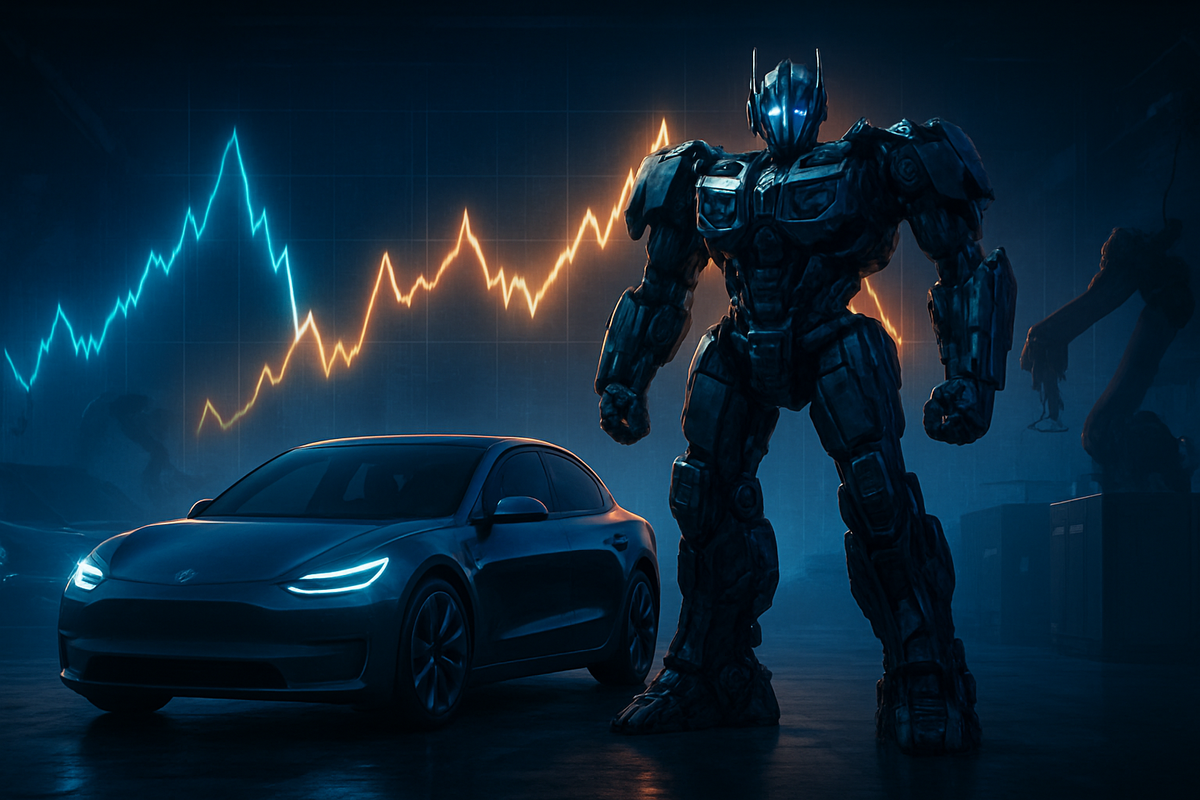
Tesla’s performance in 2025 is a microcosm of a broader trend: the "AI-fication" of the industrial sector. The market is no longer valuing Tesla based on how many Model 3s it can produce, but on its potential to dominate the humanoid robotics market with Optimus and the software-as-a-service (SaaS) potential of FSD. This shift has turned Tesla into a "speculative barometer" for the entire tech sector. When Tesla hit its all-time intraday high of $498.83 in mid-December, it single-handedly powered the Nasdaq to new peaks.
However, this reliance on a single company’s AI narrative has regulatory and policy implications. The delay of unsupervised Robotaxis highlights the gap between Silicon Valley’s "move fast and break things" ethos and the stringent safety requirements of federal transportation regulators. Furthermore, Tesla’s aggressive pricing strategies to combat BYD have triggered a "race to the bottom" in EV margins, forcing competitors to either innovate rapidly or exit the low-end EV market entirely.
Historically, this year draws comparisons to the dot-com era, where valuations were built on future promises rather than current cash flows. The difference in 2025 is Tesla’s massive infrastructure—its Gigafactories and energy business—which provide a tangible foundation that many 1990s tech darlings lacked. Yet, the volatility remains, as seen during the late-December correction where Tesla paced Nasdaq decliners, dragging the entire index down as the AI-driven trade cooled.
What Lies Ahead for 2026
Looking toward 2026, Tesla faces a critical strategic pivot. The company must prove that it can move from "supervised" to "unsupervised" autonomy to justify its $1.5 trillion market cap. Any further delays in the Robotaxi rollout or FSD regulatory hurdles could lead to a massive re-rating of the stock. Investors are also closely watching for the rumored "Model 2"—a more affordable entry-level vehicle—which many analysts believe is the only way for Tesla to regain lost ground from BYD in the mass market.
The integration of Optimus into Tesla’s own factory lines will be another key milestone. If Tesla can demonstrate that its humanoid robots can significantly reduce manufacturing costs, it may solve its margin problem without needing to raise vehicle prices. However, the challenge of maintaining a cohesive brand image amidst Elon Musk’s increasingly public political role will continue to be a wild card that could either open new doors in government contracting or continue to alienate a large segment of the traditional consumer base.
A Year of Transformation and Tension
In summary, 2025 was the year Tesla ceased to be a car company and became a high-stakes bet on the future of autonomy. The key takeaways for the year are clear: the energy business is a powerhouse, the automotive business is under siege from China, and the stock price is now untethered from traditional delivery metrics, driven instead by AI sentiment and the personal influence of Elon Musk.
Moving forward, the market is likely to remain volatile. Tesla’s outsized weight in the Nasdaq means that its idiosyncratic risks—from a Musk tweet to a regulatory setback in FSD—are now systemic risks for all tech investors. In the coming months, investors should keep a close eye on FSD version 13 adoption rates and the progress of the Austin Robotaxi pilot. Tesla has survived the rollercoaster of 2025, but the tracks ahead in 2026 look equally steep and unpredictable.
This content is intended for informational purposes only and is not financial advice.