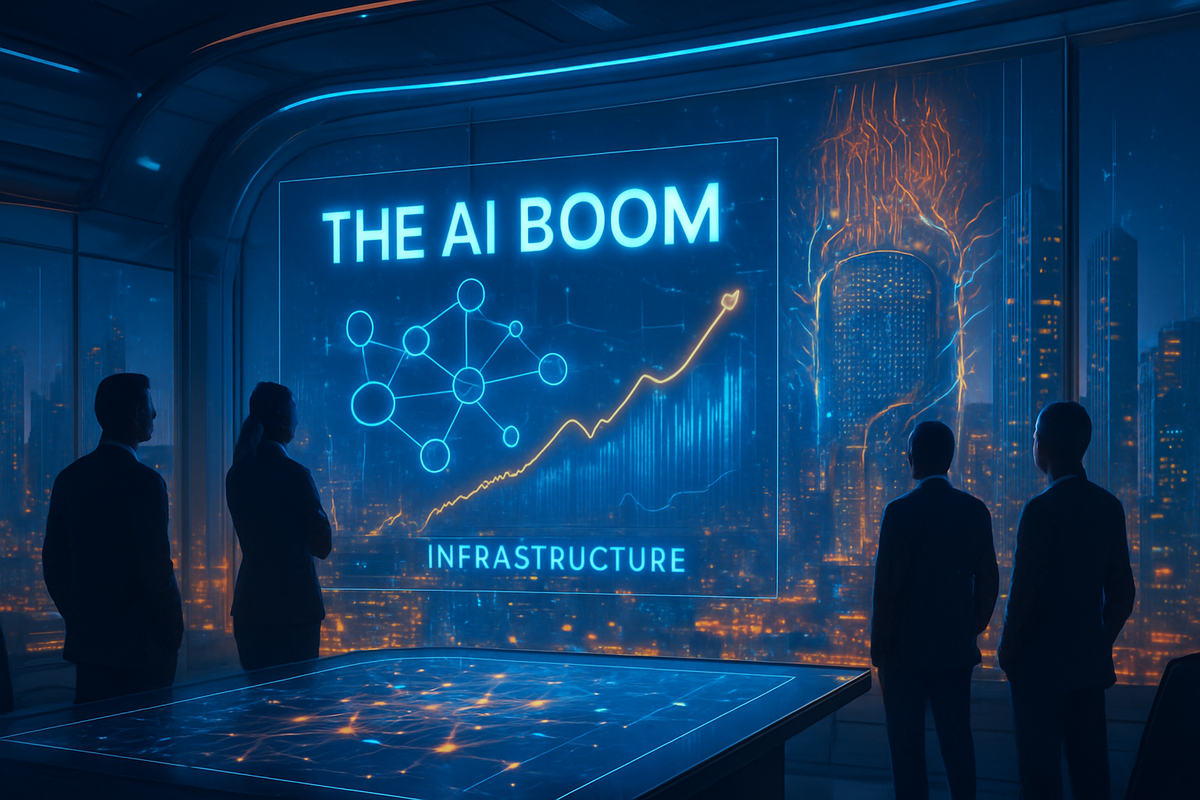
As the calendar turns to 2026, the technology sector is undergoing a profound structural transformation that has reignited the engine of global dealmaking. After years of "defensive preservation" and cautious capital allocation, the industry has entered what analysts are calling an "Innovation Supercycle." This resurgence is fueled by a dual catalyst: the maturation of the Artificial Intelligence (AI) boom from experimental software into foundational infrastructure, and a significantly more favorable interest rate environment that has finally bridged the valuation gap between buyers and sellers.
The immediate implications of this shift are staggering. In the final months of 2025, the market witnessed a flurry of multibillion-dollar announcements that signaled the end of the "wait-and-see" era. With the Federal Reserve’s gradual rate-cutting cycle guiding the market toward a projected terminal rate of 3.25% by late 2026, the cost of capital has thawed, allowing tech giants and private equity titans to deploy their massive cash reserves. This is no longer just about acquiring talent; it is a high-stakes race to secure the energy, data, and specialized hardware required to dominate the next decade of computing.
A New Playbook for the AI Arms Race
The narrative of tech M&A in 2026 has moved past the "acqui-hire" phase of 2024, where companies were bought primarily for their engineering teams. Today, the focus is on "Agentic AI" and infrastructure dominance. A pivotal moment occurred in late 2025 when ServiceNow (NYSE: NOW) announced its $7.75 billion acquisition of the cybersecurity firm Armis, a move designed to integrate AI-native proactive security into every enterprise workflow. This deal set a precedent for "platform-led rollups," where established giants swallow specialized players to offer a unified, AI-driven ecosystem.
The timeline leading to this current frenzy was marked by a series of strategic maneuvers throughout 2025. As inflation stabilized and the "higher-for-longer" interest rate narrative faded, the "bid-ask" gap—the price difference between what startups wanted and what acquirers would pay—began to evaporate. Major players like Salesforce (NYSE: CRM) capitalized on this normalization, notably with their $8 billion acquisition of Informatica (NYSE: INFA) to control the critical data management layer necessary for enterprise-grade AI. This was followed by Palo Alto Networks (NASDAQ: PANW) acquiring CyberArk (NASDAQ: CYBR) in a landmark $25 billion deal that consolidated the identity security market.
Perhaps the most surprising trend of 2026 is the convergence of tech and energy. The merger between Trump Media & Technology Group (NASDAQ: DJT) and the nuclear fusion pioneer TAE Technologies in late 2025 highlighted a new reality: AI dominance requires proprietary power. As data centers consume an ever-increasing share of the global power grid, the "Big Tech" cohort—including Alphabet (NASDAQ: GOOGL) and Amazon (NASDAQ: AMZN)—is now looking at energy providers as viable M&A targets to ensure their AI models never go dark.
The Winners and Losers of the Innovation Supercycle
The primary beneficiaries of this new M&A landscape are the "Hyperscalers" and cash-rich conglomerates. Microsoft (NASDAQ: MSFT) and Meta (NASDAQ: META) have utilized their premium stock valuations as a powerful currency to acquire niche AI startups at a fraction of their 2021-era valuations. These companies are not just winning in terms of market share; they are successfully building "moats" around their ecosystems by acquiring the entire vertical stack, from the silicon chips to the end-user applications.
Private equity firms are also emerging as major winners. With a record $2 trillion in "dry powder" entering 2026, firms like Blackstone (NYSE: BX) and KKR (NYSE: KKR) are leading a wave of "take-private" deals. They are targeting mid-cap tech firms that have strong fundamentals but failed to achieve the scale necessary to compete in an AI-first world. By taking these companies private, PE firms can restructure them away from the quarterly scrutiny of public markets, integrating AI into their core operations before a potential re-listing in 2027 or 2028.
Conversely, the "losers" in this environment are the "AI-Have-Nots"—companies that failed to integrate generative AI into their core products during the 2023–2025 window. These legacy software-as-a-service (SaaS) providers are finding themselves increasingly marginalized, their market caps dwindling as customers migrate to AI-native platforms. Additionally, highly leveraged tech companies that took on significant debt during the low-rate era of 2020-2021 are struggling. Despite the recent rate cuts, the cost of servicing old debt remains a burden, making them prime targets for "distressed M&A" where they are acquired for their remaining intellectual property rather than their ongoing business value.
Shifting Regulations and the Global AI Race
The wider significance of the 2026 M&A boom cannot be overstated, particularly regarding the regulatory shift in the United States. Under a renewed focus on "Technological Sovereignty," the Federal Trade Commission (FTC) and the Department of Justice (DOJ) have moved away from an inherently adversarial stance toward large-scale consolidation. Instead of blocking deals outright, regulators are increasingly favoring "structural remedies," such as the divestiture of non-core units, to allow American firms to scale rapidly against global competitors.
This policy shift is a direct response to the geopolitical AI race. Policymakers now view tech consolidation as a matter of national security, preferring that domestic giants like Google or Amazon acquire promising startups rather than allowing them to fall into the hands of foreign entities or languish due to a lack of capital. This "America First Antitrust" approach has cleared the path for mega-deals that would have been unthinkable just three years ago, such as Google’s massive $32 billion pursuit of the cloud security unicorn Wiz.
Historically, this period mirrors the late 1990s build-out of the internet infrastructure, but with a crucial difference: the current wave is underpinned by actual revenue and productivity gains. Unlike the dot-com bubble, the acquisitions of 2026 are focused on "Agentic AI"—systems that do not just generate text but perform complex labor. This shift is forcing a ripple effect across all sectors, from healthcare to finance, as companies realize that participating in the M&A market is no longer optional—it is a prerequisite for survival.
What Lies Ahead: The 2026 Outlook
In the short term, the market should expect a "dual-track" exit strategy to become the standard for venture-backed startups. Companies will simultaneously prepare for an IPO while engaging in serious acquisition talks, using the threat of a public listing to drive up their M&A valuation. As the IPO window reopens more fully in mid-2026, we may see a healthy mix of new public offerings and strategic exits, providing much-needed liquidity to the venture capital ecosystem.
Long-term, the focus will likely shift toward "Sovereign AI." We are already seeing Middle Eastern sovereign wealth funds, such as Saudi Arabia's Public Investment Fund (PIF) and the UAE’s MGX, becoming essential equity partners in $10 billion-plus infrastructure deals. This infusion of global capital will enable a level of infrastructure spending—specifically in subsea cables and massive GPU clusters—that even the largest individual tech companies might struggle to fund alone. Strategic pivots will be required as companies move from being "software providers" to "compute and energy orchestrators."
Closing the Chapter on the Tech Winter
The tech M&A landscape of 2026 marks a definitive end to the "tech winter" that began in late 2022. The combination of stabilized interest rates, a more permissive regulatory environment, and the undeniable imperative of AI has created a "perfect storm" for dealmaking. The key takeaway for the market is that the "great shakeout" is over, and the "great consolidation" has begun. Investors are no longer rewarding companies for simply having an AI strategy; they are rewarding those who have the scale and the balance sheet to acquire the future.
Moving forward, the market will be defined by a widening gap between the dominant platforms and the specialized providers they depend on. For investors, the coming months will require a close watch on the "AI-adjacent" sectors—specifically energy and cybersecurity—where the next wave of mega-deals is likely to occur. As the cost of capital continues to normalize, the speed of execution will be the primary differentiator between the winners who lead the 2026 cycle and the losers who are absorbed by it.
This content is intended for informational purposes only and is not financial advice.