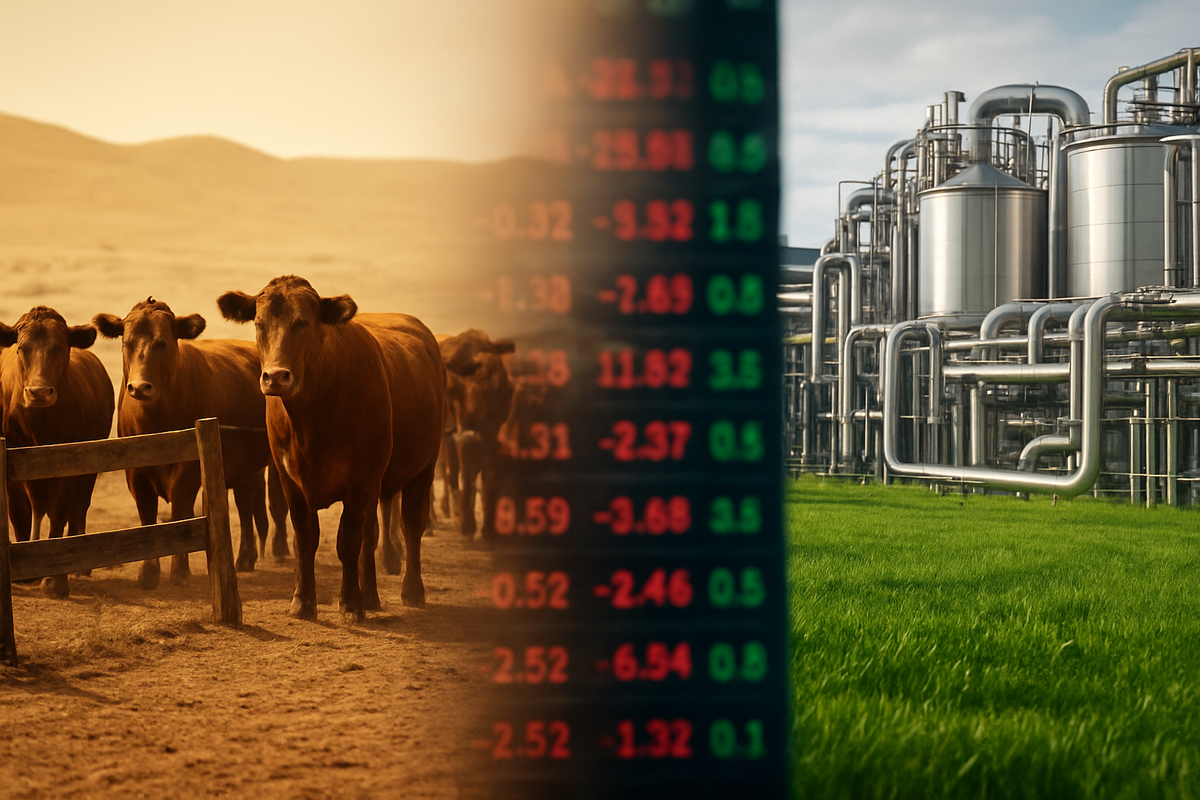
As of late December 2025, the United States livestock market is navigating a period of profound structural upheaval, defined by a historic divergence between the beef and dairy sectors. While cattle producers are grappling with a herd size not seen since the 1950s—sending beef prices to unprecedented heights—the dairy industry is facing a significant supply surplus that threatens to depress prices well into 2026. This "Great Divide" is being further complicated by aggressive shifts in federal trade policy and a strategic contraction of processing capacity among the nation's largest meatpackers.
The immediate implications for the market are stark: consumers are facing record-high prices at the grocery store, while the industrial backbone of the meat sector is under extreme financial duress. With fed cattle prices averaging between $224 and $230 per hundredweight (cwt) this month, the cost of doing business has become unsustainable for many processors. Simultaneously, a recent surge in beef import quotas from South America has sent shockwaves through the futures market, creating a volatile environment where cash bids are fluctuating wildly despite the underlying shortage of domestic animals.
The Roots of the Shortage and the Dairy Surplus
The current crisis in the cattle sector is the culmination of a multi-year liquidation phase that has seen the U.S. herd shrink to just 86.7 million head. This contraction, fueled by years of drought and high operational costs, reached a critical point in November 2025 when cattle placements into feedlots hit their lowest level since record-keeping began in 1996, dropping 11% year-over-year. The shortage has effectively stripped meatpackers of their traditional leverage, forcing them to pay record prices to secure enough inventory to keep plants running, even at reduced capacity.
The timeline of this volatility accelerated in October 2025, when the federal administration announced a major policy pivot aimed at cooling domestic food inflation. This included quadrupling the import quota for Argentinian beef and significantly lowering tariffs on Brazilian trimmings. The announcement caused an immediate $15 to $25 drop in cattle futures, as the market braced for an influx of cheaper foreign meat. Meanwhile, the southern border remains largely shuttered to live cattle imports from Mexico due to an outbreak of New World Screwworm (NWS), cutting off a vital supply of over one million feeder cattle annually for southern U.S. feedlots.
In the dairy sector, the narrative is the opposite. Milk production has surged by 3.7% year-over-year, driven by record yields per cow and a growing trend of "beef-on-dairy" crossbreeding. While this crossbreeding provides a more valuable calf for the beef market, the sheer volume of milk being produced has outpaced domestic demand. As of December 26, 2025, the USDA's all-milk price forecast for the year stands at $21.00/cwt, but analysts are already projecting a sharp decline to $18.75/cwt in 2026 as the surplus of cheese and butter continues to build.
Corporate Fallout: Winners and Losers in a Tight Market
The primary "losers" in this current cycle are the major meat processing giants, most notably Tyson Foods (NYSE: TSN). The company reported a staggering $426 million operating loss in its beef segment for fiscal 2025, a direct result of the "negative spread" between record-high live cattle costs and what consumers are willing to pay for finished beef. In a drastic move to preserve capital, Tyson announced the permanent closure of its Lexington, Nebraska facility effective January 2026 and has cut shifts at several other major plants.
JBS S.A. (OTC: JBSAY) has managed to weather the storm slightly better due to its massive global footprint. While its U.S. beef margins have been squeezed to near-zero, the company’s operations in Australia and Brazil—where cattle cycles are currently more favorable—have provided a necessary hedge. Similarly, Hormel Foods (NYSE: HRL) has seen its margins pressured by a 25% spike in raw material costs for beef and pork bellies, leading the company to accelerate a "Transform and Modernization" initiative to cut internal costs as it enters the new year.
On the winning side of the ledger are the smaller, specialized producers and new market entrants. Sustainable Beef, a regional processor backed by retail giant Walmart (NYSE: WMT), is set to begin full operations in early 2026. These newer facilities are designed for high efficiency and are often located closer to the remaining pockets of cattle inventory, allowing them to bypass some of the logistical hurdles facing the "Big Four" packers. Furthermore, grain-heavy companies may see a peripheral benefit as lower corn and soybean meal prices in late 2025 have provided a rare bit of relief for feedlot margins.
Broader Significance and Industry Trends
This market state represents a significant departure from historical norms, where beef and dairy often moved in closer tandem. The current "structural upheaval" highlights a broader industry trend toward regionalization and the increasing influence of global trade as a domestic price-control mechanism. By opening the doors to South American beef, the U.S. government is signaling that it is no longer willing to allow domestic supply shortages to dictate the "dinner table inflation" that has become a political liability.
The regulatory implications are also mounting. The ongoing closure of the Mexican border due to New World Screwworm is a reminder of how vulnerable the modern supply chain is to biological and biosecurity risks. This event has forced a re-evaluation of "just-in-time" inventory models for cattle, as feedlots in Texas and Kansas find themselves unable to source the young animals they need to stay viable. Historically, the industry would rely on a quick "heifer retention" phase to rebuild the herd, but high interest rates in 2025 have made the multi-year investment of raising a cow-calf pair too expensive for many family-owned ranches.
Furthermore, the dairy surplus is a direct byproduct of technological efficiency. The industry has become so good at producing milk that it has effectively "engineered" itself into a low-margin trap. This mirrors past cycles in the 1980s and early 2000s, where overproduction led to government intervention or massive industry consolidation. The ripple effect is already being felt by dairy cooperatives, which are beginning to implement strict production quotas to prevent a total price collapse in 2026.
The Road Ahead: Scenarios for 2026 and Beyond
Looking ahead to 2026, the livestock market is entering a "wait-and-see" period. For the beef industry, the road to recovery will be long; a heifer born today will not produce a market-ready calf until late 2028 or 2029. This suggests that the supply of domestic beef will remain tight for the remainder of the decade. Investors should expect more "right-sizing" from the major packers, with older, less efficient plants likely to follow Tyson’s Lexington facility into retirement.
In the short term, the market will be hyper-focused on whether the influx of Argentinian and Brazilian beef actually lowers retail prices or if it simply pads the margins of retailers like Walmart (NYSE: WMT) and Kroger (NYSE: KR). If the import strategy fails to cool inflation, further regulatory interventions—such as stricter price reporting requirements for packers—could be on the table.
For the dairy sector, the next 12 months will likely be a period of painful consolidation. Small to mid-sized dairies that cannot compete with the scale and efficiency of "mega-dairies" may be forced to exit the market or pivot entirely toward the "beef-on-dairy" model. This shift could eventually help alleviate the beef shortage, but the impact won't be felt in the meat case for at least another 18 to 24 months.
Summary and Final Assessment
The current state of the livestock market is a tale of two extremes: a beef sector starved for supply and a dairy sector drowning in it. The historic low in cattle inventory has shifted the balance of power toward producers in the short term, but the aggressive entry of foreign beef and the closure of domestic processing plants suggest that this leverage may be fleeting. For the "Big Four" meatpackers, 2025 has been a year of survival, and 2026 promises to be a year of restructuring.
Investors and market observers should keep a close eye on three key metrics: heifer retention rates (the first sign of a herd rebuild), the status of the Mexican border regarding Screwworm, and the volume of South American beef entering U.S. ports. While feed costs have provided a temporary cushion, the fundamental lack of "hooks" and "heads" remains the primary driver of market volatility. Moving forward, the livestock sector will be defined by its ability to adapt to a globalized supply chain that is increasingly used as a buffer against domestic scarcity.
This content is intended for informational purposes only and is not financial advice.