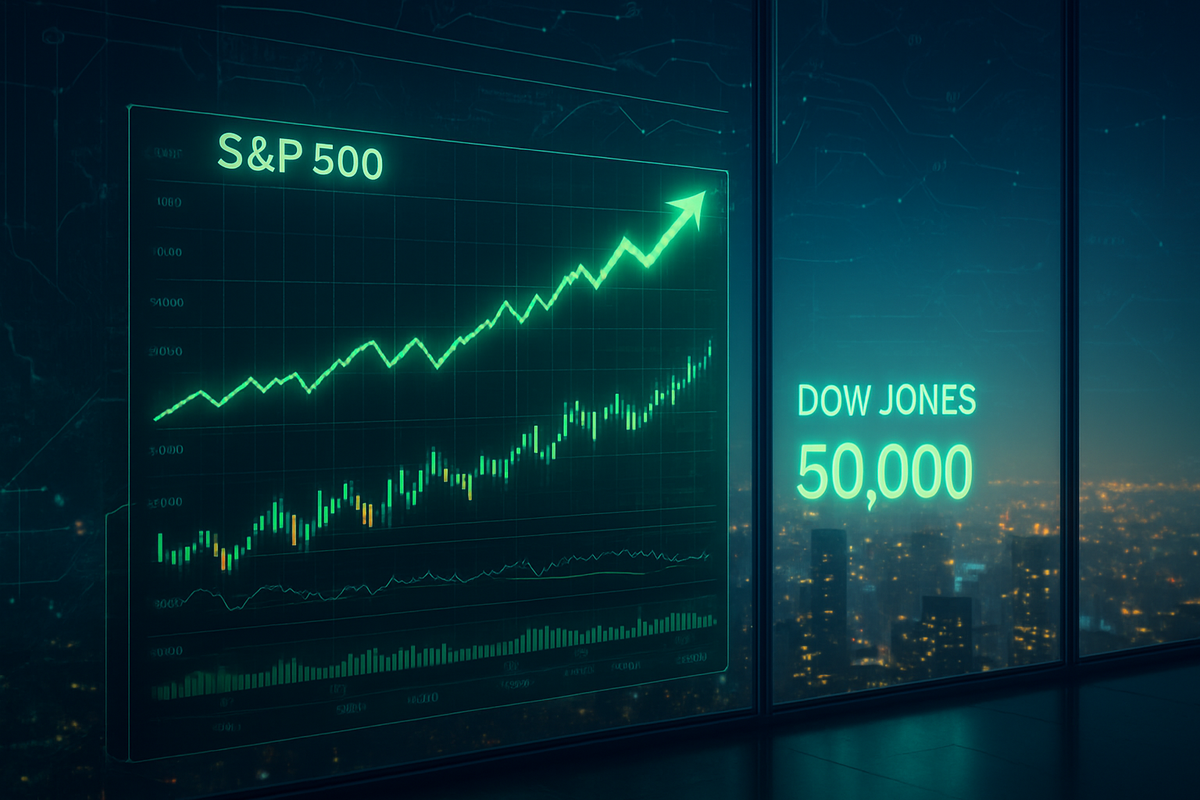
As the holiday season of 2025 draws to a close, the U.S. equity markets are delivering a gift to investors that few predicted during the volatile spring. The S&P 500 (INDEXSP: .INX) and the Dow Jones Industrial Average (INDEXDJX: .DJI) are currently hovering just below record highs, capping off a year defined by extreme policy shifts, a landmark government shutdown, and the maturation of the artificial intelligence "supercycle." With the S&P 500 trading in the 6,850 to 6,930 range and the Dow eyeing the psychological 50,000 milestone, the market is positioned for a high-stakes breakout as the calendar turns to 2026.
This resilient performance comes despite a year of significant headwinds. The "April Tariff Panic" and a record-breaking 43-day government shutdown in the fourth quarter threatened to derail the economy, yet a series of late-year interest rate cuts by the Federal Reserve and a surge in corporate AI adoption have kept the "Goldilocks" narrative alive. However, as the market enters the final week of December, technical indicators suggest that while the primary trend remains bullish, the path forward in early 2026 will require navigating overbought conditions and a looming leadership transition at the central bank.
A Year of Resilience: From Tariff Panics to AI Adoption
The market’s journey to these record levels was anything but linear. The defining moment of 2025 occurred on April 2nd, when the administration announced a sweeping trade policy involving a flat 10% duty on all imports and reciprocal tariffs reaching as high as 145% on certain goods from China. The immediate reaction was a "Tariff Panic" that saw the S&P 500 plunge 12% in a single week, while the Dow suffered historic back-to-back 1,500-point daily losses. This volatility was only quelled by a 90-day "negotiation pause" later that month, which sparked a massive 9.5% single-day rally, the largest in years.
Compounding the mid-year uncertainty was a record 43-day government shutdown in the fourth quarter of 2025. The shutdown shaved approximately 1.0% to 1.5% off annualized GDP growth, which ended the year at a modest 1.9%. However, the Federal Reserve stepped in to provide a safety net, implementing three 25-basis-point rate cuts in September, November, and December. This brought the federal funds rate down to a range of 3.50% – 3.75%, providing the liquidity necessary to fuel the year-end rally.
Throughout this period, the "Magnificent 7" continued to play a pivotal role, though the nature of their leadership shifted. While 2024 was about the "builders" of AI infrastructure, 2025 became the year of the "adopters." Investors began rewarding companies that could demonstrate tangible Return on Investment (ROI) from their massive AI capital expenditures, rather than just those selling the chips. This shift helped broaden the rally, as sectors like Financials and Industrials began to participate more meaningfully in the market's ascent.
The AI Pivot: Winners and Losers in the New Regime
The primary winners of the late-2025 rally have been the "AI Adopters" and "Hyperscalers" who successfully transitioned from experimentation to monetization. Microsoft (Nasdaq: MSFT) and Alphabet (Nasdaq: GOOGL) have maintained their leadership positions by integrating generative AI into core enterprise and search products, driving margin expansion that surprised analysts. Similarly, Amazon (Nasdaq: AMZN) saw its cloud division, AWS, benefit from a surge in custom AI model hosting, helping the stock reach new heights in December.
Conversely, the "AI Builders"—specifically the semiconductor giants—have seen their dominance wane slightly as the market reached a saturation point for hardware. While NVIDIA (Nasdaq: NVDA) remains a titan, its stock has entered a consolidation phase as investors look for the next leg of growth beyond GPU sales. Companies that were heavily exposed to the "April Tariff Panic" without a diversified supply chain also struggled to regain their early-year momentum, creating a K-shaped recovery within the technology and consumer discretionary sectors.
Financial institutions have emerged as surprise victors in the latter half of 2025. JPMorgan Chase (NYSE: JPM) and Goldman Sachs (NYSE: GS) benefited from a resurgence in deal-making and IPO activity as the Fed’s rate-cut cycle began. Furthermore, these banks have been at the forefront of using AI to automate back-office operations, a move that bolstered their bottom lines even as the broader economy slowed during the government shutdown.
The Macro Landscape: Tariffs, Shutdowns, and the Fed
The broader significance of the current market highs lies in the successful navigation of "policy whiplash." The 2025 trade policies forced a massive re-evaluation of global supply chains, pushing many U.S. companies to accelerate "near-shoring" efforts. This trend has provided a long-term tailwind for the Industrials sector, with companies like Caterpillar (NYSE: CAT) seeing increased demand for domestic infrastructure projects.
Furthermore, the 43-day government shutdown, while painful in the short term, has created a "coiled spring" effect for the first quarter of 2026. Economists expect a "frothy" GDP print of 2.6% in Q1 2026 as deferred government spending and delayed projects finally hit the books. This anticipated growth is a primary reason why the S&P 500 and Dow are currently holding near their peaks; the market is effectively "pricing in" the recovery from the Q4 stagnation.
However, a looming regulatory and policy shift remains the biggest wildcard for 2026. Federal Reserve Chair Jerome Powell’s term is set to expire in May 2026, and the market is already beginning to speculate on his successor. Historically, leadership transitions at the Fed lead to increased volatility as investors try to gauge the new Chair's stance on inflation. With CPI ending 2025 at 2.8%—still above the 2% target—the "last mile" of the inflation fight will be a critical theme for the incoming leadership.
Technical Outlook: The Road to S&P 7,000 and Dow 50,000
From a technical perspective, the markets are at a crossroads. The S&P 500 is currently testing a major psychological resistance level at 7,000. Technical analysts point to the 7,100 level (a key Fibonacci extension) as the ultimate "breakout or breakdown" point for early 2026. If the index can clear 7,100 on high volume, the next structural target is 8,000. However, the Relative Strength Index (RSI) is currently sitting near 72, indicating that the market is in "overbought" territory and may be due for a 5% to 7% "healthy correction" to the 6,550 support level.
The Dow Jones Industrial Average faces a similar challenge at the 50,000 mark. While the index briefly tested 48,880 in mid-December, it has shown a "bearish divergence" on the MACD (Moving Average Convergence Divergence) indicator. This suggests that while prices are hitting new highs, the underlying momentum is slowing. Major support for the Dow sits at 48,000, with a deeper structural floor at 47,000. A breach of 47,000 would signal a shift in the medium-term trend from bullish to neutral.
In the short term, investors should watch for the "January Effect," where tax-loss harvesting in December is followed by a fresh wave of capital in the new year. If the market can absorb the overbought conditions without breaking key support levels (6,550 for the S&P and 48,000 for the Dow), the momentum could easily carry the indices to their 2026 targets of 7,500 and 52,000, respectively.
Conclusion: Navigating the 2026 Transition
As we look toward 2026, the market is characterized by a "Year of the Beneficiary" theme. The infrastructure for the AI revolution has been laid, and the focus has now shifted to which companies can turn that technology into sustained earnings growth. While the S&P 500 and Dow are at historic levels, the "easy money" of the initial AI hype has been made. The next phase of the bull market will be driven by fundamental execution and the ability of the Federal Reserve to manage a smooth leadership transition.
Investors should remain optimistic but cautious. The primary takeaways from 2025 are that the U.S. consumer and corporate sectors are remarkably resilient to policy shocks, but technical indicators suggest the market is "priced for perfection." In the coming months, watch for the Q4 2025 earnings season to see if AI "adopters" can justify their current valuations, and keep a close eye on the 7,100 and 50,000 resistance levels. A clean breakout above these marks would signal that the bull market still has plenty of room to run into the late 2020s.
This content is intended for informational purposes only and is not financial advice