Advanced biofabrication techniques like 3D bioprinting and microfluidics now recreate the liver's complex cellular architecture. These engineered tissues improve drug testing and disease modeling, though scaling and standardization challenges remain before clinical use becomes widespread.
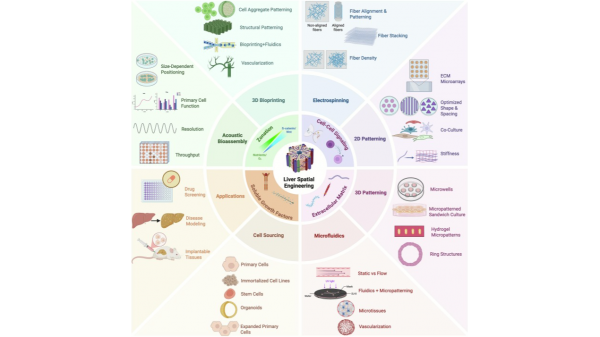
-- The liver performs more than 500 metabolic, synthetic, and detoxification functions through a hierarchical arrangement of hepatocytes and non-parenchymal cells. Scientists working to replicate this intricate organization are developing sophisticated biofabrication strategies that encode spatial control in engineered liver tissues, according to a comprehensive review published in Advanced Drug Delivery Reviews.
The research examines multiple fabrication approaches including self-assembled aggregates, soft lithography, electrospun scaffolds, three-dimensional bioprinting, and microfluidic systems. Each method offers distinct advantages for capturing physiological features such as zonation, polarity, and vascular or biliary networks. Hybrid approaches that combine multiple modalities demonstrate enhanced structural complexity and functional performance.
"Precise spatial patterning is fundamental to reconstructing the liver's multicellular organization," the authors note. The review analyzes how different biofabrication techniques enable controlled positioning of hepatic cells and biochemical signals to mirror native tissue architecture.
Human liver models created through these advanced fabrication methods show promise across several applications. Drug metabolism and toxicity screening benefit from more accurate predictions of hepatic responses. Disease modeling capabilities allow researchers to study pathological conditions in controlled laboratory environments. Potential therapeutic applications include regenerative medicine approaches for patients with liver failure.
The paper identifies persistent challenges including scalability, reproducibility, and standardization that must be addressed before widespread clinical translation. Manufacturing larger tissue constructs while maintaining cellular organization requires continued innovation. Batch-to-batch consistency remains difficult to achieve across different laboratories and platforms.
Emerging opportunities in volumetric bioprinting, machine learning-guided design, and regulatory qualification of liver microphysiological systems represent promising directions for the field. Computational approaches can optimize fabrication parameters and predict tissue behavior. Regulatory frameworks are evolving to accommodate these novel testing platforms as alternatives to animal models.
The MTM Laboratory authors emphasize that engineered liver models are positioned to bridge the gap between in vitro research and in vivo applications. As biofabrication technologies mature, these platforms will play an increasingly important role in pharmaceutical development, disease research, and regenerative medicine.
The comprehensive review provides researchers, clinicians, and industry professionals with a detailed assessment of current capabilities and future trajectories in liver tissue engineering. Full findings are available in Advanced Drug Delivery Reviews.
Contact Info:
Name: Salman Khetani, PhD
Email: Send Email
Organization: The MTM Lab
Address: 851 S. Morgan St 218 SEO, Chicago, IL 60607, United States
Phone: +1-312-413-9424
Website: https://www.mtmlaboratory.com
Source: PressCable
Release ID: 89179560
If there are any deficiencies, discrepancies, or concerns regarding the information presented in this press release, we kindly request that you promptly inform us by contacting error@releasecontact.com (it is important to note that this email is the authorized channel for such matters, sending multiple emails to multiple addresses does not necessarily help expedite your request). Our dedicated team is committed to addressing any identified issues within 8 hours to guarantee the delivery of accurate and reliable content to our esteemed readers.